


Farewell to SaaS Doom!US Stock Funds Are Systematically Shifting Positions, and the AI Application Sector Is Rebound



AI Podcast


Capital is rotating into AI application sectors, which exhibit lower valuations and healthier structures, moving away from AI hardware. Despite prior underperformance, recent earnings reports, particularly Snowflake's, demonstrate AI contributing real revenue and easing fears of a "SaaS Apocalypse." This shift suggests a potential recovery for oversold AI application stocks. This rotation indicates a broader theme moving from AI infrastructure to data and applications, potentially leading to upward revisions in earnings and valuations for software companies leveraging AI.

Tradingkey - On May 29, the three major U.S. stock indices all moved higher today. However, an underlying shift has occurred that many have yet to realize: capital is quietly rotating into the AI application sector, which features lower valuations and healthier positioning structures.
Since the beginning of the year, the technology sector has been the primary force driving the U.S. stock market rally. Within it, AI hardware—including servers and optical modules—has been the mainstay, while the AI application sector, including SaaS providers, has consistently underperformed the broader market.
Since the market recovery began on March 31, the Nasdaq Composite has gained approximately 30% and the Philadelphia Semiconductor Index has surged by as much as 80%, but AI application stocks have risen only 18% over the same period, significantly underperforming the market. Behind this notable market divergence lies a deep-seated concern among investors that artificial intelligence technology will disrupt the traditional software industry.
However, as several representative companies in the industry have recently released their financial reports, the market is beginning to re-examine the valuation logic of the software sector. Snowflake ( SNOW )'s first-quarter earnings report confirmed one thing: AI has begun to contribute real revenue to relevant companies.
Snowflake CFO Brian Robins stated during an analyst call on Wednesday that core AI tools such as Cortex Code are driving a step-function breakthrough in the revenue potential of the company's AI business. Buoyed by the strengthening market momentum of its two core AI products, Snowflake Intelligence and Cortex Code, Snowflake simultaneously raised its performance guidance for the relevant business segments.
Snowflake expects an adjusted operating margin of 12.5% for the second fiscal quarter, with product revenue ranging from $1.415 billion to $1.420 billion. This is significantly higher than the market's previous expectations of 11.9% and $1.37 billion.
Snowflake's performance has eased market fears that new AI tools will replace Software-as-a-Service (SaaS), potentially triggering what the industry calls the "SaaS Apocalypse." After months of valuation compression, the market's previous pessimism toward the AI application sector is now seeing a significant opportunity for a recovery from oversold conditions.
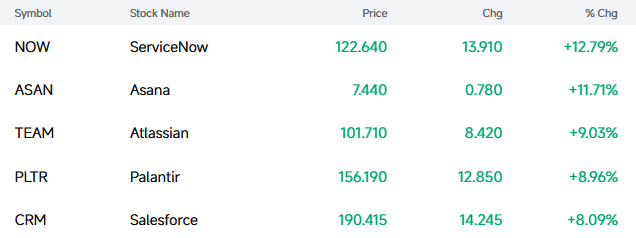
This phenomenon is also very evident in today's trading. While Snowflake appeared slightly fatigued after yesterday's 37% surge, it still gained over 4%. Elsewhere in the sector, ServiceNow ( NOW) rose 12.79%, Asana ( ASAN) rose 11.71%, Atlassian ( TEAM) rose 9.03%, Palantir ( PLTR) rose 8.96%, Salesforce ( CRM) rose 8.09%.
In contrast, the optical communications sector and chip stocks, which led the earlier gains, have shown signs of "falling behind" over the past two days. As of press time, Corning ( GLW) fell more than 3%, Lumentum ( LITE) fell more than 2%, and TSMC fell more than 1%.
From the perspective of core liquidity logic, once the market confirms that revenue growth in the software sector can stabilize or even rebound by leveraging AI, it will trigger a classic "Davis Double Play"—a simultaneous upward revision of both earnings expectations and valuation levels.
When such signals of certainty emerge, capital will naturally rotate from "high to low," moving from sectors with large cumulative gains and narrowed performance gaps into areas that have just begun to show marginal improvement and have healthier positioning structures.
This characteristic of capital flow is a direct manifestation of the current AI trading theme shifting from the physical infrastructure layer toward value discovery in the data and application layers.
Integrating all the aforementioned market signals, it is clear that the market is forming a complete new narrative logic—capital is systematically rotating from the AI hardware sector to the software sector.
This content was translated using AI and reviewed for clarity. It is for informational purposes only.
Recommended Articles












Comments (1)
Click the $ button, enter the symbol, and select to link a stock, ETF, or other ticker.