


Why Microsoft Is Investing $10 Billion in Japan?



AI Podcast


Microsoft will invest $10 billion in Japan over four years (2026-2029) to build AI data centers and infrastructure with SoftBank and Sakura Internet. This move prioritizes data sovereignty, a growing competitive barrier in cloud services. The investment aims to secure domestic AI training data and government support, potentially giving Microsoft a dominant position for Japan's "national-level AI." Competitors like Amazon and Google may face challenges securing similar government alignment. While posing risks such as energy bottlenecks and talent shortages, the investment strengthens Microsoft's pricing power and competitive moat in the sovereign cloud sector.

TradingKey - April 2, 2026, Microsoft ( MSFT) President Brad Smith announced in Tokyo that the company will invest $10 billion (approximately 1.6 trillion yen) in Japan over the next four years (2026-2029) to expand AI data centers and collaborate with SoftBank and Sakura Internet to build Japan's domestic AI computing infrastructure. This marks Microsoft's largest single-country overseas investment in the global AI race, signaling that data sovereignty is becoming a core competitive barrier for cloud service providers.
Following the announcement, the Japanese stock market reacted sharply at the opening on Friday, April 3. Sakura Internet, Microsoft's core computing partner in Japan, surged by approximately 20% intraday, triggering a limit-up circuit breaker and marking its largest single-day gain since September 2025. Meanwhile, SoftBank Corp. shares rose slightly by about 0.5%.
I. What did Microsoft invest $10 billion in in Japan?
Nikkei reported that Microsoft plans to invest $10 billion (approximately 1.6 trillion yen) in Japan over the next four years, primarily to build AI infrastructure such as data centers. During this period, Microsoft will collaborate with SoftBank and Sakura Internet to jointly build data infrastructure capable of running artificial intelligence within Japan.
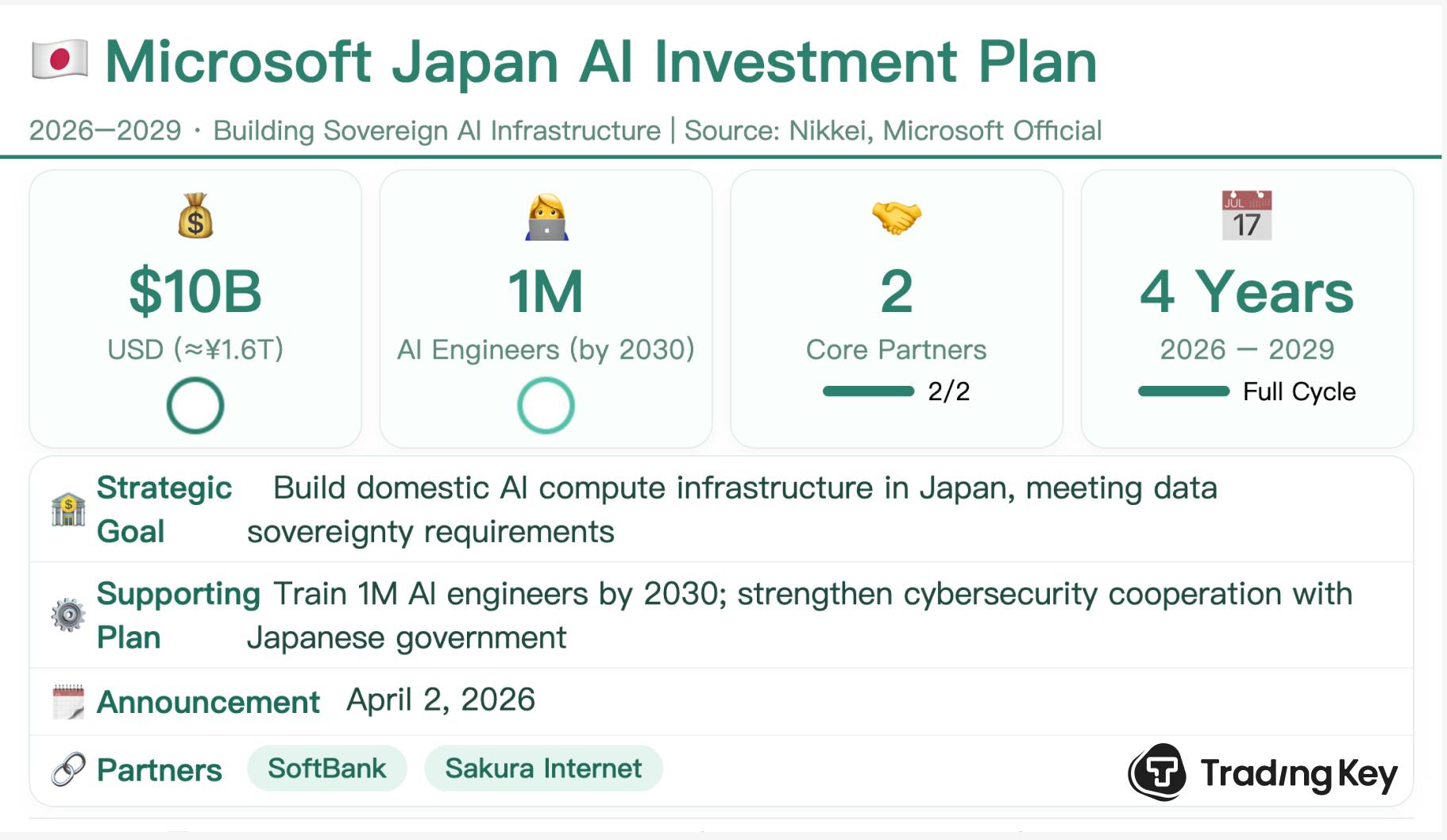
II. Why is this investment garnering such significant attention?
2.1 Microsoft’s Capital Allocation Logic: Shifting from 'Efficiency' to 'Security'
Microsoft's global AI infrastructure capital expenditure for fiscal year 2026 is projected to reach as high as 100 billion to 120 billion USD. The 10 billion USD investment in Japan accounts for approximately 10%, but its strategic weight far exceeds the figures themselves:
- Data Sovereignty Premium: The Japanese government explicitly requires that AI training data and sensitive information be stored domestically. Through localized data centers, Microsoft has established a 'compliance moat' that other competitors (especially Chinese firms) cannot penetrate.
- Policy Synergy: Japan's Ministry of Economy, Trade and Industry (METI) has pledged to invest 10 trillion yen (approximately 67 billion USD) into AI infrastructure by 2030 and is collaborating deeply with Microsoft. For every dollar Microsoft invests, it is expected to leverage 0.5–0.7 USD in matching funds from the government and partners.
2.2 Potential Impact on Microsoft's Stock Price
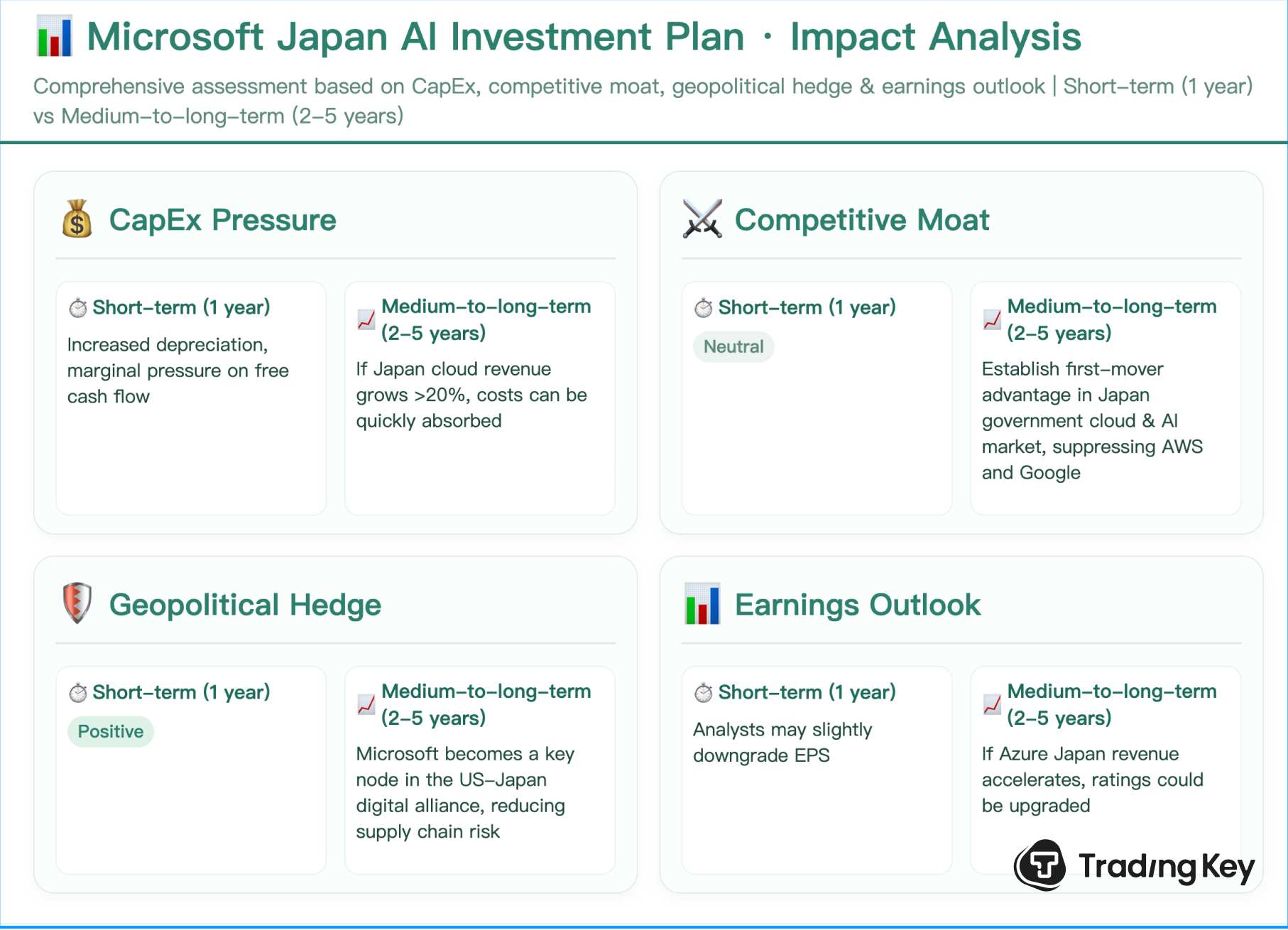
Current Wall Street Consensus: In Microsoft's Q2 2026 earnings report (expected to be released in late April), the Azure growth rate will be the key metric. While the investment in Japan will not significantly improve Q2 data in the short term, it will support Asia-Pacific cloud revenue expectations for 2027–2029.
III. Competitive Landscape: How should Amazon and Google respond?
3.1 Microsoft vs. Amazon AWS vs. Google Cloud — Comparison of Existing Market Share in Japan
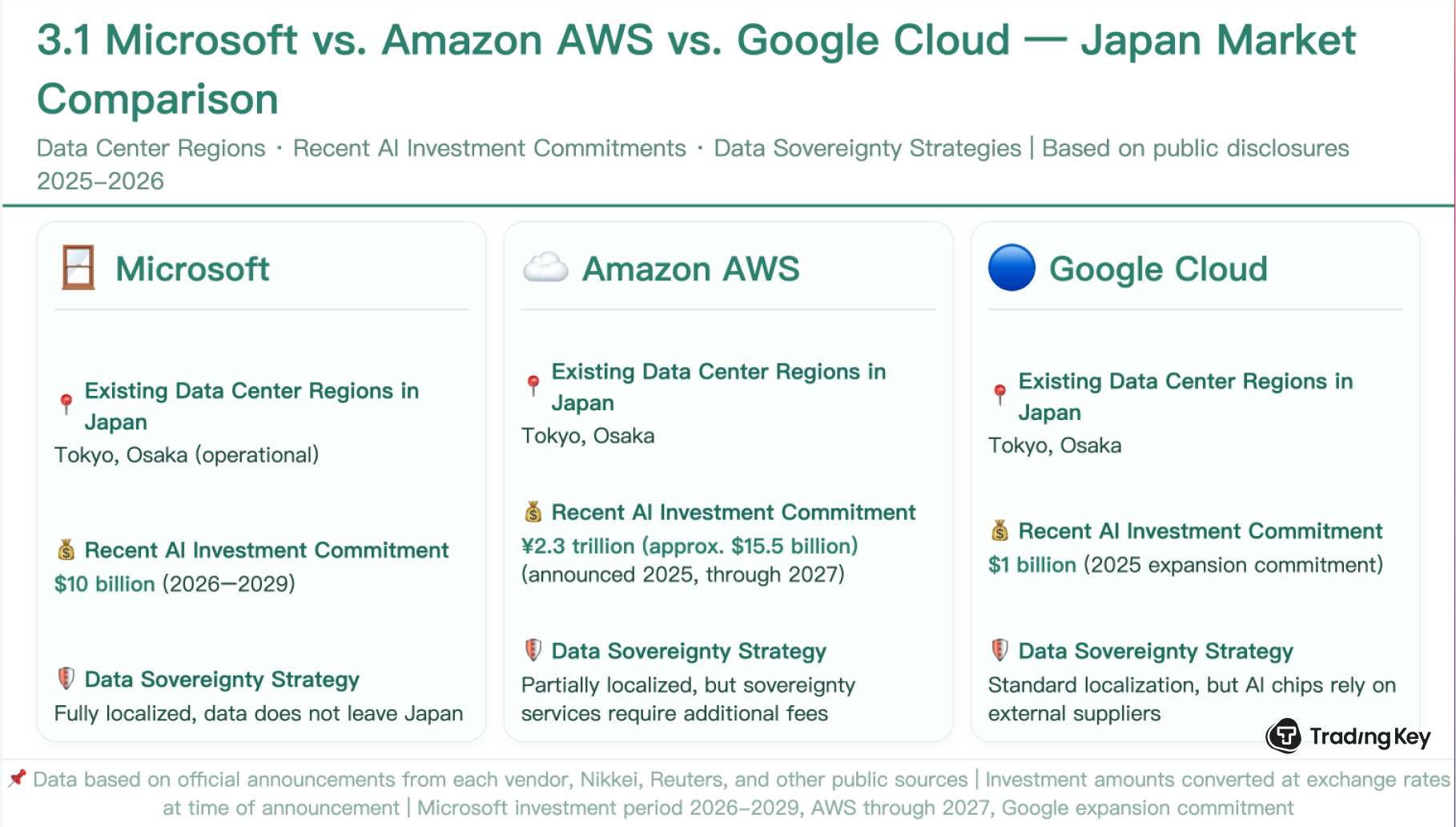
Key Differences: Microsoft's current investment is explicitly tied to SoftBank—a core player in the development of Japan's domestic AI foundation models and a recipient of government subsidies. This implies that Microsoft could become the exclusive cloud infrastructure for Japan's "national-level AI," while Amazon ( AMZN) AWS and Google ( GOOGL) are left to compete for the commercial market.
3.2 Impact on Cloud Pricing and Gross Margins
Japanese enterprise customers are less price-sensitive than those in Southeast Asia but are extremely sensitive to data security. By offering sovereign commitments, Microsoft can command a premium of 10–20%. It is projected that starting from 2027, the operating margin for Microsoft Azure in Japan will exceed the global average (approximately 72% vs. 65% globally).
IV. What is Data Sovereignty?
4.1 What is Data Sovereignty? Why is it Surging Now?
Data sovereignty refers to a nation's jurisdiction and control over the data generated within its territory. With the proliferation of generative AI, governments are concerned that:
- Foreign AI models trained on domestic citizens' data could result in "data colonialism";
- Cross-border flows of sensitive government and corporate information could be intercepted by adversaries.
Japan will revise its Personal Information Protection Act in 2025, requiring that "critical data" should not, in principle, leave the country. Microsoft's local data centers are a commercial solution tailored to this regulation.
4.2 The Collective Pivot of U.S. Tech Giants
- Microsoft: $10 billion in Japan + $5.5 billion in Singapore + $1 billion in Thailand (all including data sovereignty clauses)
- Amazon: Announced the establishment of new sovereign cloud zones in Saudi Arabia and India in 2025
- Google: To launch a "Sovereign AI" product line in Q1 2026, deployable in customer-specified jurisdictions
Investment Implications: Data sovereignty is no longer a compliance cost but a source of differentiated pricing power. Cloud providers with the most local data center regions globally (Microsoft currently leads) will benefit from a long-term competitive moat.
V. Risks and Challenges
- Energy Bottlenecks: Japan relies on imports for over 90% of its energy, and data centers are massive power consumers. Microsoft's commitment to be carbon negative by 2030 may force it to purchase high-priced green power or carbon offsets in Japan, squeezing profit margins.
- Talent Shortage: Japan's AI engineer gap is projected to reach 500,000 by 2027. Microsoft has committed to training 1 million people, but the conversion rate of this training remains to be seen.
- Currency Volatility: $10 billion translates to 1.6 trillion yen. If the yen depreciates to 160 against the dollar (from about 150 currently), Microsoft's actual spending will exceed its budget. The company has already hedged some risk via FX forwards.
- Competitive Countermeasures: AWS may respond with a price war or more aggressive local partnerships (e.g., with NTT). Google might partner with Fujitsu to launch sovereign AI chips.
- Geopolitical Shift: A change in the Japanese government could shift attitudes toward U.S. tech giants. Currently, however, the LDP and major opposition parties both support AI infrastructure development.
VI. What should investors focus on?
Short-term (0–6 months): Focus on earnings and event-driven opportunities
- Monitor Microsoft's Q2 earnings: Pay close attention to whether capital expenditure guidance is revised upward following the $10 billion investment in Japan. If free cash flow falls short of expectations, Microsoft's stock price may see a 3%–5% correction, potentially providing a window for long-term investors to buy in stages.
- Watch for volatility in Sakura Internet: The stock surged 20% in a single day following the announcement, posing a risk of short-term sentiment exhaustion.
Medium-to-long term (1–3 years): Target three main beneficiary themes
- Microsoft remains the top choice for AI infrastructure: The investment in Japan strengthens Microsoft's first-mover advantage in the sovereign cloud sector. Compared to Amazon and Google, Microsoft enjoys higher enterprise customer stickiness, and its long-term moat continues to expand.
- Supply chain extension opportunities:
- NVIDIA ( NVDA ): Microsoft's Japan data centers will procure significant quantities of H100/B200 GPUs, directly boosting demand for computing chips.
- Data center REITs (such as DLR, EQIX): Their joint ventures in Japan are likely to benefit from leasing and operational collaborations with Microsoft.
Key metrics to watch
- Quarterly revenue growth of Microsoft Azure in Japan
- Actual progress of Japanese government AI subsidy disbursements
- Whether SoftBank's proprietary data centers will compete with Microsoft (currently a partnership, but potentially a variable over the long term)
VII. Microsoft Japan’s Multi-Billion Investment: A Long-term Strategic Layout for Data Sovereignty and AI Computing Power
Microsoft's latest investment is not a case of short-term thematic speculation, but a landmark event signaling the transition of global cloud competition into its second phase. The first phase involved "building data centers and laying networks," while the second phase is defined by "meeting sovereign compliance and aligning with national strategies." Providers that take the lead in completing this second-phase strategic positioning will enjoy greater pricing power and lower churn rates by 2030. For investors, Microsoft's moat is expanding from a technological edge to a politico-economic composite advantage.
This content was translated using AI and reviewed for clarity. It is for informational purposes only.
Recommended Articles











Comments (0)
Click the $ button, enter the symbol, and select to link a stock, ETF, or other ticker.