


Amazon Plummets After Hours, Using $200 Billion AI Check for $200 Billion Market Value Wipeout



AI Podcast


Amazon's Q4 2025 results exceeded revenue expectations with $213.39 billion in net sales, a 14% year-over-year increase. AWS revenue grew 24% to $35.58 billion, its fastest growth since late 2022, driven by enterprise demand for AI. Advertising revenue rose 22% to $21.32 billion. However, the stock fell over 11% post-earnings due to guidance for 2026 capital expenditures expected to reach $200 billion, a 50% increase. This aggressive investment, aimed at AI and other growth areas, exceeds analyst consensus and raises concerns about future returns, mirroring broader market anxieties around tech spending.
TradingKey - After the bell on February 5, Eastern Time, global e-commerce and cloud computing giant Amazon (AMZN) released its fourth-quarter results for fiscal 2025. Although core financial metrics generally exceeded expectations, the company's forward guidance for 2026 capital expenditures became the key variable that weighed on the stock price. Shares plunged more than 14% in after-hours trading, eventually closing down over 11%, with more than $200 billion in market value wiped out in a single day.
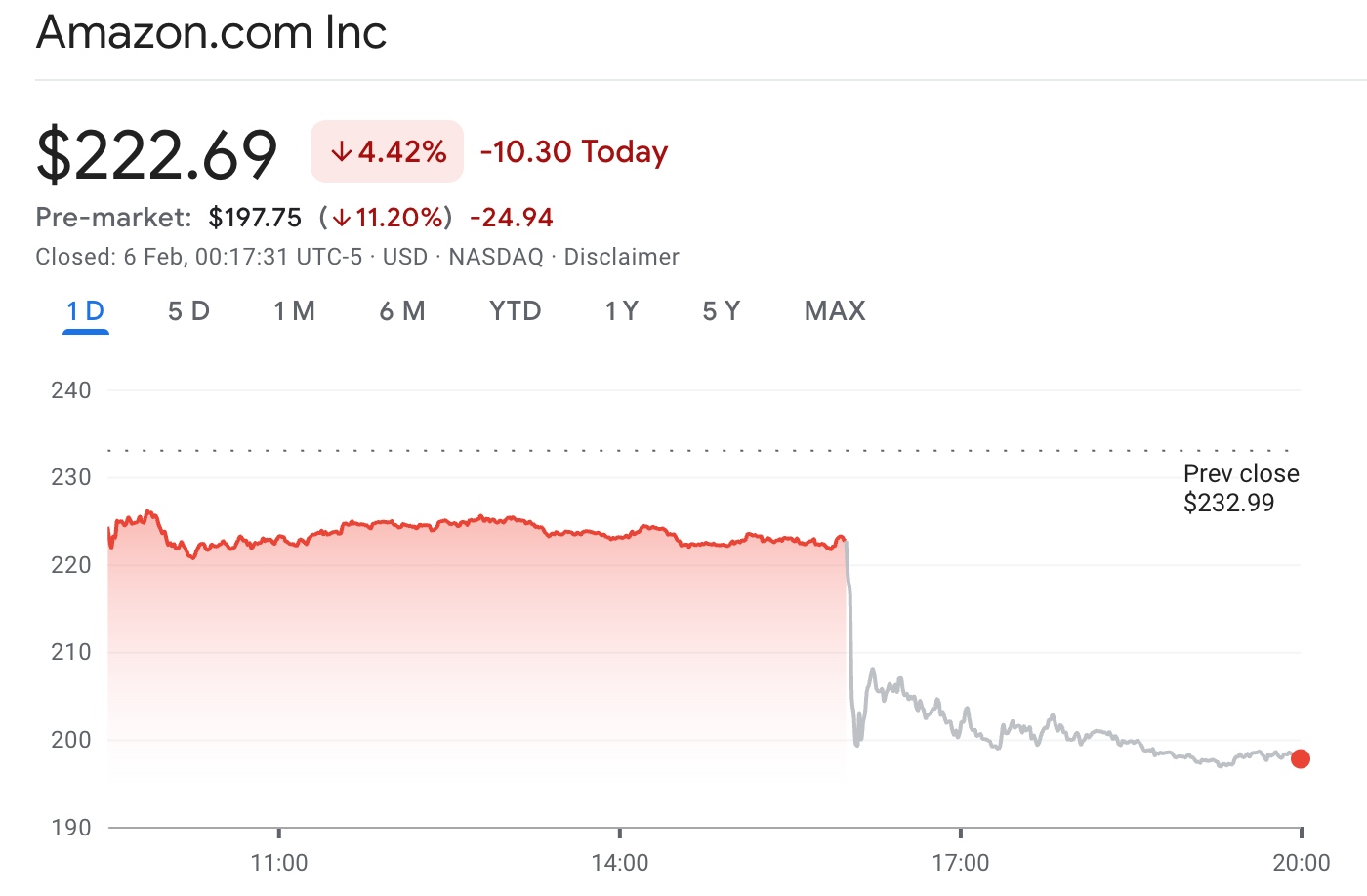
[Google's after-hours stock price fell sharply; Source: Google Finance]
From the perspective of the results themselves, Amazon's fourth-quarter fundamentals remain solid. Quarterly net sales reached $213.39 billion, up 14% year-over-year, significantly higher than the analyst consensus; net income was $21.19 billion, up 6% year-over-year; earnings per share was $1.95, slightly below the market expectation of $1.97, but this did not shake its overall earnings resilience.
As the company's core profit engine, AWS remained the biggest highlight of the quarter. Cloud business revenue grew 24% year-over-year to $35.58 billion, not only significantly exceeding market expectations but also marking the fastest growth rate since late 2022, indicating that enterprise demand for computing power and AI-related services continues to accelerate. Meanwhile, the advertising business maintained steady expansion with revenue reaching $21.32 billion, up 22% year-over-year, further solidifying its high-margin nature.
Meanwhile, Amazon expects capital expenditures in 2026 to reach as high as $200 billion, a surge of over 50% from $131 billion in 2025, and approximately 36.9% higher than the Wall Street consensus of $146.6 billion, equivalent to spending one quarter of Google's revenue on AI. This figure not only exceeds the median expenditure of approximately $180 billion previously announced by Google's parent company Alphabet, but is also nearly double that of Meta.
Amazon CEO Andy Jassy attempted to set the tone for this "aggressive investment plan" in the earnings statement. He stated clearly that the current high capital expenditures are not blind expansion but stem from strong real demand for existing products and services, as well as the "structural and pioneering opportunities" the company faces in fields such as AI, self-developed chips, robotic automation, and low-Earth orbit satellites.
During the subsequent earnings call, Jassy further broke down the allocation of capital expenditures. AWS still accounts for the largest share. Affected by its massive capital spending, Amazon's stock price saw a significant correction. Over the past week, as tech giants like Google and Microsoft disclosed their financial reports, "whether capital expenditure is spiraling out of control" has become the core topic across all earnings calls.
According to market expectations, the total capital expenditures of the four major tech giants—Amazon, Microsoft, Alphabet, and Meta—are expected to exceed $630 billion in 2026, a scale far surpassing any previous technology investment cycle. Such massive investment has led the market to question the return cycle, and the brewing sentiment is gradually triggering collective sell-offs in the market.
This content was translated using AI and reviewed for clarity. It is for informational purposes only.
Recommended Articles










Comments (0)
Click the $ button, enter the symbol, and select to link a stock, ETF, or other ticker.