


Why Did Strategy's Stock Price Plummet? Can MSTR Reach $1,000?



AI Podcast


MicroStrategy (MSTR) shares plunged as Bitcoin neared $80,000, partly due to CEO Phong Le's comments suggesting potential Bitcoin sales if mNAV falls below 1 and financing is unavailable. This signaled a shift from the "never sell" dogma. Despite a strong software business, MSTR's profitability heavily relies on Bitcoin holdings, making it a Bitcoin proxy. Recent institutional sell-offs and MSCI's potential delisting add pressure, while competition from spot Bitcoin ETFs erodes its proxy status. Reaching $1,000 hinges on Bitcoin exceeding $150,000-$200,000, a prospect supported by some analysts but complicated by MSTR's leverage and financing costs.

MSTR News
TradingKey - Bitcoin (BTC) plunged towards the $80,000 mark on December 1, dragging MicroStrategy (Nasdaq: MSTR) shares to a low of $155, their lowest level since October 2024.
MicroStrategy CEO Phong Le's remarks on November 28 sparked market panic. During a podcast, Le publicly stated that the company would "only consider selling BTC if the ratio of the company's value to its Bitcoin holdings (mNAV) falls below 1, and it is unable to raise new capital through financing."
Since January 2025, despite MicroStrategy's continuous accumulation of Bitcoin, the company has failed to reverse its stock's downward trend, which has plummeted nearly 70% from its peak. This phenomenon has raised market concerns: Is it Bitcoin's market performance dragging it down, or does MicroStrategy's strategy itself pose risks? Can MSTR's share price still surge past $1,000 in the future?
What is MSTR?
MSTR is the stock ticker for US company Strategy (formerly MicroStrategy), which has transformed into a dual-engine entity. The firm now combines its core AI and BI offerings with a massive Bitcoin treasury. Strategy is a business intelligence (BI) software company, founded in 1989. It initially focused primarily on business intelligence (BI) and data analytics software, with key products including MicroStrategy ONE, HyperIntelligence, and AI data analytics services.
In 2020, founder Michael Saylor announced the company would allocate its cash reserves to Bitcoin. The firm subsequently acquired more, becoming the world's largest institutional holder of Bitcoin. Consequently, it is widely regarded as a "Bitcoin proxy company" or a "proxy investment vehicle for Bitcoin." This strategic shift shows MSTR has moved from a single business focus to a "Bitcoin + AI & BI" dual-engine strategy.
How does MSTR make money?
MicroStrategy (MSTR) profits are almost entirely reliant on its Bitcoin holdings, despite maintaining a software business. Its earnings overwhelmingly depend on the appreciation of its Bitcoin portfolio.According to MSTR's financial reports, third-quarter 2025 revenue was approximately $129 million, yet net profit soared to $2.8 billion, primarily due to fair value changes in Bitcoin.
Revenue Source | Specific Data (Q3 2025) | Proportion | Description |
Software Business Revenue | Approx. $128.7 million | <5% | Derived from BI software licenses, cloud subscriptions, and consulting services; limited growth observed. |
Bitcoin Investment Gains | Approx. $3.891 billion(EBIT) | >90% | Primarily from Bitcoin's fair value changes, with BTC prices rising from $107,000 to $114,000. |
MSTR's Aggressive Bitcoin Investment Strategy
MicroStrategy's Bitcoin investment strategy transcends mere holding, representing an aggressive, transparent, and forward-looking corporate finance experiment that transforms the company into a Bitcoin-centric entity.It not only invests in Bitcoin but also redefines the company itself as a vehicle centered around Bitcoin as its core asset.
Strategy Aspect | Description | Implementation / Case Studies |
Forward- Looking Approach | Began shifting corporate treasury reserves to Bitcoin in 2020. | Initial investment of $250 million acquired over 21,000 bitcoins. |
Diversified Funding Sources | Continuously increased holdings through various financing methods. | - Internal cash flow |
Scale of Bitcoin Holdings | Publicly traded company with the largest Bitcoin holdings globally. | As of December 2, 2025, held over 650,000 bitcoins, valued at more than $56 billion |
Core Philosophy | Never selling Bitcoin, treating it as a primary treasury asset. | Founder Michael Saylor has repeatedly emphasized that "Bitcoin is digital gold." |
High Transparency | Adheres to US Financial Accounting Standards Board (FASB) guidelines, reporting Bitcoin holdings at fair market value. | Regularly discloses Bitcoin holdings and average cost. |
Pronounced Leverage Effect | Financing Bitcoin purchases amplifies the impact of Bitcoin price movements. | In bull markets, share price gains often exceed Bitcoin's appreciation; conversely, losses are also greater in bear markets. |
How has MSTR's stock price performed?
As the crypto bear market concluded in 2020, Bitcoin (BTC) prices climbed out of their $4,000-$10,000 bottom range, surging to a peak of $69,000 by late 2021. During the same period,MicroStrategy (MSTR) shares soared from around $9 to $130, marking a gain of over 1,300%, slightly trailing Bitcoin's 1,600% rally.
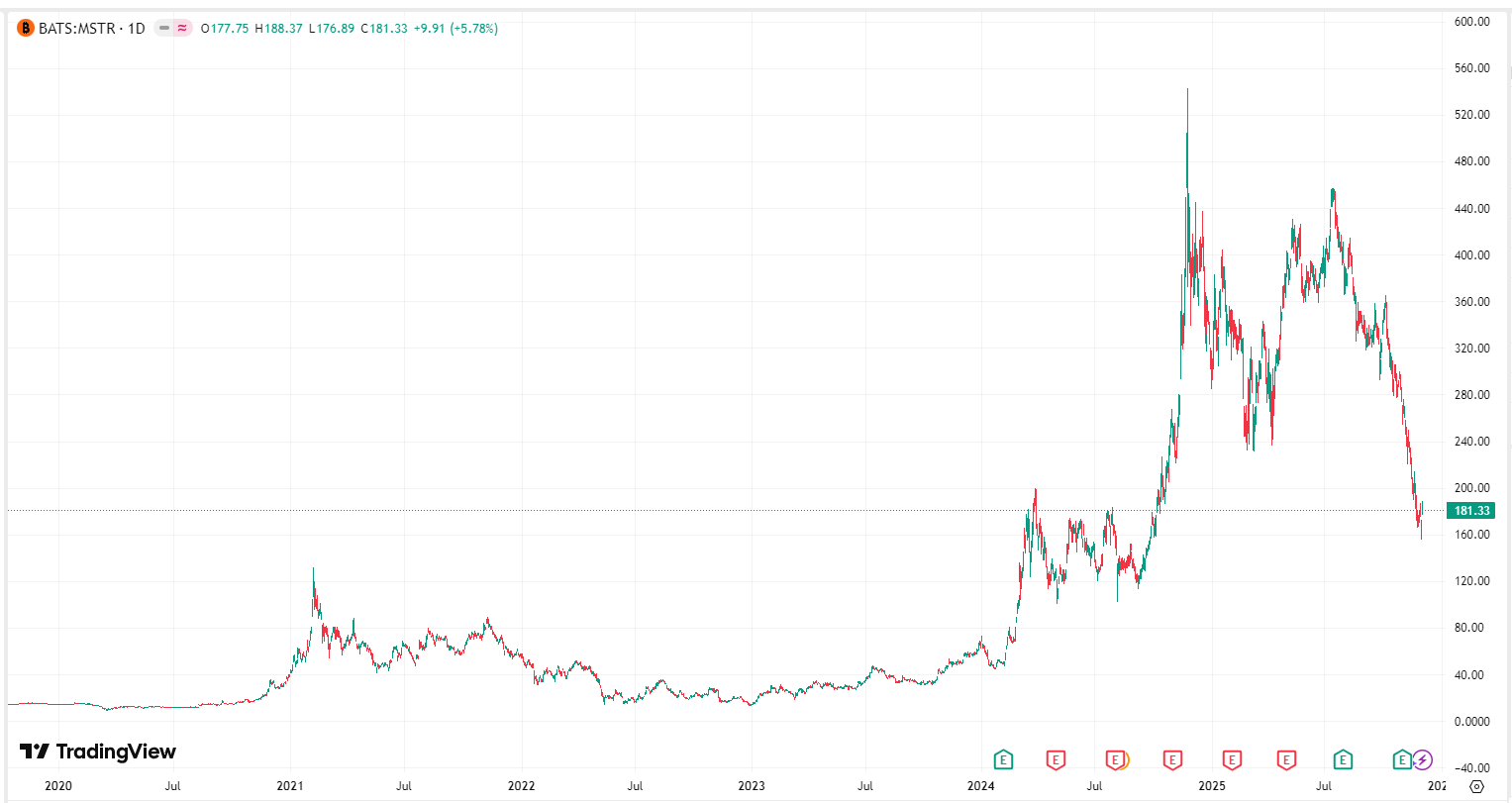 MSTR Stock Price Chart (2020-Present), Source: TradingView.
In 2022, MSTR shares rallied before retreating into a prolonged correction,plummeting to a low of $13 in 2023. This represented a peak decline of 90%,significantly outpacing Bitcoin's 76% drop over the same period. By 2024, MSTR shares began a gradual recovery, soaring to $180 in March and surpassing previous highs. In December, the stock surged further to $543, setting a new all-time high. From 2023 to 2024,MSTR's peak gain exceeded 40-fold, vastly outperforming Bitcoin's less than six-fold increase during the same timeframe.
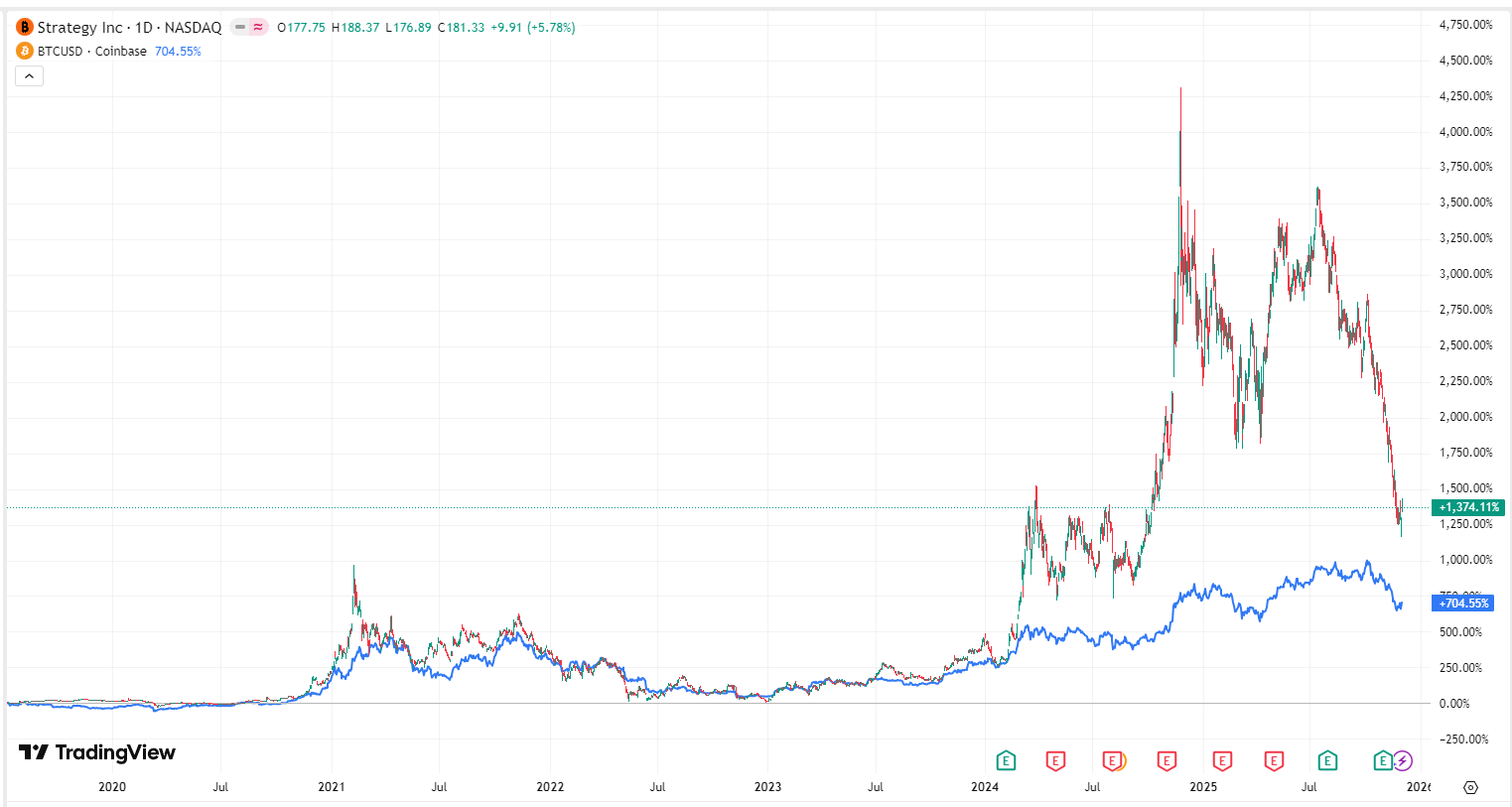 MSTR, BTC Price Performance (2020-Present), Source: TradingView.
Entering 2025, MSTR shares have been in acontinuous decline,dropping from their peak to a low of $155. The stock has accumulated adecline of over 70% year-to-date.By contrast, Bitcoin has seen a less than 20% decline this year. Following a brief correction at the start of the year, BTC soared to $125,000, establishing a new all-time high.
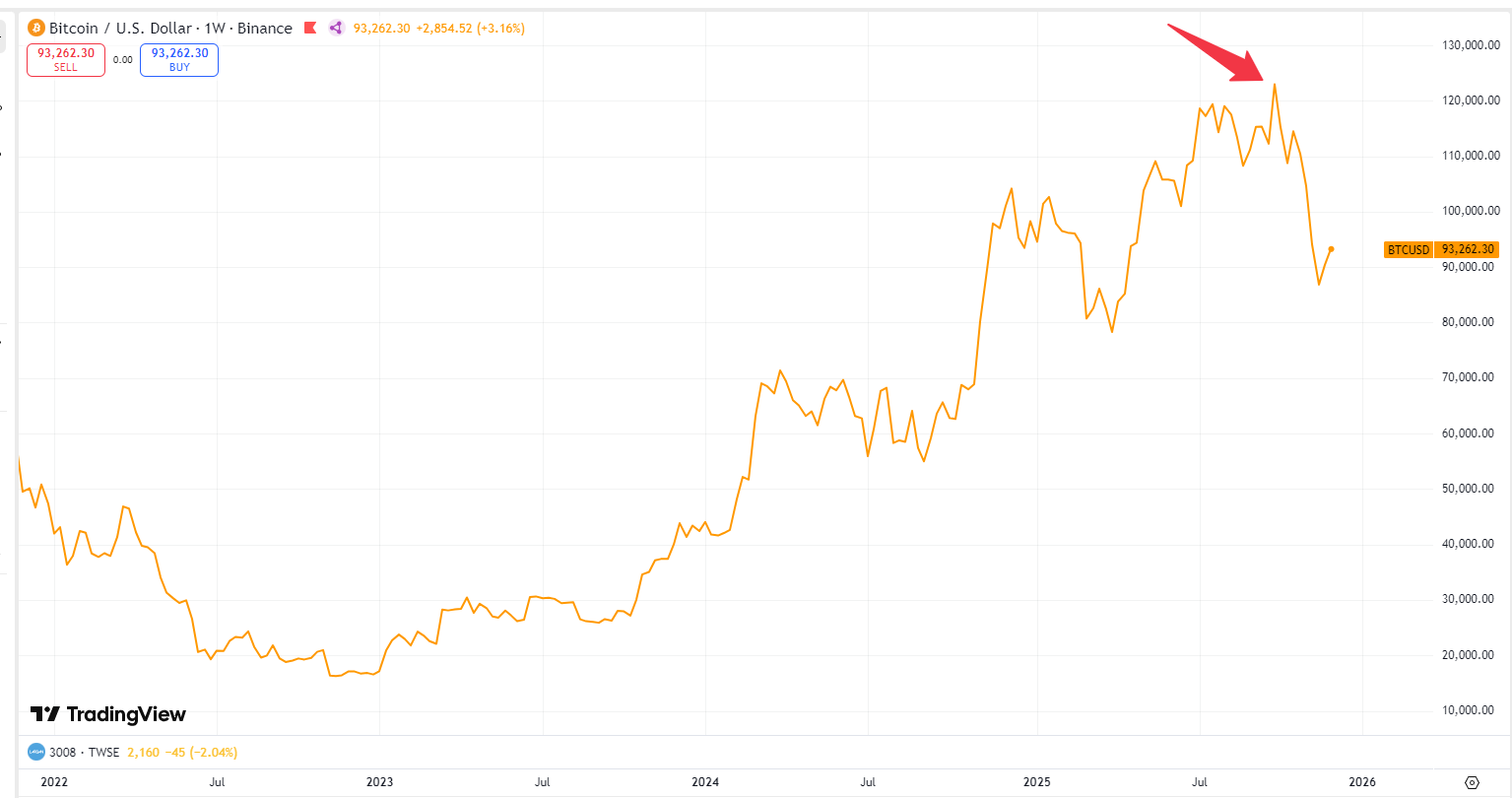 Bitcoin Price Chart, Source: TradingView.
Why did MSTR drop so much?
Since 2025, Bitcoin's price decline has indeed impacted its asset value, consequently dragging down MSTR's stock. However, MSTR's drop has significantly outpaced Bitcoin's, indicating other contributing factors. These include the company's first hint at potentially selling Bitcoin, MSCI's consideration of delisting, competitive threats, and market concerns over its high-leverage model and debt pressure, among others.
Company Hints at Potential Bitcoin Sales
CEO Phong Le stated that if mNAV (market cap to Bitcoin holdings ratio) falls below 1 and the company can no longer secure financing, it might sell some Bitcoin. This statement broke Michael Saylor's long-held "never sell Bitcoin" credo, which the market interpreted as a potential sell signal, triggering panic selling.
Substantial Debt and Dividend Pressure
The company faces annual payments of approximately $800 million for interest and preferred stock dividends, exacerbating its selling risk. Although MSTR has announced the establishment of a $1.44 billion cash reserve, the market believes this is insufficient to eliminate liquidity risk.
MSCI Considers Removing MSTR
MSCI is considering removing MSTR from its major equity indices. This would weaken demand for MSTR shares, adding to downward pressure on its stock price. If MSCI indeed delists MSTR on January 15, 2026, it could lead to significant forced withdrawals of passive funds . J.P. Morgan noted that "being removed will call into question the company's future equity and debt financing costs and capabilities."
Competition from Alternatives
While MSTR has been viewed as a Bitcoin proxy, the increasing variety of channels for investing in Bitcoin diverts capital that might otherwise flow into MSTR. This erodes its scarcity premium as the "sole compliant proxy," posing a competitive threat. For many investors, buying spot Bitcoin ETFs like GBTC and IBIT offers a more direct, lower-fee option without exposure to the company's financial leverage risks.
Is MSTR stock still worth buying?
MicroStrategy (MSTR) shares recently saw a significant institutional sell-off, heavily impacting buying power.According to CryptoSlate data, multiple institutions, including Capital International, Vanguard, BlackRock, and Fidelity, reduced their Strategy stock holdings by $5.4 billion in Q3 2025.
Furthermore, J.P. Morgan and Amundi, Europe's largest asset manager, both sold over 700,000 Strategy shares. Further eroding market confidence, Strategy Executive Vice President Shao Wei-Ming offloaded 30,000 MSTR shares in October and 58,000 in November, cumulatively cashing out over $20 million.
Addressing the recent MSTR stock sell-off and J.P. Morgan's claim thatMSTR faces $2.8 billion in capital outflows,Strategy founder Michael Saylor stated in a November 24 interview that "the actual figure will be significantly less than $2.8 billion, and MSTR's stock price has overreacted."
Currently, bullish market sentiment for MSTR shares is gradually recovering.CryptoQuant founder and CEO Ki Young Ju posted on November 26 that "MSTR appears oversold relative to its Bitcoin holdings and historical premium levels." Separately, TD Cowen maintains a bullish outlook on Strategy, believing the company is nearing its previous bear market lows from 2021-2022.
Can MSTR's stock price reach $1,000?
Given its current asset allocation, MicroStrategy (MSTR) holds substantial Bitcoin, making its stock price highly correlated with the cryptocurrency's movements. This means MSTR's future stock price fluctuations will track Bitcoin's price, often exhibiting a 1.5-2x leverage effect. Consequently, if Bitcoin surpasses $150,000-$200,000, MSTR's stock price could potentially hit $1,000. Conversely, if Bitcoin's price has bottomed out and fails to breach its October 2025 all-time high of $125,000, MSTR is highly unlikely to achieve its $1,000 target. So, what is the likelihood of Bitcoin reaching $150,000-$200,000?
In the long run, particularly during the next bull market, potentially after the fourth halving event in 2029, Bitcoin has a strong possibility of reaching $200,000. Historically,Bitcoin's price in each new bull market has surpassed the previous bull market's peak by 100%; for instance, it rose from a $19,000 peak in 2017 to $69,000 in 2021.
Standard Chartered Bank, for example, believes Bitcoin could still reach $200,000 by year-end. Furthermore, BitMEX co-founder Arthur Hayes maintains that BTC will hit $250,000 by year-end. Grayscale Research also projects an all-time high for Bitcoin in 2026. If these institutions and professionals are correct, MSTR's stock price could still surge to $1,000, propelled by Bitcoin's performance. However, it is crucial to note that MSTR's stock price in 2025 may not perfectly track Bitcoin's ascent. Investors should be aware of this potential risk, especially as Bitcoin spot ETFs, with their unique advantages, threaten MicroStrategy's "Bitcoin proxy function," thereby diminishing investor demand for its shares.
Conclusion
MicroStrategy (MSTR) stock, despite pressures from Bitcoin volatility and its weak core business, represents the most leveraged investment in a Bitcoin bull market. The company's stock path to $1,000 largely depends on Bitcoin's market performance. Major institutions, including Standard Chartered and Grayscale, remain actively bullish on Bitcoin's outlook. Should this optimism hold, rising Bitcoin prices would favor an MSTR stock rebound, potentially even challenging the $1,000 mark. Conversely, investors must also guard against Bitcoin shifting into a bearish trend or MSTR's stock reacting indifferently.
This content was translated using AI and reviewed for clarity. It is for informational purposes only.
Recommended Articles












Comments (0)
Click the $ button, enter the symbol, and select to link a stock, ETF, or other ticker.