


Japan and South Korea Stocks Slump in Tandem, Nikkei Falls Below 60,000, Samsung Strike Turmoil Deepens South Korean Equity Pullback



AI Podcast


The Nikkei 225 declined 2%, falling below 60,000 points due to the Bank of Japan's cautious monetary policy amid "imported inflation" and slowdown risks. Geopolitical tensions increased crude oil prices, pushing JGB yields to 30-year highs, and the yen neared intervention levels, dampening market sentiment. While the long-term trend for Japanese stocks remains intact, oil price volatility, rising yields, and yen fluctuations could trigger short-term profit-taking. South Korea's KOSPI also fell 2%, led by tech stocks, as a potential strike by Samsung union members faced significant legal hurdles and economic impact concerns.

TradingKey - The Nikkei 225 Index opened 0.2% lower in early trading before its decline rapidly widened to 2%, marking its fifth consecutive trading day of weakness and falling below the 60,000-point mark for the first time this month.
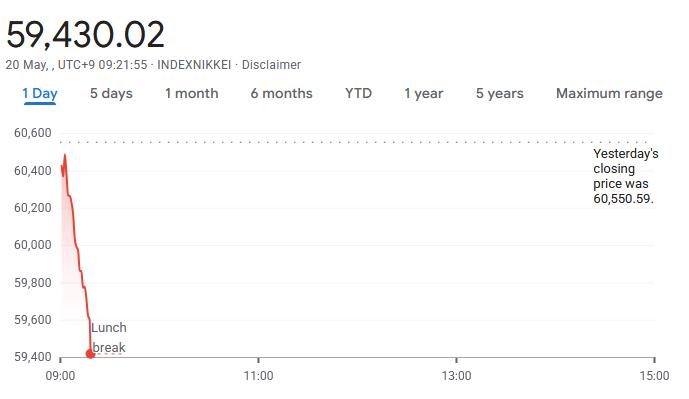
The Bank of Japan decided at its April policy meeting to keep the benchmark interest rate unchanged at 0.75%, a move consistent with broad market expectations. However, analysts pointed out that the pause in rate hikes is not a signal of a policy pivot but rather a reflection of Japan's current dilemma between "imported inflationary pressure" and "the risk of an economic slowdown," causing the pace of monetary policy adjustments to become more cautious.
Meanwhile, geopolitical risks have pushed up crude oil prices, driving Japanese government bond yields to near 30-year highs. Coupled with the yen's exchange rate approaching the official potential intervention zone, market sentiment has turned prudent. Although the medium-to-long-term upward trend of Japanese stocks has not fundamentally reversed, multiple factors—including high-level oil price volatility, rising bond yields, intensified yen fluctuations, and potential currency market intervention—could trigger short-term profit-taking pressure.
South Korea's KOSPI Index opened 0.7% higher in early trading, but intraday losses subsequently widened to 2%, with heavyweight tech stocks leading the market lower. Among them, SK Hynix shares fell more than 2%, while Samsung Electronics also declined in tandem.
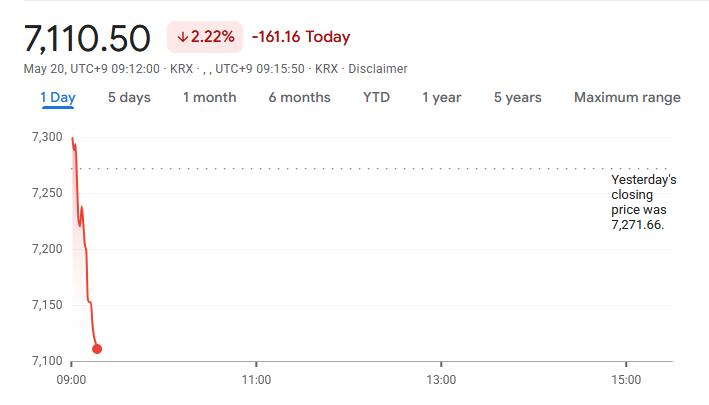
Reportedly, the Samsung union plans to hold an 18-day strike starting this Thursday, May 21, unless its demands are met.
However, a South Korean court's latest ruling has hit the pause button on the strike plan; if the union persists in striking, it will face a daily fine of 100 million won. This ruling not only significantly raises the cost of executing the strike but also leaves room for both parties to restart negotiations.
Previously, South Korean Industry Minister Kim Jung-kwan stated publicly that if a strike causes production line shutdowns, daily economic losses could reach up to 1 trillion won, and more than 1,700 upstream and downstream partners would face a chain impact, potentially even weakening the global competitiveness of South Korea's semiconductor industry.
This content was translated using AI and reviewed for clarity. It is for informational purposes only.
Recommended Articles








Comments (0)
Click the $ button, enter the symbol, and select to link a stock, ETF, or other ticker.