


European Central Bank 2026 Monetary Policy Outlook And Euro Exchange Rate 2026 Trend How?



AI Podcast


The Federal Reserve has implemented three rate cuts in 2025 and is projected to continue cutting rates in 2026. Conversely, the European Central Bank has paused rate cuts and is expected to maintain current interest rates in 2026, with inflation rising above its 2.0% target. The Eurozone economy shows slow but resilient growth, despite challenges in its automotive and tech sectors and facing U.S. tariffs. U.S. economic growth is expected to re-accelerate, with potentially less aggressive Fed rate cuts than anticipated. Forecasts for EUR/USD in 2026 vary, with Citi predicting a fall to 1.10 and UBS anticipating a rise to 1.20, influenced by interest rate differentials and economic performance.

TradingKey - The Federal Reserve has begun its rate-cutting cycle, implementing its third consecutive cut since September of this year. Meanwhile, the European Central Bank has maintained a wait-and-see stance, keeping its interest rate unchanged at 2.15% since July. 2 In 026, the Federal Reserve is expected to maintain an accommodative monetary policy. If the European Central Bank remains on hold, what will be the future trajectory of the euro exchange rate?
Eurozone Economic Growth: Weak but Resilient
The Eurozone economy is growing slowly, exhibiting structural lags. For instance, Germany's automotive industry saw a 5% decline in output, affected by factors such as the transition to electric vehicles and supply chain disruptions. Furthermore, insufficient innovation investment has caused Eurozone countries to fall behind the U.S. and China in the technology sector.
The U.S. Trump administration's implementation of a "reciprocal tariff" policy exacerbated trade frictions, posing a drag on Eurozone economic growth. The U.S. plans to impose tariffs of 10% to 20% on EU goods, directly impacting the export-oriented economy. EU exports to the U.S. declined by 3%, with the automotive and chemical industries being hit the hardest.
The European Commission stated in its Autumn Economic Forecast that output is projected to grow by 1.3% in 2025, 1.2% in 2026, and 1.4% in 2027. This implies an upward revision of this year's forecast compared to the May projection, while the 2026 forecast was slightly lowered, reflecting the European Commission's concerns about the economic performance in 2026.
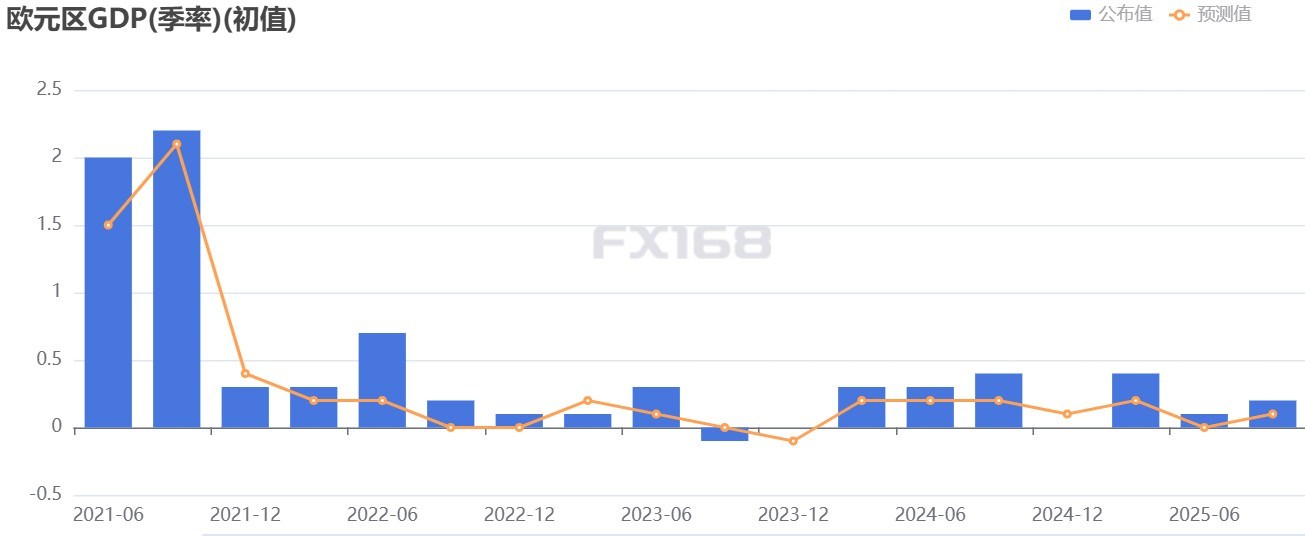 Eurozone GDP
There are disparities in economic growth among Eurozone member states. The Eurozone's third-quarter output grew by 0.2%, with Spain and France growing by 0.6% and 0.5% respectively, while Germany and Italy remained stagnant.
Although Eurozone economic growth is sluggish, it continues to show resilience, providing a solid fundamental underpinning for the euro's trajectory.
Rising Eurozone Inflation Bolsters ECB Interest Rates
There are signs of rising inflation in the Eurozone. Preliminary statistical data released by Eurostat shows that Eurozone inflation in November, calculated on an annual basis, was 2.2%, up from 2.1% in October, and remains above the European Central Bank's (ECB) medium-term target of 2.0%. Energy prices fell by 0.5%, while service prices rose by 3.5%, continuing to increase from 3.4% in October. The European Commission forecasts continued EU economic growth and a gradual slowdown in inflation.
On December 18, the European Central Bank announced it would keep the Eurozone's three key interest rates unchanged, maintaining the deposit facility rate, the main refinancing operations rate, and the marginal lending facility rate at 2.00%, 2.15%, and 2.40% respectively.
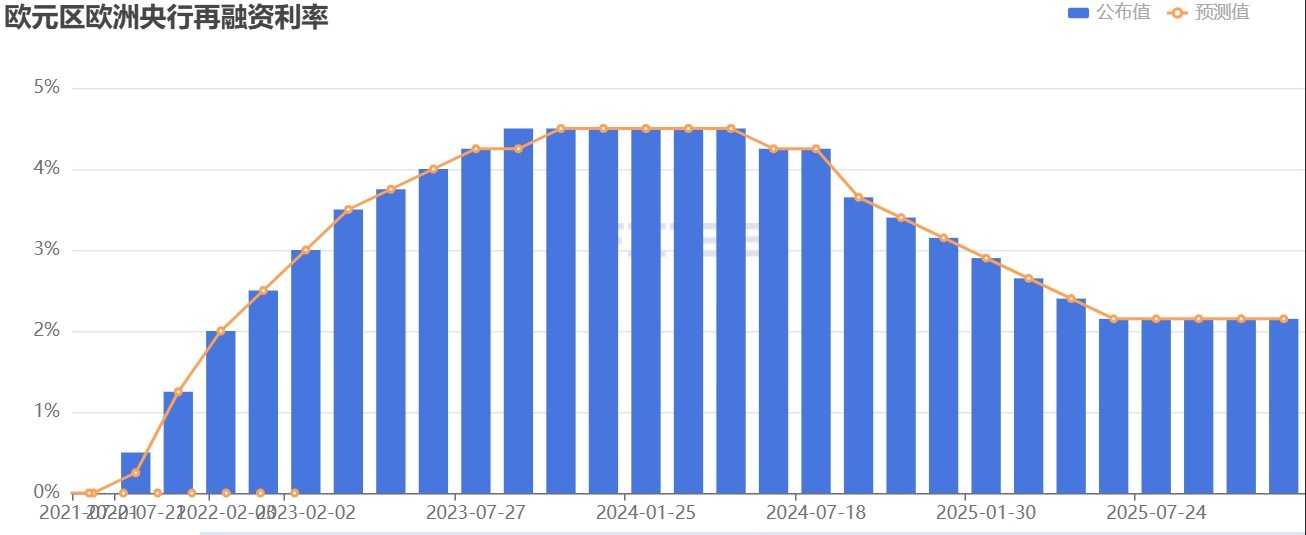
ECB Interest Rates
The ECB has paused rate cuts in the second half of 2025. Furthermore, the latest forecasts indicate that inflation will moderately reach its target over the next three years. Therefore, in 2026, the ECB is highly likely to maintain current interest rates, with no urgency to hike rates nor any need for further cuts.
ECB President Christine Lagarde continued to hint at the central bank's lack of urgency to act during her press conference following the December monetary policy meeting. She stated that the current interest rate policy is in a "good position."
Christian Kopf, Head of Bond Portfolio Management at German asset manager Union Investment, stated that he expects no interest rate adjustments in the Eurozone in the short term. If there are changes in 2026, they are most likely to be rate hikes towards the end of 2026 or early 2027.
Most economists surveyed by Reuters expect that the European Central Bank will keep interest rates unchanged in 2026 and 2027, although the forecast range for the latter year is wide, between 1.5% and 2.5%.
Isabel Mateos y Lago, Chief Economist at BNP Paribas, noted that the threshold for action in either direction is likely to be quite high at the next few meetings.
Federal Reserve Cut Rates Three Times in 2025, May Maintain Pace in 2026
The Federal Reserve has cut interest rates three times this year. While the Fed originally projected two rate cuts for 2025 in December 2024, it ultimately implemented three. In March of this year, the Fed maintained rates at 4.5% for the second consecutive time, partly due to concerns that tariffs could reignite inflation and slow the pace of price declines. However, as inflation slowed in the second half of the year, coupled with a weakening job market, the Fed initiated its first rate cut of 25 basis points in September, followed by further cuts in October and December, bringing the federal funds rate range down to 3.5%-3.75%.
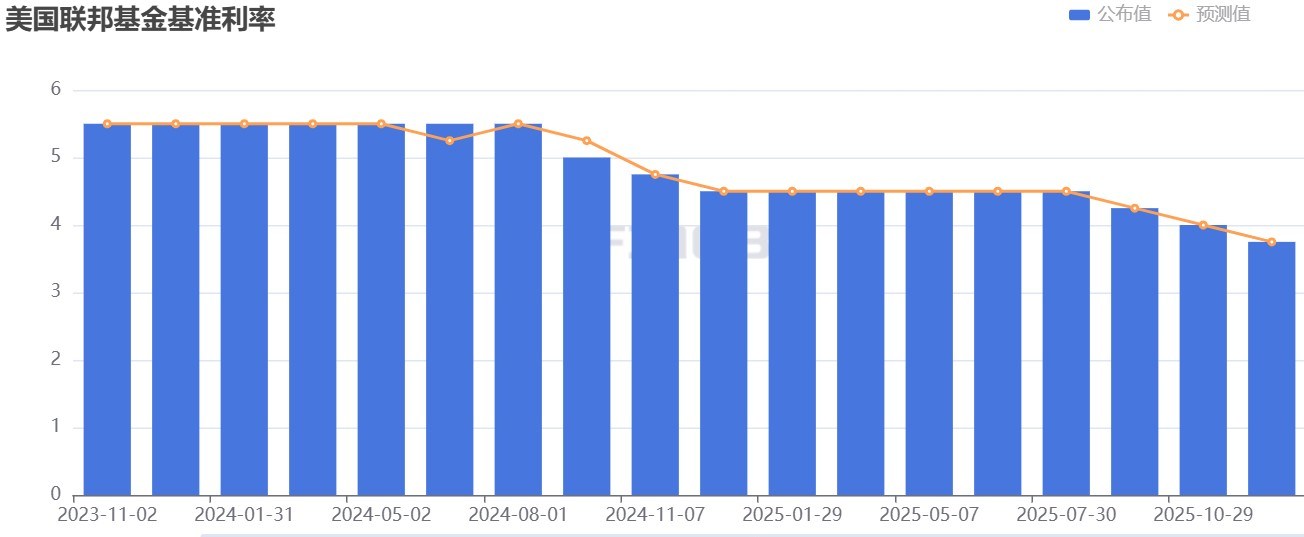
Federal Reserve Interest Rates
Federal Reserve Chairman Jerome Powell's term is set to conclude in May 2026, and he is highly unlikely to be reappointed. U.S. President Trump has repeatedly criticized Powell for being slow to cut rates and has emphasized that a new Fed chair would accelerate the pace of rate reductions.
U.S. President Trump stated that he would select the next Federal Reserve Chair in early January next year. Bessent has organized and overseen the candidate screening process, using it to establish an agenda that could bring comprehensive changes to the Fed while pushing for rate cuts.
The Federal Reserve may continue its rate-cutting policy in 2026. Mark Zandi, Chief Economist at Moody's, stated that the Fed could cut rates multiple times in 2026, but not due to a booming economy. Instead, he believes the current economy is in a delicate state of balance.
Institutions including Goldman Sachs, Morgan Stanley, Bank of America, Wells Fargo, Nomura, and Barclays project that the Federal Reserve will cut rates twice in 2026, bringing the policy rate down to 3.00%-3.25%. Nomura expects one rate cut each in June and September next year, while Goldman Sachs anticipates the two rate cuts to occur in March and June next year, respectively.
What will be the trajectory of EUR/USD in 2026?
The trajectory of EUR/USD in 2026 will be influenced by factors such as the performance of the Eurozone economy and ECB interest rates. Furthermore, the growth of the U.S. economy and the direction of Federal Reserve interest rates will also impact the U.S. Dollar Index, thereby affecting the EUR/USD exchange rate.
If overall Eurozone economic growth is stronger than 1.3% and inflation slowly rises, the European Central Bank will maintain interest rates. This would be favorable for a stronger euro, with EUR/USD potentially testing above the 1.20 level.
However, if the Eurozone economy shows weak performance, with its growth rate remaining below 1.3%, to boost the Eurozone's economic performance, the European Central Bank might press the rate-cut button. This would end the EUR/USD's rebound rally in 2025, causing EUR/USD to fall back to the 1.13 support level.
Citi forecasts that the USD/EUR exchange rate will strengthen to 1 euro per 1.10 U.S. dollars in 2026, as the dollar is expected to benefit from a re-acceleration of U.S. economic growth and the Federal Reserve's rate cuts will be less aggressive than market expectations. Citi projects EUR/USD to fall to a low of 1.10 in the third quarter of 2026, representing a nearly 6% decline from the current level of 1.1650.
Themis Themistocleous, Chief Investment Officer EMEA at UBS Global Wealth Management, stated that the euro could strengthen against the dollar next year as interest rate differentials move in its favor. He noted that the ECB is highly likely to maintain unchanged interest rates, while the Federal Reserve may cut rates further in 2026. This would narrow the interest rate differential and support a stronger EUR/USD. UBS anticipates EUR/USD to rise to 1.20 by mid-2026.
This content was translated using AI and reviewed for clarity. It is for informational purposes only.
Recommended Articles








Comments (0)
Click the $ button, enter the symbol, and select to link a stock, ETF, or other ticker.