


Why the Dollar’s Continuous Depreciation Still Fails to Save the Yen? When Will the Yen Strengthen?



AI Podcast


Despite a weakening US dollar, the Japanese yen remains near 160 due to a widening interest rate differential and Japan's trade deficit exacerbated by high energy import costs. Carry trades, where investors borrow yen for higher-yield dollar assets, exert selling pressure on the yen. A return to yen strength necessitates a significant drop in energy prices or US interest rates, alongside substantial shifts in monetary policy by both the Federal Reserve and the Bank of Japan. Until these conditions materialize, the yen is expected to trade within a range of 155 to 160.

TradingKey - While the U.S. Dollar Index has been steadily retreating from its highs amid easing geopolitical tensions and rate cut expectations, the Japanese yen, rather than seizing the opportunity to strengthen, has continued to hover near the psychological threshold of 160, repeatedly approaching the Japanese authorities' 'red line' for intervention.
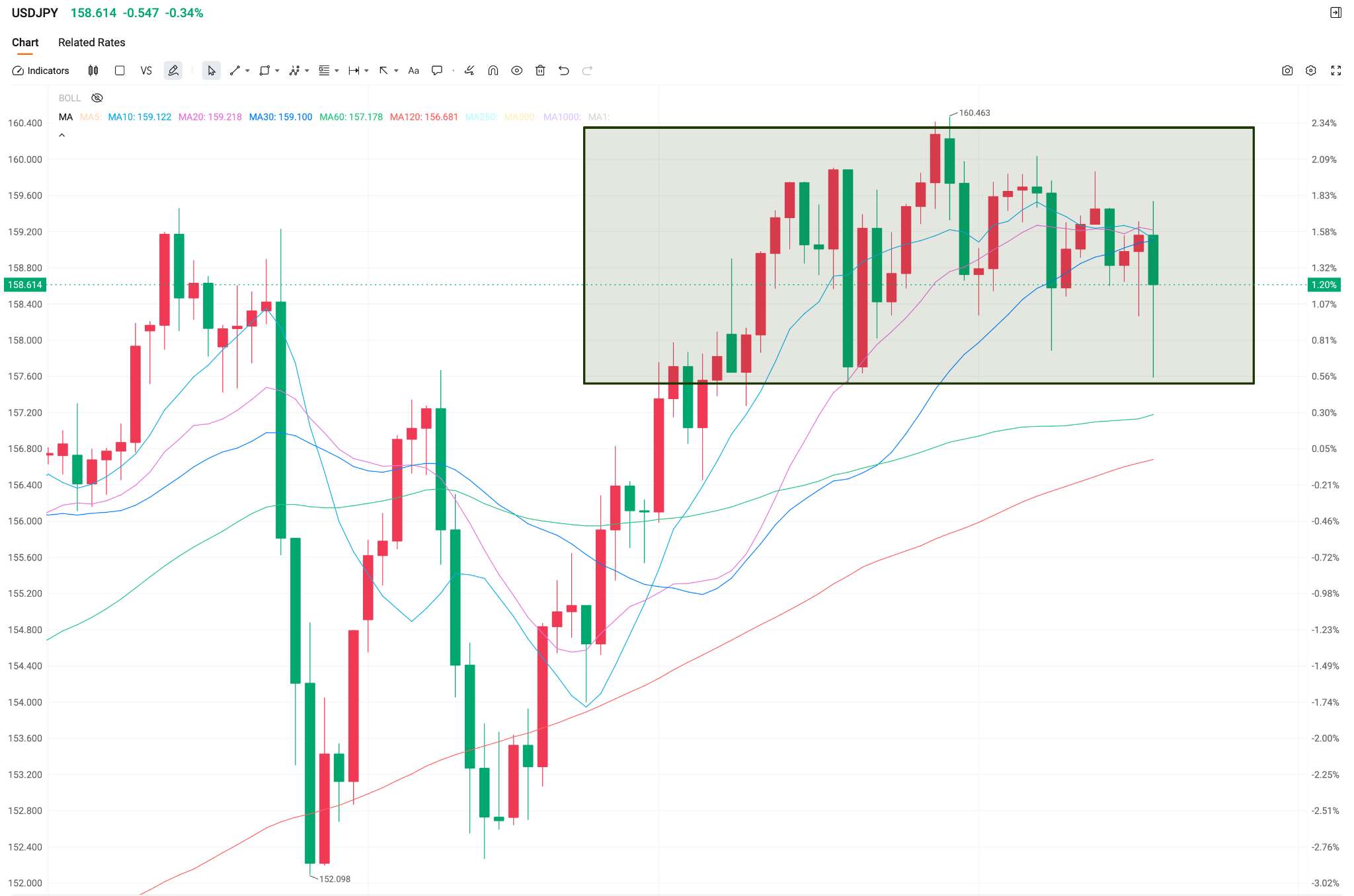
A weakening dollar should have been the prime opportunity for a yen rally, but in this round of dollar correction, the yen has become the ultimate 'bystander'.
The Us Dollar Weakens, Yet the Yen Breaches the 160 Mark
Since early April, as expectations for US-Iran ceasefire negotiations have intensified, safe-haven demand in the Middle East has rapidly receded. The US Dollar Index has retreated continuously, falling from near the 100 level to a low of 97.60, erasing all gains made since the outbreak of the US-Iran conflict.
According to traditional foreign exchange pricing logic, a weakening dollar typically suggests a strengthening of non-US currencies. However, the yen has continued to weaken against the trend. On March 27, USD/JPY breached the 160 level for the first time in nearly two years, and the exchange rate has since remained in a stalemate near 160. Despite the Japanese Finance Minister continuously ramping up verbal intervention signals, the yen's weakness has yet to be reversed.
This "weak dollar, even weaker yen" dislocation stems from the fact that the two sets of logic driving the movements of the US dollar and the yen have completely decoupled.
The "Siphon Effect" of the Widening US-Japan Interest Rate Differential
Since ending its negative interest rate policy in March 2024, the Bank of Japan has implemented a total of four rate hikes, the most recent being an increase to 0.75% in December 2025. However, this tightening pace, combined with the U.S. policy of maintaining high interest rates, has created a structural yield gap.
Federal Reserve officials have recently issued a flurry of hawkish signals, with Chicago Fed President Austan Goolsbee stating that rate cuts could be delayed until 2027. As Treasury yields remain elevated, this has directly fueled the continued expansion of carry trades. Investors borrow low-cost yen and convert them into high-yield assets like the dollar to capture interest rate differentials, a flow of capital that exerts relentless selling pressure on the yen.
In an April 16 report, ING analyst Chris Turner noted that the interest rate gap between the U.S. and Japan, coupled with a trade deficit, represents a "double whammy" for the yen's weak pricing. As long as the U.S.-Japan yield differential does not narrow significantly, the carry trade of borrowing yen to buy dollars will not cease.
Japanese Yen Under Pressure from Energy Imports and Trade Deficit
Beyond the carry trade, the yen is also facing rigid pressure from the energy sector. As a major global net energy importer, the situation in the Strait of Hormuz since the outbreak of the Middle East conflict has driven up global energy prices, directly worsening Japan's terms of trade. Japan must pay more yen for dollar-denominated energy, further exacerbating the trade deficit and exerting continuous downward pressure on the yen's exchange rate.
Research from the Nomura Research Institute shows that this energy crisis could lower Japan's real GDP by 0.65% while pushing up prices by 1.14%.
The Bank of Japan's cautious stance on the pace of interest rate hikes is also intensifying bearish market expectations for the yen.
On March 19, the Bank of Japan voted 8-1 to maintain interest rates at 0.75% for the second consecutive time; on April 17, Kazuo Ueda emphasized in his latest statement that "policy response is very difficult," and market expectations for a rate hike this month have dropped sharply from 55% to 19%.
This predicament of "unmet rate hike expectations and high energy costs" makes it difficult for both verbal intervention and potential actual currency intervention by Japanese authorities to reverse the yen's persistent weakness.
When Will the Japanese Yen Strengthen?
Judging from the current constraints on the yen, a sharp retreat in energy prices or a significant decline in U.S. interest rates is the only path for the yen to truly strengthen.
Fundamentally, for the yen to completely reverse its weak exchange rate position, the full restoration of navigation through the Strait of Hormuz, a significant drop in oil prices, and the alleviation of the underlying drivers of the trade deficit are necessary conditions. Furthermore, clear rate-cut signals from the Federal Reserve and a rate hike by the Bank of Japan that exceeds market expectations would serve as catalysts for the yen as the U.S.-Japan interest rate differential enters a channel of substantial narrowing.
For now, market pricing for a rate hike at the Bank of Japan's April 28 meeting is deemed significantly low; even if a hike materializes, it would only serve as a "tactical firewall" against USD/JPY breaking above 160, and it remains fundamentally far from triggering a "strategic turning point" for sustained yen strength.
In the current yen predicament, until the external variables of falling oil prices and Federal Reserve rate cuts materialize, the yen's movement is likely to continue fluctuating within a range of 155 to 160, as the market currently sees no signals that could support a stronger yen.
This content was translated using AI and reviewed for clarity. It is for informational purposes only.
Recommended Articles












Comments (0)
Click the $ button, enter the symbol, and select to link a stock, ETF, or other ticker.