


GPT-Rosalind Sparks CRO Sector Slump: Should Investors Buy the Dip or Exit Amid AI Drug R&D Impact?



AI Podcast


OpenAI's GPT-Rosalind, a life sciences LLM, has caused a decline in the CRO sector, particularly pre-clinical service providers, due to potential efficiency gains in early-stage R&D. Clinical CROs like IQVIA, with large data assets and high-touch services, are less exposed. While GPT-Rosalind aids research, it's not expected to replace scientists. This launch intensifies the AI in life sciences competition, notably against Google's AlphaFold technology and its subsidiary Isomorphic Labs, which focuses on protein structure prediction for drug discovery. The overall AI drug discovery market is projected for significant growth, suggesting opportunities for CROs adopting AI.
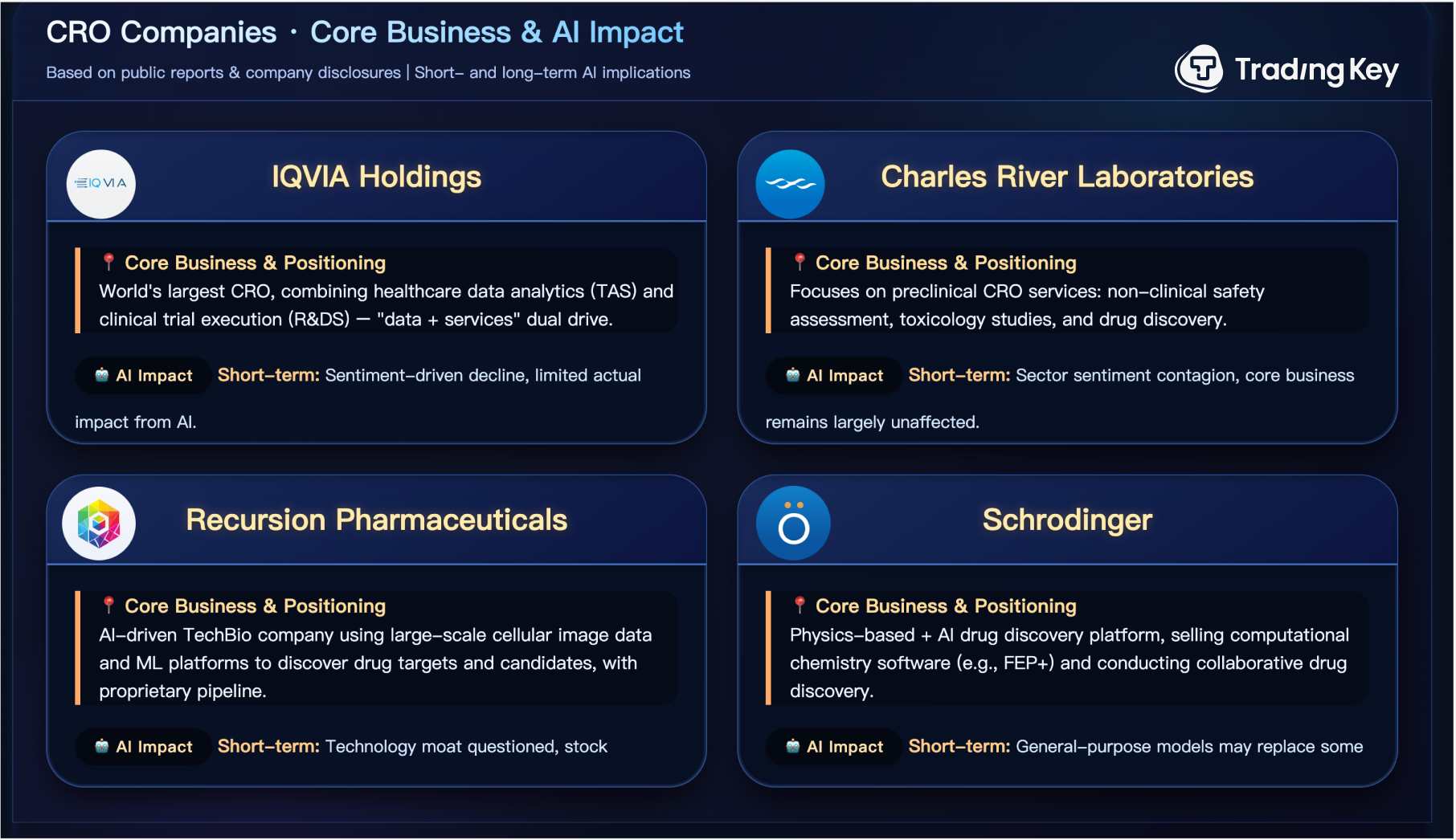
TradingKey - On April 16, 2026, OpenAI released GPT-Rosalind, a large language model specifically designed for life sciences research. Initial users include pharmaceutical giant Amgen ( AMGN ), vaccine manufacturer Moderna ( MRNA ), and the Allen Institute. Upon the announcement, the CRO sector fell collectively, with IQVIA Holdings ( IQV) dropping 3.5%, Charles River Laboratories ( CRL) declining 2.6%, and Recursion Pharmaceuticals ( RXRX) and Schrodinger ( SDGR) falling more than 5% at one point.
What is a CRO?
CRO stands for Contract Research Organization, an industry that provides outsourced R&D services for pharmaceutical companies. Based on different stages of the business cycle, CROs can be broadly categorized into pre-clinical CROs and clinical CROs.
Pre-clinical CRO It primarily focuses on the stages before a drug enters human trials, which include target identification, molecular screening, toxicology research, and safety assessment.
Charles River Laboratories is a leader in this field, with its DSA business accounting for approximately 60% to 70% of revenue and research model services comprising about 19%. This segment mainly relies on information processing and experimental operations, making it one of the areas most likely to be impacted by GPT-Rosalind.
Clinical CRO It is primarily responsible for the processes involved after a drug enters human trials, including clinical trial design, patient recruitment, data management, and regulatory reporting. IQVIA Holdings and Medpace both fall into this category.
IQVIA is the world's largest contract research organization, with its primary revenue derived from clinical-stage services; R&D operations account for approximately 55% of revenue. Furthermore, it possesses the world's largest de-identified patient data asset through its TAS business—a data moat that AI cannot replicate.
Medpace is a pure-play clinical CRO that focuses on providing integrated, full-service solutions. Its clients are predominantly small-to-mid-sized biotech companies, accounting for 78% of the total. The firm specializes in executing the entire lifecycle of Phase I through IV clinical trials. Its operations rely heavily on offline coordination among hospitals, patients, and regulatory agencies—a high-touch, low-structured service where artificial intelligence is difficult to penetrate.
Why did the CRO sector experience a collective decline?
Pharmaceutical companies opt for outsourcing to balance cost and efficiency; building a complete R&D team from the lab to the clinic faces the dual constraints of long cycles and high fixed costs. By leveraging economies of scale and professional specialization, CROs help pharmaceutical firms reduce R&D expenses and shorten trial timelines.
According to data from Evaluate Pharma, global pharmaceutical R&D spending has risen from $30 billion in 2005 to $220 billion in 2025, representing an average annual growth rate of approximately 9%.
Industry reports indicate that the global CRO market size will reach approximately $90 billion by 2025; among the world's top ten pharmaceutical companies, an average of 42% of R&D budgets is allocated to outsourcing firms.
If AI tools can significantly enhance in-house R&D efficiency, allowing a small team of scientists to complete work that would otherwise be outsourced to CROs in a shorter timeframe, the cost-effectiveness of outsourcing must be re-evaluated. This explains why the CRO sector experienced a collective decline following the release of GPT-Rosalind.
What exactly can GPT-Rosalind do?
Joy Jiao, head of life sciences research, stated clearly that GPT-Rosalind aims to be a research collaboration tool rather than a replacement for scientists. She noted that OpenAI does not currently believe AI is capable of independently proposing new disease treatments.
The model assists scientists in referencing data, screening literature, and formulating hypotheses, but humans remain responsible for the ultimate decisions to conduct experiments, design protocols, and implement clinical procedures. GPT-Rosalind addresses the challenge of information overload, not the replacement of human labor.
Technically, GPT-Rosalind incorporates fifty common biological workflows and access to mainstream public databases into its general large language model framework, helping researchers quickly filter relevant information from a vast sea of academic papers.
Which CRO segments are most vulnerable to impact?
Since GPT-Rosalind is merely an auxiliary tool, why is there panic in the CRO sector? It is necessary to break down the CRO business to understand the situation.
The early drug discovery phase includes target identification, molecular screening, and literature reviews—tasks that primarily rely on information processing capabilities. GPT-Rosalind can replace some tasks performed by junior researchers in literature screening and hypothesis generation. Since Recursion and Schrodinger are companies that fundamentally rely on AI for drug discovery, the launch of a similar model by OpenAI has led investors to worry about the risk of their technology being superseded.
The clinical trial phase involves patient recruitment, data management, and compliance reporting, which require extensive offline coordination with hospitals, patients, and regulatory agencies. These services are high-touch and low-structure, making them difficult for language models to process. This is where IQVIA and Charles River earn most of their revenue; therefore, their stock price declines were driven primarily by sentiment contagion rather than actual impact.
Manufacturing and supply chain services (CDMO) fall completely outside the capabilities of GPT-Rosalind. Furthermore, a research report from CSC Financial pointed out that this segment stands to benefit overall.
The conclusion is clear: the impact of AI on the CRO sector is uneven. Early-stage R&D outsourcing is under greater pressure, while the moat for clinical CROs has actually widened. Investors should differentiate between the risk profiles of various sub-sectors rather than succumbing to across-the-board panic.
OpenAI vs. Google: Different Technical Approaches in the Life Sciences Sector
The strategic aspect of OpenAI's release of GPT-Rosalind is to officially launch a challenge against Google ( GOOGL ). In 2024, two scientists from Google DeepMind were awarded the Nobel Prize in Chemistry for AlphaFold. AlphaFold solved the 50-year-old biological puzzle of protein structure prediction, significantly heightening industry focus on AI's potential in the life sciences.
AlphaFold has entered the commercialization phase. Alphabet, Google's parent company, established a specialized subsidiary, Isomorphic Labs, to apply AlphaFold technology to practical drug discovery. Isomorphic Labs has now partnered with Eli Lilly ( LLY) and Novartis ( NVS) to sign AI drug development cooperation agreements totaling nearly $3 billion, focusing primarily on research targets previously considered undruggable. An anti-cancer drug candidate developed using AlphaFold technology underwent human clinical trials in 2025, demonstrating that AI-designed drugs have moved from the theoretical stage to practical application. The company completed a $600 million Series A funding round in March 2025, as capital markets have cast their votes with real investment.
OpenAI’s GPT-Rosalind follows an entirely different path. While AlphaFold focuses on the highly specific and complex problem of protein folding, GPT-Rosalind is a general-purpose language model tailored for biological workflows, encompassing literature review, data integration, and target screening. Rather than competing directly, the two represent different approaches to how AI can assist the life sciences.
Investors must continuously track the competitive landscape of this sector. The entity that first completes the commercialization loop will hold a dominant position in the next technological wave. GPT-Rosalind has already secured its first corporate users, including Amgen and Moderna, while Google DeepMind continues to collaborate with pharmaceutical giants. The competition between these two companies has expanded beyond academic influence into practical product applications and monetization.
Is the CRO sector still worth investing in?
Several brokerage research firms hold varying views on the impact of AI. CSC Financial believes that the short-term impact of AI on the pharmaceutical and pharmaceutical outsourcing sectors is limited; while the impact on CROs in the early R&D stage is divergent, the production-side CDMO sector stands to benefit overall. Data from China Post Securities warrants further attention. The global market for AI-assisted drug discovery is projected to reach $11.9 billion in 2023 and grow to $74.6 billion by 2032, representing a compound annual growth rate (CAGR) of 22.6%.
This is an incremental market rather than a zero-sum game. Clinical research organizations that proactively adopt artificial intelligence technologies are likely to gain a competitive advantage amid these new industrial trends.
In the coming weeks, data from the earnings season will serve as the primary source of verification. IQVIA is expected to release its earnings report on May 5, and Charles River is expected on May 6. If guidance for both companies is not significantly revised downward, current price lows likely represent an opportunity created by sentiment-driven selling. Meanwhile, the competition between OpenAI and Google in the life sciences sector has only just begun and warrants long-term attention.
This content was translated using AI and reviewed for clarity. It is for informational purposes only.
Recommended Articles





Comments (0)
Click the $ button, enter the symbol, and select to link a stock, ETF, or other ticker.