


ETH vs. Ethereum Stocks — Which Is the Better Investment?




Introduction: Ethereum’s Rise Shifts Market Focus
TradingKey – In 2025, institutional investors have flooded into the crypto market, accumulating Ethereum (ETH) as a treasury asset. This surge pushed ETH past $3,800, shifting attention from Bitcoin to Ethereum, and from Bitcoin-linked stocks to Ethereum-linked stocks.
Yet, many investors are still unfamiliar with the concept of “Ethereum-linked stocks.” This guide breaks down their definition, categories, key players, and investment strategies to help you navigate this emerging sector.
What Are Ethereum-Linked Stocks?
- Narrow Definition: Public companies that hold large amounts of ETH as part of their treasury.
- Broad Definition: Companies that are closely tied to the Ethereum ecosystem, including infrastructure providers, dApp developers, and staking platforms.
While both types are influenced by ETH price movements, narrowly defined Ethereum stocks tend to react faster and more sharply, especially if they hold significant ETH reserves.
Ethereum Stocks vs. Bitcoin Stocks
Ethereum Stocks | Bitcoin Stocks | |
Core Asset | ETH | |
Tech Focus | Smart contracts, dApps | Digital gold, payments |
Business Models | DeFi, NFTs, RWA, staking | Mining, payments, hedging |
Revenue Sources | Gas fees, dev tools, staking commissions | Mining rewards, trading fees, custody |
Valuation Drivers | Developer activity, dApp count, TVL | Hash rate, energy cost, BTC reserves |
Key Metrics | Avg. gas fees, contract deployments | Network hash rate, mining difficulty |
Who Are the Top Ethereum-Linked Stocks?
Direct ETH Holders
These companies hold large ETH reserves and are highly sensitive to ETH price movements:
- SharpLink Gaming (SBET) – Holds 360,807 ETH, the largest among public firms
- Bitmine Immersion (BMNR) – Holds 300,657 ETH, aiming to control 5% of ETH supply
- Coinbase (COIN) – Holds 137,300 ETH, also a co-issuer of USDC
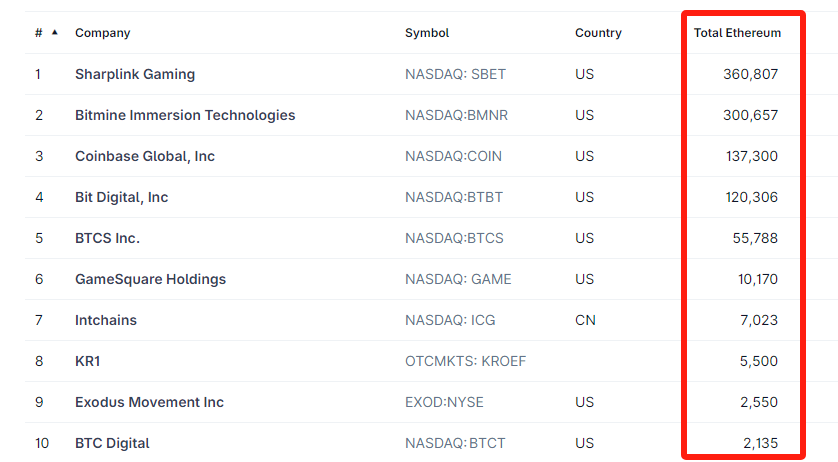
The top ten listed companies by ETH holdings, source: coingecko
Indirect Ethereum Exposure
These firms offer Ethereum-related services but hold little or no ETH:
- Robinhood (HOOD) – Supports ETH trading and payments
- Hut 8 Mining (HUT) – Operates GPU infrastructure for ETH-compatible chains
- Galaxy Digital (GLXY) – Provides Ethereum staking and custody
- Block (XYZ) – Offers Ethereum-based payment solutions
- FA South Ethereum ETF (03068.HK) – Tracks ETH performance in Hong Kong
ETH vs. Ethereum Stocks: Which Is Better?
Ethereum (ETH) | Ethereum Stocks | |
Pros | -Direct exposure to ETH growth -High upside in bull markets -Decentralized asset | -Lower volatility -Diversified exposure -Potential dividends |
Cons | -High volatility -Security risks -Requires technical knowledge | -Dependent on company performance -May lag ETH price -Subject to corporate governance |
Portfolio Strategy Suggestions
- Aggressive: 70% ETH + 30% Ethereum stocks
- Balanced: 50% ETH + 50% Ethereum stocks
- Conservative: 20% ETH + 80% Ethereum stocks
Conclusion
Whether Investing Directly in ETH or Ethereum-Linked Stocks, Your Strategy Should Reflect Your Risk Profile and Financial Goals. Ethereum offers high-risk, high-reward potential, making it attractive for aggressive investors during bullish cycles. In contrast, Ethereum-linked stocks can offer more stable returns and long-term growth, often benefiting from diversified business models, regulatory protection, and cash flow mechanisms like dividends.
Recommended Articles









Comments (0)
Click the $ button, enter the symbol, and select to link a stock, ETF, or other ticker.