


How to Survive Bitcoin Winter? Will It Still Fall Below $60,000 in 2026?



AI Podcast


Bitcoin's price surge past $73,000, driven by potential regulatory action, contrasts with previous expectations of a bear market. Key price drivers include global liquidity, geopolitical risks, and regulatory sentiment. While some view Bitcoin as a safe-haven asset, its performance during extreme risk suggests it behaves more like a volatile risk asset. Market institutions are polarized on future direction, with price targets varying significantly. Downside risk below $60,000 is a concern for some analysts, contingent on tightening liquidity and USD strength, while others point to demand support levels.

TradingKey - Recently, after meeting with the CEO of Coinbase, Donald Trump pressured Congress to push for the CLARITY Act. Driven by this news, Bitcoin (BTC) prices once surged past $73,000, successfully breaking out of their recent consolidation range after a period of volatility.
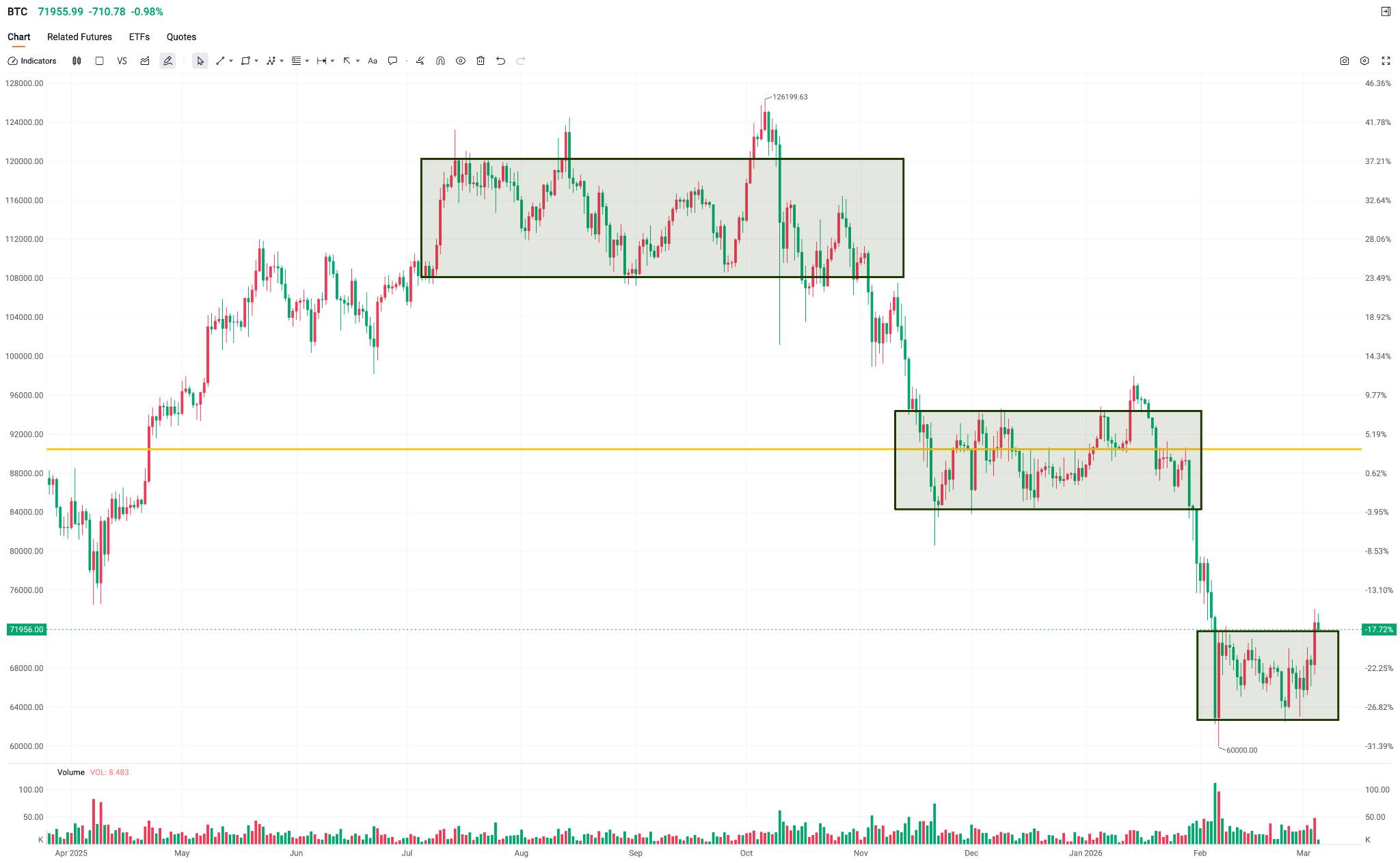
Previously, mainstream financial media and market institutions generally believed that Bitcoin had entered a relative bear market. Although Bitcoin recently rebounded to $71,900, a trend reversal has yet to be confirmed, and there remains significant disagreement in the market regarding Bitcoin's direction for 2026.
While the price targets set by most investment banks are far above current levels, the market's valuation of Bitcoin has undergone a reshuffling.
What key factors are driving Bitcoin's price movements?
The macro liquidity environment remains one of the core variables affecting Bitcoin.
Over the past few years, one of the significant drivers of Bitcoin's rise has been global liquidity expansion and the low-interest-rate environment. When real interest rates are low and market liquidity is abundant, risk assets tend to attract capital, and Bitcoin has benefited from this trend.
However, as inflationary pressures remain resilient and market expectations for the number of rate cuts this year continue to be revised downward, global financial conditions have tightened periodically. This has, to some extent, suppressed investors' risk appetite for crypto assets.
Geopolitical risks and shifts in safe-haven sentiment also impact Bitcoin.
In recent years, Bitcoin was once viewed by some investors as "digital gold," possessing safe-haven attributes during risk events. However, recent market performance suggests that when global risks escalate sharply, capital still tends to flow into traditional safe-haven assets, such as gold or the US dollar and Treasuries, while Bitcoin may actually experience a simultaneous pullback. This indicates that in extreme risk environments, Bitcoin remains closer to a high-volatility risk asset rather than a traditional safe-haven tool.
Regulatory policies and market sentiment are also factors that cannot be ignored.
Changes in the regulatory stance of major global economies toward crypto assets often swiftly impact market confidence. For instance, the policy direction of US regulators regarding crypto trading platforms, stablecoins, and ETF products can all alter institutional investors' willingness to participate.
Does Bitcoin face the downside risk of falling below $60,000 again?
Regarding whether the critical $60,000 level will be breached, the views of major institutions are polarized.
One view holds that given Bitcoin's price has fallen more than 40% from its October peak of nearly $127,000, the risk of an extreme decline is limited. Most institutions and analysts in the market state that Bitcoin has multiple layers of demand support in the $60,300–$61,000 range, which also serves as a psychological and technical support level that has been tested several times since 2024.
Another group of institutional perspectives is more cautious. Geoffrey Kendrick, Head of Global Digital Assets Research at Standard Chartered, stated that their analysis suggests if global liquidity tightens further, the US dollar continues to strengthen, or a macro credit event occurs, Bitcoin's downside risk must still be priced in. In such a scenario, a drop below $60,000 or even a test of the $50,000 level is not unexpected, as high-valuation risk assets often appear more fragile than their fundamentals during periods of macro headwinds.
Notably, Geoffrey Kendrick was previously one of the prominent Bitcoin bulls, having once forecast Bitcoin to reach $200,000.
Although Bitcoin remains in a "crypto winter" phase, Donald Trump's recent pressure on the Senate to push for crypto legislation caused Bitcoin to briefly rebound above $73,000, seemingly giving Bitcoin investors hope. Furthermore, major Wall Street regulators are advancing plans to regulate the cryptocurrency industry and the burgeoning prediction markets—new measures that could have a long-term impact on the broader financial markets.
This content was translated using AI and reviewed for clarity. It is for informational purposes only.
Recommended Articles











Comments (0)
Click the $ button, enter the symbol, and select to link a stock, ETF, or other ticker.