


BTC Slips Under $75,000 — Will the World’s Biggest Corporate Whale Finally Blink?



AI Podcast


Bitcoin fell below $75,000 to a 10-month low, influenced by U.S. government shutdown and a hawkish Federal Reserve nominee. MicroStrategy's holdings, above its cost basis, spark sell-off concerns that could trigger a significant price drop to $30,000-$40,000. However, market sentiment is expected to stabilize if MicroStrategy avoids liquidation, with prices potentially holding at $75,000. The short-term downside probability is assessed as low, pending resolution of these factors.

TradingKey - Bitcoin prices briefly fell below $75,000, hitting a new 10-month low, though the probability of continued short-term downside remains low.
On Monday (February 12), the cryptocurrency market collectively plunged, with Bitcoin (BTC) falling more than 4% today to break below $75,000. The current price is $74,973, marking a new low since April 2025.
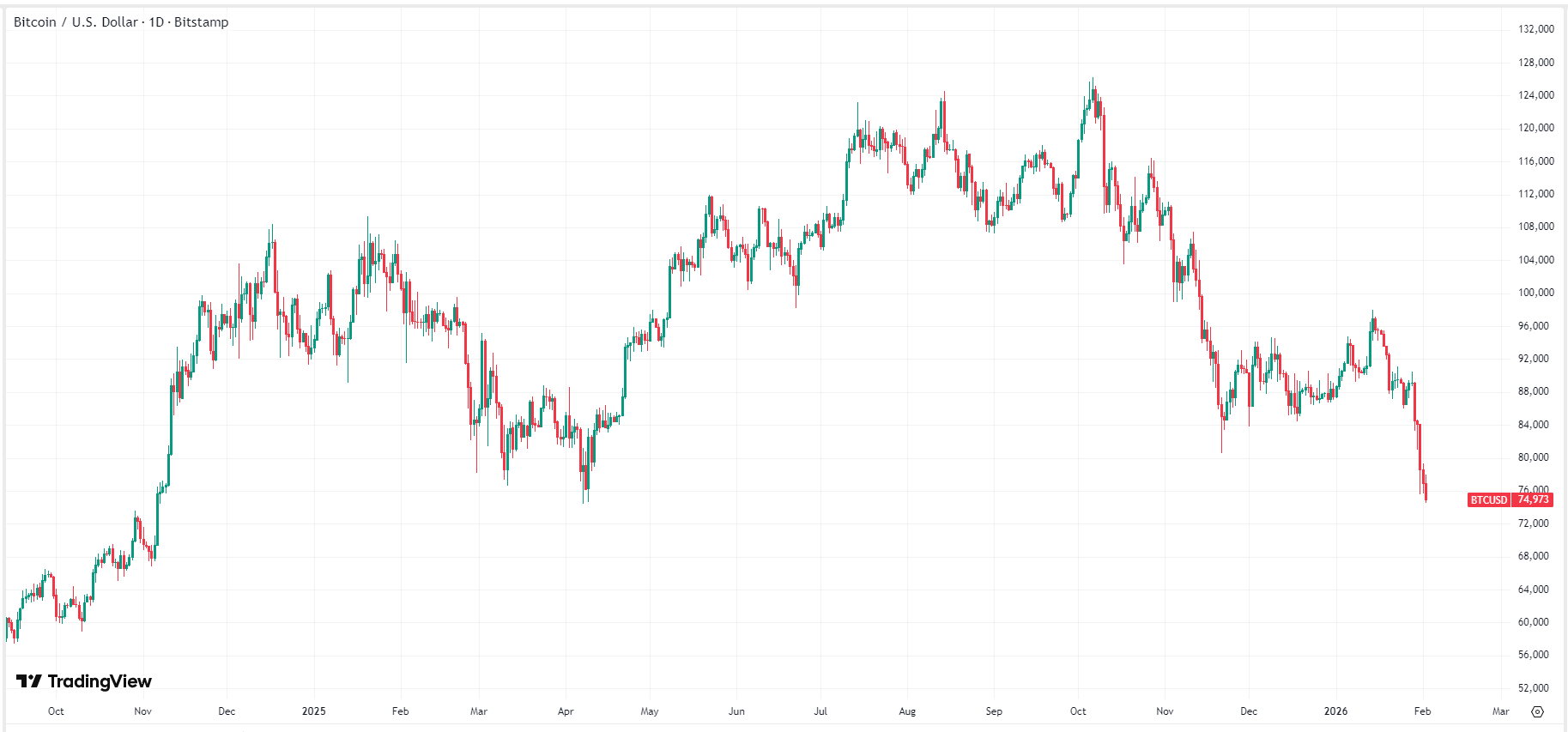 Bitcoin price chart, Source: TradingView
Last Friday (January 30), U.S. President Trump announced the nomination of former Fed Governor Kevin Warsh as the new Federal Reserve Chair. Additionally, the U.S. government entered another shutdown, triggering declines in U.S. stocks, gold, silver, and cryptocurrencies, as panic continues to spread.
Over the past five days, Bitcoin prices have fallen for five consecutive sessions, with a cumulative decline of over 16%. Currently, the price of Bitcoin has dropped below the cost basis of Strategy (MSTR)'s holdings, fueling market concerns that the company might sell off Bitcoin on a massive scale, triggering an even larger slump.
As of press time, Strategy's average BTC holding cost is $76,000, with total holdings of over 710,000 Bitcoins, accounting for more than 3% of the circulating supply. It ranks first among all holding entities and holds more than the combined holdings of the U.S., China, and the U.K., which is a key reason for the market's concern about a potential sell-off.
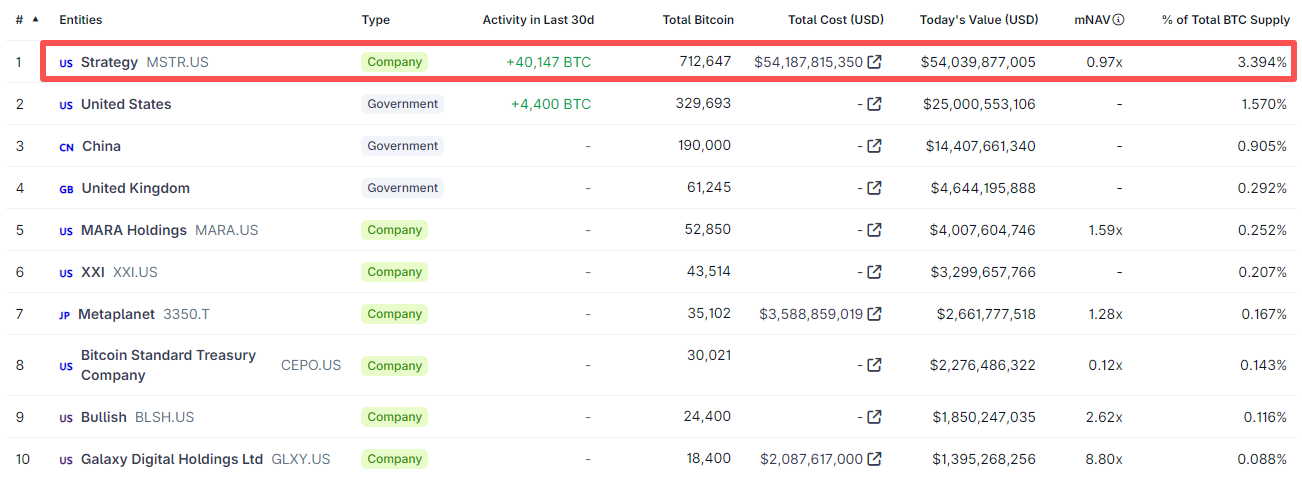 Top 10 entities by Bitcoin holdings, Source: CoinGecko
If Strategy were to actually sell off its Bitcoin, it would have severe consequences. First, its massive volume would directly threaten Bitcoin prices and further fuel panic. Second, it would signal the failure of the DAT corporate model, potentially prompting similar companies to follow suit in liquidating their crypto assets.
CryptoQuant CEO Ki Young Ju stated, "Unless Saylor (Strategy founder) significantly sells off his holdings, the market will not see a 70% crash as in previous cycles." This undoubtedly indicates that if Strategy significantly reduces its Bitcoin holdings, prices will plummet. Based on a 70% drop from the high of $125,000, Bitcoin's price would retrace to $30,000-$40,000.
If Strategy does not sell its Bitcoin, the price will gradually stabilize at $75,000. Judging solely from the two root causes, the bearish sentiment is likely temporary because the U.S. government will not remain shut down indefinitely. Furthermore, although Trump's nominee Warsh was previously hawkish-leaning, interest rate cuts are a long-held objective, and it is unlikely that someone would be appointed to oppose him.
This content was translated using AI and reviewed for clarity. It is for informational purposes only.
Recommended Articles










Comments (0)
Click the $ button, enter the symbol, and select to link a stock, ETF, or other ticker.