


Bitcoin Price Surges To $90,000. U.S. Arrests Venezuela's President, Triggers Bull Frenzy



AI Podcast


Bitcoin surged over 1% to $91,350, a two-week high, influenced by U.S. military action in Venezuela. While the conflict initially caused a brief dip, Bitcoin rebounded as investors re-evaluated. Limited economic impact currently caps upside, but potential capital flight or currency devaluation could boost demand. The event has improved market sentiment, shifting the Fear & Greed Index to neutral. Technical analysis suggests a potential short-term rebound to $96,000 resistance. Broader global adoption and significant price appreciation may require larger macroeconomic events.

TradingKey - Venezuela Incident Drives Bitcoin Price Stronger, Breaking $90,000. Is the $100,000 Milestone Within Reach?
On Sunday (January 4), Bitcoin (BTC) price surged over 1%, breaking the $90,000 mark, with the current price at $91,350, marking a two-week high. Concurrently, the Fear & Greed Index has rebounded from 10 to 40, transitioning from extreme fear to a neutral level.
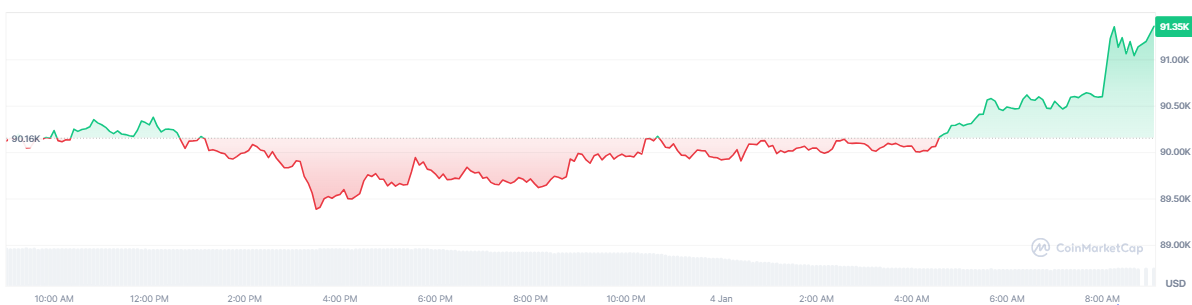 Bitcoin Price Chart, Source: CoinMarketCap.
Bitcoin's price suddenly reversed its downtrend today, rebounding strongly, primarily influenced by the conflict between the United States and Venezuela. On January 3, 2026, the United States launched military action against Venezuela, arresting President Maduro and his wife. U.S. President Trump claimed that 'all Venezuelan military forces have been completely suppressed' and stated that the U.S. would continue to administer Venezuela until a safe, proper, and prudent transfer of power could be completed.
Following the announcement of the U.S. military action against Venezuela, Bitcoin's price did not immediately rebound; instead, it first fell before rising. At that time, Bitcoin's price briefly declined to $89,000, then recovered to $90,000. It is evident that investors' reaction to the event was slow and insufficient.
The market's performance was not very strong, partly due to thin liquidity during the holidays, and primarily because the situation is currently confined to a military conflict, with limited impact on the economy and its currency. Should this event lead to capital flight, sanctions, or currency devaluation, the local populace would highly likely turn to Bitcoin as a store of value, creating substantial demand support, and simultaneously presenting an excellent opportunity for bulls to rally.
From a market sentiment perspective, the conflict has already ignited bullish investor sentiment, gradually dispelling the cloud of fear. Furthermore, with the arrival of 2026, investors harbor new expectations, a common phenomenon observed in previous years. From a technical analysis standpoint, Bitcoin is currently forming an ascending triangle, with the potential for a continued short-term rebound to $96,000, which marks the rebound high since the sharp decline on November 20 and acts as a significant resistance level.
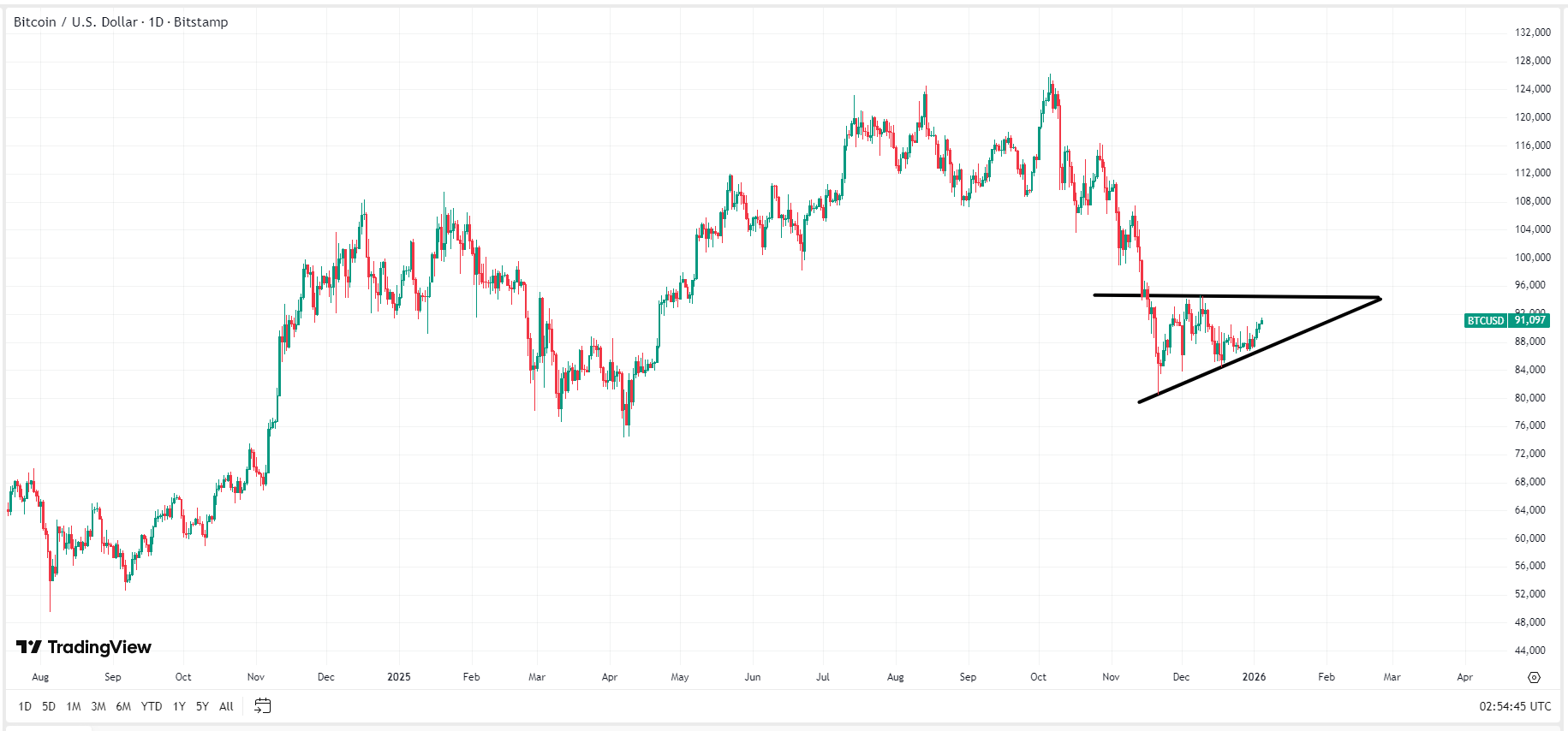 Bitcoin Price Chart, Source: CoinMarketCap.
However, can Bitcoin's price break through this resistance level and return to its historical peak of $125,000? If the conflict is limited to the U.S. and Venezuela, it might incentivize the Venezuelan populace to purchase Bitcoin, but it is unlikely to drive further global adoption of Bitcoin, with insufficient demand limiting its upside potential. However, macroeconomic events such as the U.S. midterm elections or a Federal Reserve leadership change could potentially have such an impact.
This content was translated using AI and reviewed for clarity. It is for informational purposes only.
Recommended Articles








Comments (0)
Click the $ button, enter the symbol, and select to link a stock, ETF, or other ticker.