


Wall Street Sounds Alarm: "Bitcoin's Four-Year Cycle Invalidated" - Will the Crypto Bull Market Persist?



AI Podcast


Wall Street firms and crypto professionals are debating the validity of Bitcoin's four-year "halving cycle." Proponents of the cycle's invalidation cite stable capital from ETFs and institutional demand. Conversely, some analysts, like Morgan Stanley, believe the cycle remains intact and the bull market is nearing its end. If the cycle fails, significant drawdowns may be less likely, though price volatility persists. Investors are advised to maintain a balanced, adaptable strategy, manage portfolio exposure, and monitor capital flows, regulatory developments, and Federal Reserve policy.

Wall Street Challenges Bitcoin's Cyclicality
TradingKey - Recently, Wall Street firms led byJPMorgan, Bernstein, and ARK Invest ignited debate, asserting Bitcoin's four-year cycle is broken. They claim the pattern is weakened, suggesting the crypto bull market isn't over.
Furthermore, numerous crypto institutions and professionals echo this sentiment. Among them are crypto asset management giant Grayscale, crypto market maker Wintermute, Binance founder Changpeng Zhao (CZ), BitMEX founder Arthur Hayes, BitMine Chairman Tom Lee, Bitwise CEO Hunter Horsley, and Glassnode co-founder Negentropic. They collectively believe the traditional Bitcoin four-year cycle is now invalid.
But what exactly is the Bitcoin four-year cycle? Why do Wall Street firms and other crypto professionals collectively deem this pattern invalid, and what are the implications?This article will address these questions individually. Furthermore, it will explore whether Bitcoin (BTC) is heading into a bear market.
What is the Bitcoin four-year cycle?
Bitcoin's four-year cycle, marked by alternating bull and bear markets, emerges approximately every four years. This cycle directly aligns with Bitcoin's block reward halving events, consequently earning it the moniker "halving cycle."
Historically, Bitcoin has undergone four halvings to date, occurring in 2012, 2016, 2020, and 2024. In each instance, the reward for miners per block was consecutively halved, dropping to 25 BTC, 12.5 BTC, 6.25 BTC, and 3.125 BTC, respectively. Notably, Bitcoin halvings are typically followed by a bull market, with prices peaking in the subsequent year (approximately 2014, 2018, and 2022). Subsequently, Bitcoin prices consistently decline, entering a bear market and bottoming out in the year preceding the next halving (around 2015, 2019, and 2023).
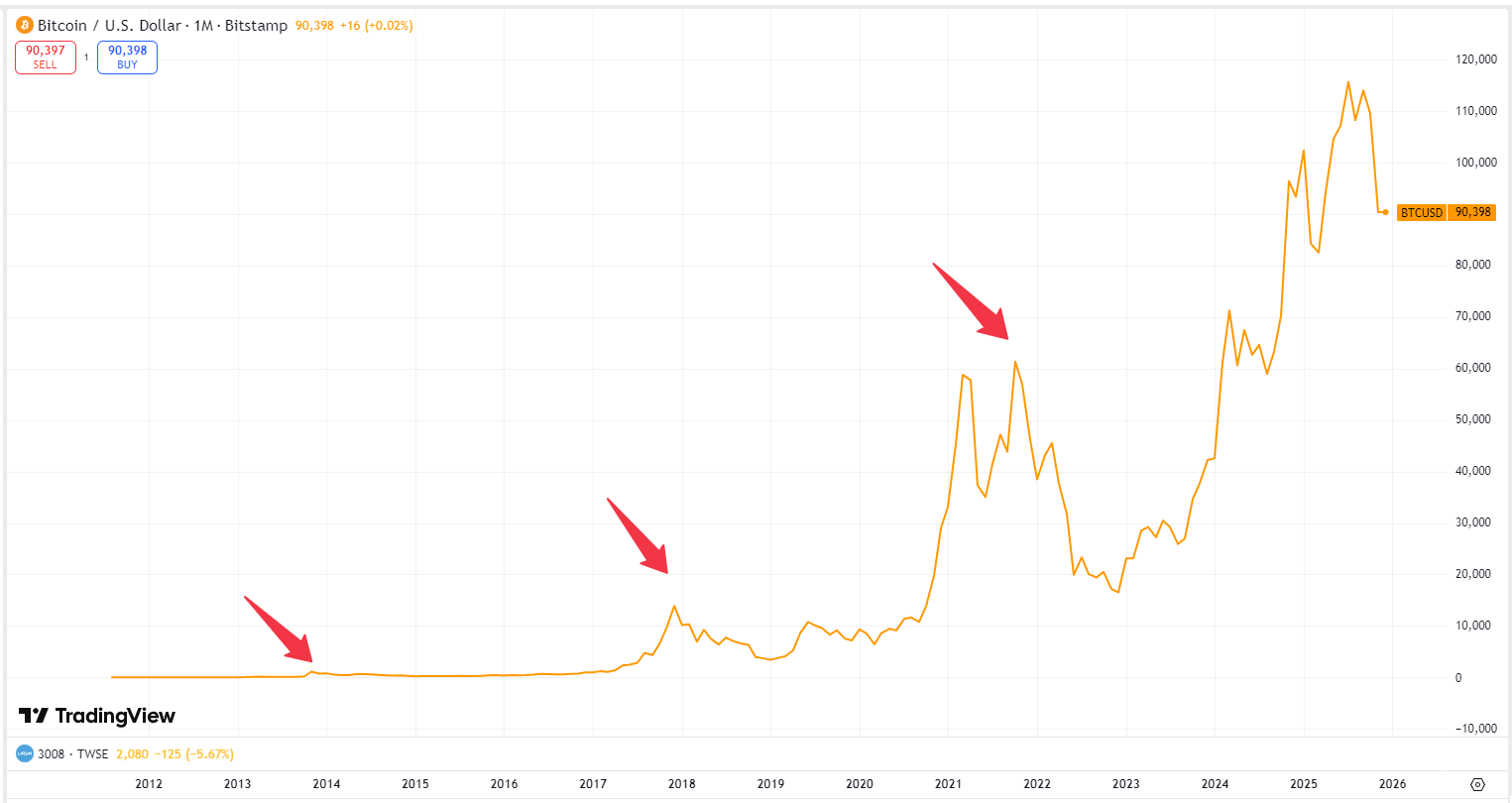 Bitcoin Price Chart and Bull/Bear Market Timelines, Source: TradingView.
Why is Wall Street exclaiming "Bitcoin's four-year cycle has failed"?
Wall Street institutions are increasingly declaring Bitcoin's four-year cycle invalid. This could mean a true extended bull market, or a fabricated narrative designed to inflate prices before a sell-off. The crucial question is whether this invalidation is genuine or a manufactured illusion.
Proponents of the cycle's invalidation argue that demand from entities such as ETF investors, DAT companies, and nations advocating for strategic cryptocurrency reservesis injecting stable capital into the market, thus providing sustained support for Bitcoin's price.JPMorgan Chase, for instance, believes ETF investors are introducing a more stable funding structure to the market. Furthermore, Changpeng Zhao (CZ) remarked at the Bitcoin Middle East Conference in Abu Dhabi that institutional involvement and the potential for a U.S. strategy to reserve cryptocurrencies could propel the market into a "super cycle."
Should capital consistently flow into the crypto market, it could indeed disrupt the historical four-year cycle. However, this remains an unverified hypothesis, currently impossible to either confirm or refute. Therefore, conspiracy theories cannot be entirely dismissed. Consequently, these institutions or individuals might be leveraging narratives like a "super cycle" or "perpetual bull market" to mitigate market selling pressure, simultaneously attracting more buyers, and ultimately driving up Bitcoin's price.This strategy would facilitate their own high-priced exits.In fact, this practice isn't unique to the crypto market; such narratives frequently emerge in the mid-to-late stages of any financial bull run.
Based on historical precedents or the aforementioned models,Bitcoin's price is projected to peak in 2026.Subsequently, it would reverse its upward trend, gradually declining into a bear marketand reaching its price trough in 2027.From a chronological perspective, Bitcoin still has a one-year window before potentially entering a bear market, offering ample time for "buy" calls to ferment and entice investors. Furthermore, a crucial detail warrants attention: the narrative of the four-year cycle's invalidation did not emerge during the early stages of the bull market in 2024. Instead, it surfaced after the bull run had been underway for some time, inevitably raising suspicions about its underlying motives.
Has Bitcoin's four-year cycle truly failed?
Morgan Stanley believes Bitcoin's four-year cycle remains intact and that the bull market is nearing its end, a view echoed by Sigma Capital, which predicts a significant price correction.
While a chorus of voices proclaims the demise of Bitcoin's four-year cycle, not all analysts agree. A contrasting view holds that the cycle remains valid, with Morgan Stanley notably among its proponents.
In Morgan Stanley's assessment, Bitcoin's four-year cycle is still active, and the bull market is gradually approaching its conclusion.In early November, Morgan Stanley strategist Denny Galindo, speaking on the 'Crypto Going Mainstream' podcast, indicated that the crypto market has entered the 'autumn' phase of Bitcoin's four-year cycle. He advised investors to lock in profits during this period to prepare for an impending 'crypto winter.'
Vineet Budki, CEO of venture capital firm Sigma Capital, concurs that the crypto market's 'four-year cycle' has not ended. Speaking at the 2025 Global Blockchain Congress in Dubai, UAE, in October, Budki projected that 'Bitcoin prices will correct by 65% to 70% in the next two years.'
What exactly does the invalidation of Bitcoin's four-year cycle mean?
Historical data indicates Bitcoin has consistently suffered drawdowns exceeding 70% from its bull market peaks to subsequent lows,with each cycle registering a maximum retraction of over 70%,as outlined below:
Bear Market Cycle | Timeframe | Peak Price (Previous High) | Trough Price | Maximum Drawdown |
After First Halving | 2014–2015 | $1,163 | $152 | -87% |
After Second Halving | 2017–2018 | $19,800 | $3,200 | -84% |
After Third Halving | 2021–2022 | $69,000 | $15,500 | -77% |
After Fourth Halving | 2025-2026 | XXX | XXX | XXX |
This implies that if Bitcoin's four-year cycle theory continues to hold, its price could also fall by over 70% in 2026.Based on the current peak price of $125,000, Bitcoin's price might drop below $37,000. However,if Bitcoin sets a new all-time high next year, the lowest price in a 70% maximum drawdown would consequently be higher.
If the four-year cycle fails, Bitcoin's price may not see a significant drawdown next year. Any brief correction would likely be limited. JPMorgan, for instance, previously indicated that ETF investors make an 80% deep Bitcoin drawdown unlikely. While this projection might hold, Bitcoin could still halve in value. Its price had already fallen over 30% from its peak by November 21. Consequently, investors should not be complacent and must implement measures to protect their positions.
How to Respond to Bitcoin's Four-Year Cycle Theory
The validity of Bitcoin's four-year cycle is uncertain, making a balanced, adaptable strategy crucial to avoid extreme positions. No single prediction can be 100% guaranteed, as the cycle may prove correct or incorrect. Therefore, investors should neither hold no positions based on its continuation nor go all-in if it potentially fails. A flexible, intermediate approach is advisable, preventing a passive stance from misjudgment.
Regarding position management, never go completely uninvested, nor ever go all-in. Always maintain a base position (no higher than 50%) to prevent significant losses from over-allocating, while also effectively mitigating the risk of missing out on gains. A crucial point to note is the timing:Entering 2026, especially the second half of next year,investors should observe Bitcoin's price fluctuations and gradually reduce positions to around 30%.
Furthermore, proponents of the 'failure theory' argue that Bitcoin's price is primarily supported by Exchange Traded Funds (ETFs), Digital Asset Trusts (DATs), and national, particularly U.S., strategic cryptocurrency reserves. Therefore, these three key factors require close monitoring. Should adverse conditions emerge, rapid position reduction is necessary. Conversely, significant positive developments could warrant considering an increase in positions. Another undeniable factor is the Federal Reserve's interest rate decisions. If future policies lean dovish, Bitcoin's bull market could very likely be extended. However, should a hawkish stance prevail, investors should approach Bitcoin with caution.
Conclusion
The crypto market is evolving into a more mature and rational phase, driven by shifting participant demographics and heightened macroeconomic influences, even as the validity of Bitcoin's four-year cycle remains uncertain.The continuation of the bull market will hinge on capital momentum, the regulatory landscape, and overall market sentiment.Investors should avoid blindly trusting any single forecast. Instead, maintaining an open mindset, managing portfolio exposure, and adopting a flexible approach will be crucial for navigating Bitcoin's future price volatility.
This content was translated using AI and reviewed for clarity. It is for informational purposes only.
Recommended Articles











Comments (0)
Click the $ button, enter the symbol, and select to link a stock, ETF, or other ticker.