


Goldman Sachs Warns of Strait of Hormuz Supply Risks: Brent Crude May Top $120 in Fourth Quarter



AI Podcast


Goldman Sachs reports that persistent disruptions in the Strait of Hormuz could drive Brent crude above $120 per barrel by Q4 2026. While the bank’s baseline forecast remains at $80, geopolitical tensions significantly elevate upside risk. Reduced transit capacity and shrinking supply buffers threaten global inventories, potentially reigniting inflationary pressures and forcing central banks to reconsider monetary easing. Investors should monitor vessel traffic and export data, as sustained supply constraints could dampen growth in transport and manufacturing sectors while simultaneously challenging liquidity for high-valuation assets. Market volatility remains contingent on the duration of regional maritime conflicts.

TradingKey - Goldman Sachs ( GS) Global Commodities Research team released its latest report stating that if crude oil and refined product shipments through the Strait of Hormuz continue to face severe disruptions, Brent crude ( UKOIL) prices could rise to over $120 per barrel in the fourth quarter of 2026. Goldman Sachs also emphasized that $120 is not its current baseline forecast, but rather an upside scenario based on conditions such as prolonged navigation restrictions in the strait, a significant drop in Gulf crude exports, and insufficient alternative transit capacity.
The recent escalation of the US-Iran conflict has made shipping security in the Strait of Hormuz the primary risk factor for the crude oil market. The market is concerned that if military actions expand, resulting in tankers being attacked, seized, or routes blocked, crude oil and liquefied natural gas (LNG) shipments from major energy exporters such as Saudi Arabia, Iraq, the UAE, Kuwait, and Qatar could all be affected. Even if the strait is not completely closed, as long as vessel transit efficiency declines, tanker companies may reduce their entry into relevant waters, thereby driving up freight rates, insurance premiums, and risk premium costs.
Goldman Sachs pointed out that current Persian Gulf crude shipments are estimated to have fallen below 45% of pre-war levels, and the short-term supply buffer in the crude market is weakening. Although some producing countries can bypass the Strait of Hormuz via overland pipelines or Red Sea ports, the transit capacity of existing alternative routes is limited and cannot fully absorb the oil originally exported through the strait. Once shipping disruptions persist for weeks or even months, global inventories could fall rapidly, and spot market supply will tighten significantly.
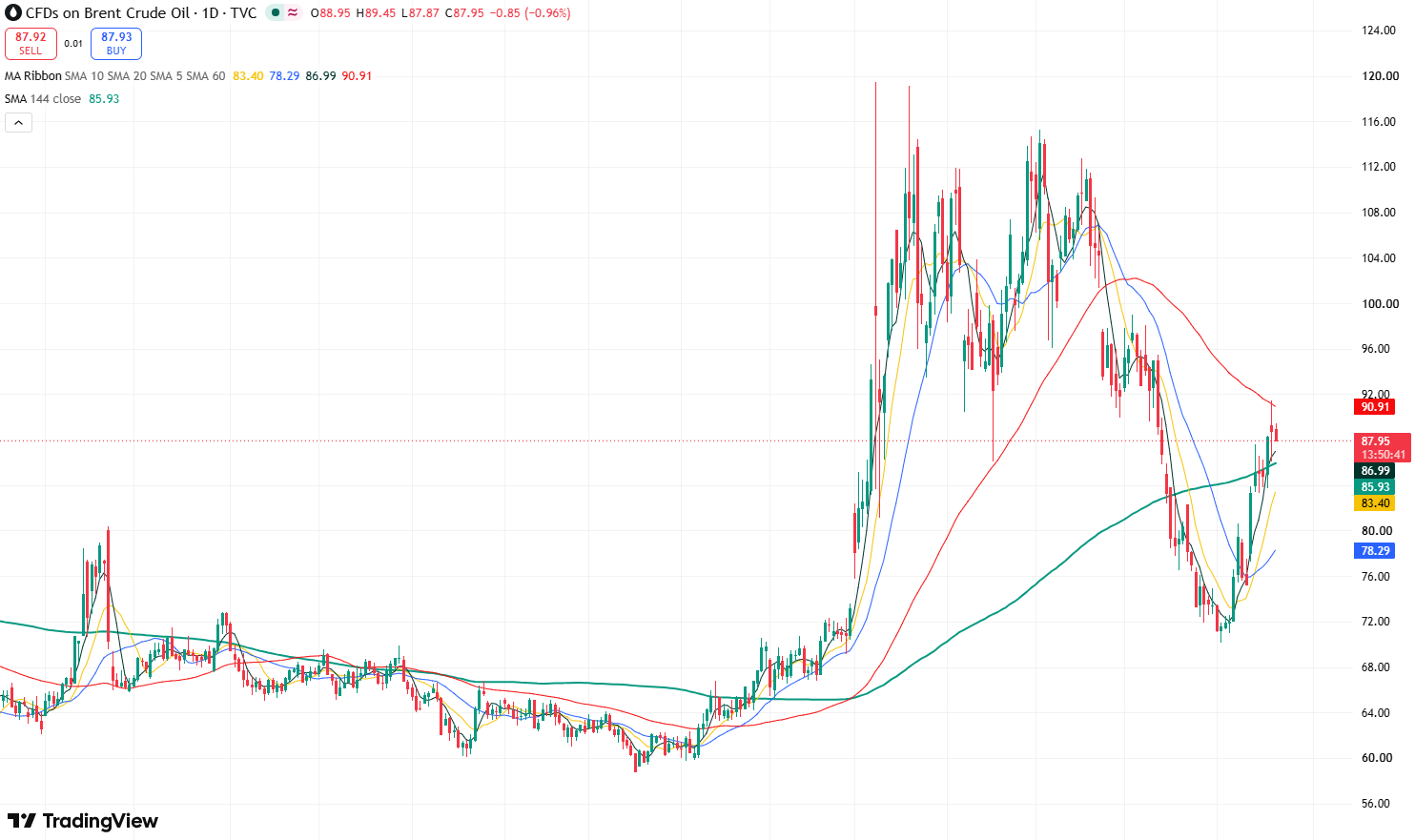
Brent Crude Daily Price Chart, Source: TradingView
Driven by supply concerns, Brent crude briefly broke above $90 during Monday's session, while WTI crude ( USOIL) also rose to a high of $84.60. Meanwhile, the premium of the front-month Brent contract relative to back-month contracts widened, indicating that refiners and traders are willing to pay a higher price for immediate delivery of crude, reflecting growing market concerns over tightening short-term physical supply.
However, in Goldman Sachs' baseline scenario, the situation in the Middle East is still expected to gradually de-escalate, and transit through the Strait of Hormuz will slowly return to normal. Under this scenario, the bank expects Brent crude to average around $80 per barrel in the fourth quarter and about $75 in 2027. Therefore, whether Brent crude will truly break above $120 depends primarily on the duration of the strait's shipping disruption, the volume of affected exports, and whether major consuming nations release strategic petroleum reserves.
If oil prices rise above $120 per barrel, the impact will not be limited to energy markets. Prices for gasoline, diesel, jet fuel, and chemical feedstocks could rise in tandem, pushing up global transportation and production costs and reigniting global inflationary pressures. Major central banks, such as the Federal Reserve and the European Central Bank, might delay interest rate cuts or even reopen discussions on the necessity of tightening policy.
For financial markets, energy stocks and oilfield service companies could benefit from rising oil prices, but aviation, transportation, consumer, and manufacturing sectors will face cost pressures. High-valuation tech stocks could also be dragged down by rising US Treasury yields and tightening liquidity. For investors, key areas of focus going forward include daily vessel traffic through the Strait of Hormuz, export data from Gulf nations, US-Iran military actions, and whether the US releases its Strategic Petroleum Reserve, as these factors will determine whether the oil price risk premium continues to expand.
This content was translated using AI and reviewed for clarity. It is for informational purposes only.
Recommended Articles












Comments (0)
Click the $ button, enter the symbol, and select to link a stock, ETF, or other ticker.