


Kioxia CEO Downplays Deeper SK Hynix Ties, Warns Rapid NAND Price Hikes Could Impact AI Investment



AI Podcast


During the Asian trading session on September 9, Kioxia CEO Hiroo Ota dismissed prospects of deepening manufacturing cooperation with SK Hynix, citing potential antitrust hurdles and coordination challenges with SanDisk. Ota noted that NAND prices have reached sustainable highs following significant recent surges, and the company will avoid sharp further increases to protect data center customers' AI investment budgets. Despite ruling out joint production, existing business ties remain. Meanwhile, analysts project robust profit growth, and Kioxia plans substantial long-term investments in Japan contingent on government support, prioritizing value over pure market share.
TradingKey - During the Asian trading session on September 9, according to a report by Bloomberg, Kioxia CEO Hiroo Ota downplayed the possibility of further deepening manufacturing cooperation with SK Hynix (SKHY). He also stated that NAND prices are already at high levels, and the company does not wish to continue raising prices sharply to avoid dampening data center customers' willingness for long-term AI investments.
On September 2, SK Group Chairman Chey Tae-won stated that cooperation between Kioxia and SK Hynix in manufacturing could be considered. Hiroo Ota responded by saying that further expanding manufacturing cooperation could face antitrust hurdles and would also be difficult to coordinate with the existing joint manufacturing system of Kioxia and SanDisk (SNDK).
Regarding the idea of joint production among Kioxia, SanDisk, and SK Hynix, Hiroo Ota stated that no relevant negotiations are currently taking place and said he was unaware of why Chey Tae-won proposed the idea.
Although the two parties are not pushing forward with joint production, Kioxia and SK Hynix still maintain multiple business ties, including the joint development of non-volatile magnetic memory technology, and some Kioxia SSDs also use DRAM supplied by SK Hynix.
In addition, SK Hynix holds an economic interest through convertible bonds in an investment vehicle that holds a 14.19% stake in Kioxia.
Regarding prices, in the quarter ending June this year, Kioxia's NAND average selling price rose 70% quarter-on-quarter, following a gain of more than 100% in the previous quarter. Hiroo Ota stated that he has instructed the sales team to avoid continuing to raise prices sharply for data center customers.
Hiroo Ota stated that NAND prices have risen high enough. He believes that another 70% single-quarter surge is unlikely to recur, as even hyperscale cloud providers have limited budgets.
However, Ota did not rule out the possibility of future price adjustments. He noted that the company currently prefers to maintain existing high price levels rather than continuing to drive significant price increases.
Rising NAND prices and strengthening AI data center demand have also improved market expectations for Kioxia's profitability. On September 9, Kioxia's stock price fell 0.71% to 57,000 yen (approximately $372.11).
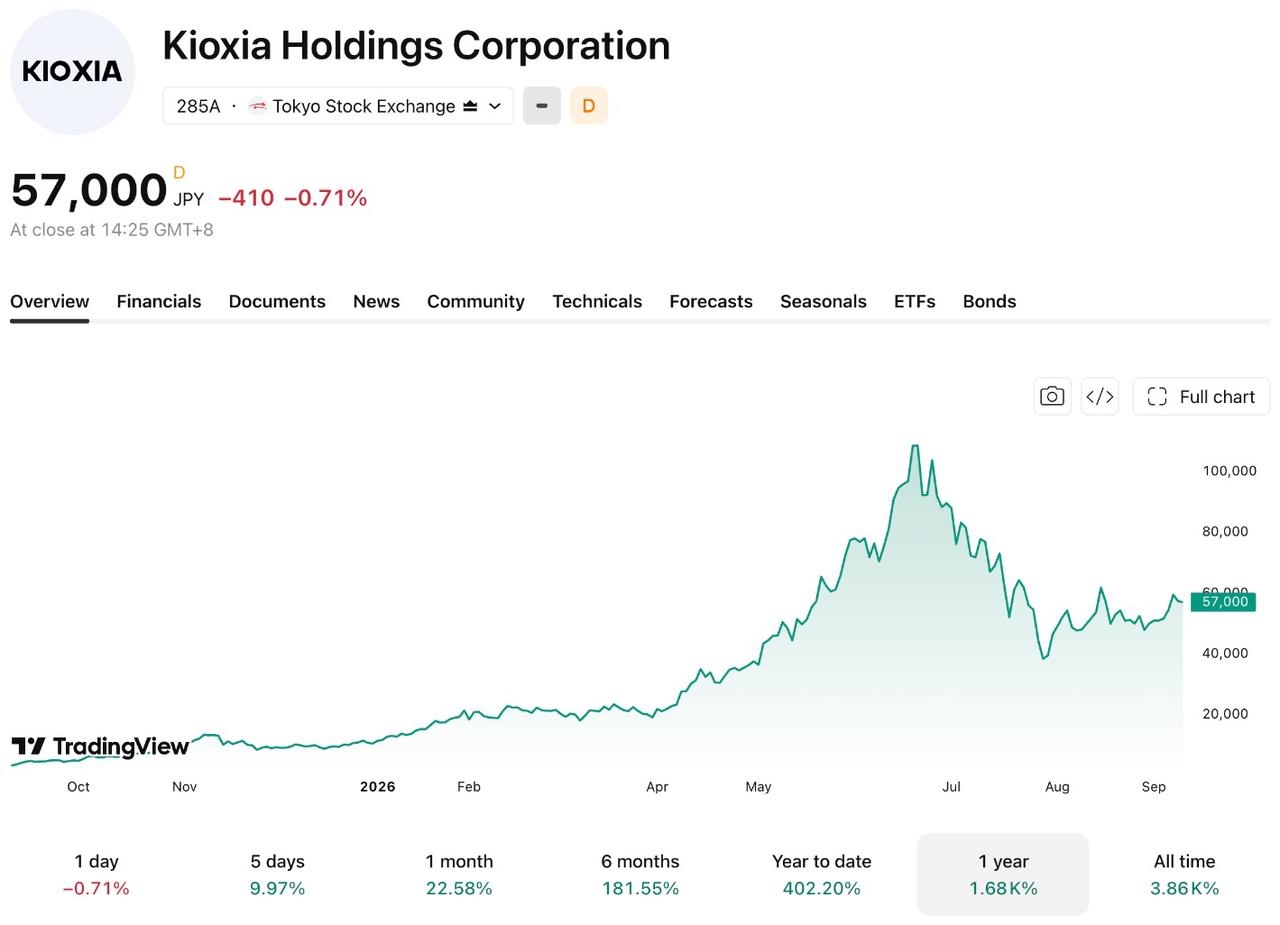
[Source: TradingView]
According to Bloomberg, analysts expect on average that Kioxia's operating profit will grow more than ninefold for the fiscal year ending March 2027. Meanwhile, Kioxia and SanDisk plan to invest approximately 5 trillion yen in Japan by 2032, focusing on infrastructure, equipment, and technology upgrades at the Yokkaichi and Kitakami plants, with the investment plan subject to receiving government support.
Hiroo Ota also stated that Kioxia will not pursue "market share simply for the sake of market share," but instead aims to provide technology that enterprise customers prioritize selecting.
Judging from Hiroo Ota's latest remarks, Kioxia currently seeks to maintain relatively high NAND prices while avoiding rapid price increases that could weaken data center customers' willingness for long-term AI investments.
This content was translated using AI and reviewed for clarity. It is for informational purposes only.
Recommended Articles










Comments (0)
Click the $ button, enter the symbol, and select to link a stock, ETF, or other ticker.