


WTI Crude Prices Capped at $100, Has the Rally Ended? How to Trade the Short Term?



AI Podcast


WTI crude oil exhibits volatility due to geopolitical risks and inventory data. While tensions and maritime safety concerns increase physical crude premiums, unexpected U.S. inventory builds exert downward pressure. An agreement to resume Iraqi exports via Ceyhan offers temporary relief. Technically, WTI is consolidating in a symmetrical triangle, with support at $90.00 and resistance at $95.00. A break above $95.00 could target $100.00 and potentially $115.00. Short-term traders should use strict stop-losses. Medium-term investors should monitor the risk of premiums diluting due to the absence of permanent supply bottlenecks.

TradingKey - Today (March 18), WTI crude oil continued to exhibit significant short-term volatility, driven by a tug-of-war between headlines and data. Intraday, prices retreated from Tuesday's high of $98.42 to a low of $91.45. The market appears to be oscillating between "panic premiums" and physical supply realities—a true reflection of the current environment, shaped by both geopolitical risks and the dampening effect of inventory data.
Fundamentals
From a fundamental perspective, several clues are worth noting. Tensions in the Gulf and concerns over maritime safety have pushed risk premiums for physical delivery higher. Certain Middle Eastern light crude grades are trading at significant premiums in the spot market. This divergence between the basis and futures reflects the market re-pricing uncertainties around transportation and delivery. A follow-up report by the Financial Times captured this as well, noting that spot premiums for some regional grades have hit record highs in the short term.
Meanwhile, the supply-demand picture is not one of one-way tightening. An unexpected signal from industry data showed a surprise build in U.S. crude inventories. According to market sources, weekly API data indicated an increase of approximately 6.6 million barrels, exerting downward pressure on prices in the short term. However, a decline in refined product inventories suggests that refinery utilization and demand for products have not fully weakened. This divergence makes determining the market direction more challenging.
One piece of positive news briefly suppressed the risk premium on prompt futures: an agreement was reached between Iraq and Kurdish authorities to resume exports via the Turkish port of Ceyhan. Once the port's operations are restored, some of the worst-case expectations for supply disruptions will be mitigated, providing temporary relief to the market.
Overall, the fundamental logic remains clear: geopolitical shocks are heightening tensions, but any news indicating supply recovery or an unexpected inventory build could quickly stifle short-term gains. Capital is rotating rapidly between headlines and actual flows. A common trading pattern has emerged: prices and volume surge on news, only to see prices retreat immediately if the news is debunked.
Technical Analysis
Source: TradingView
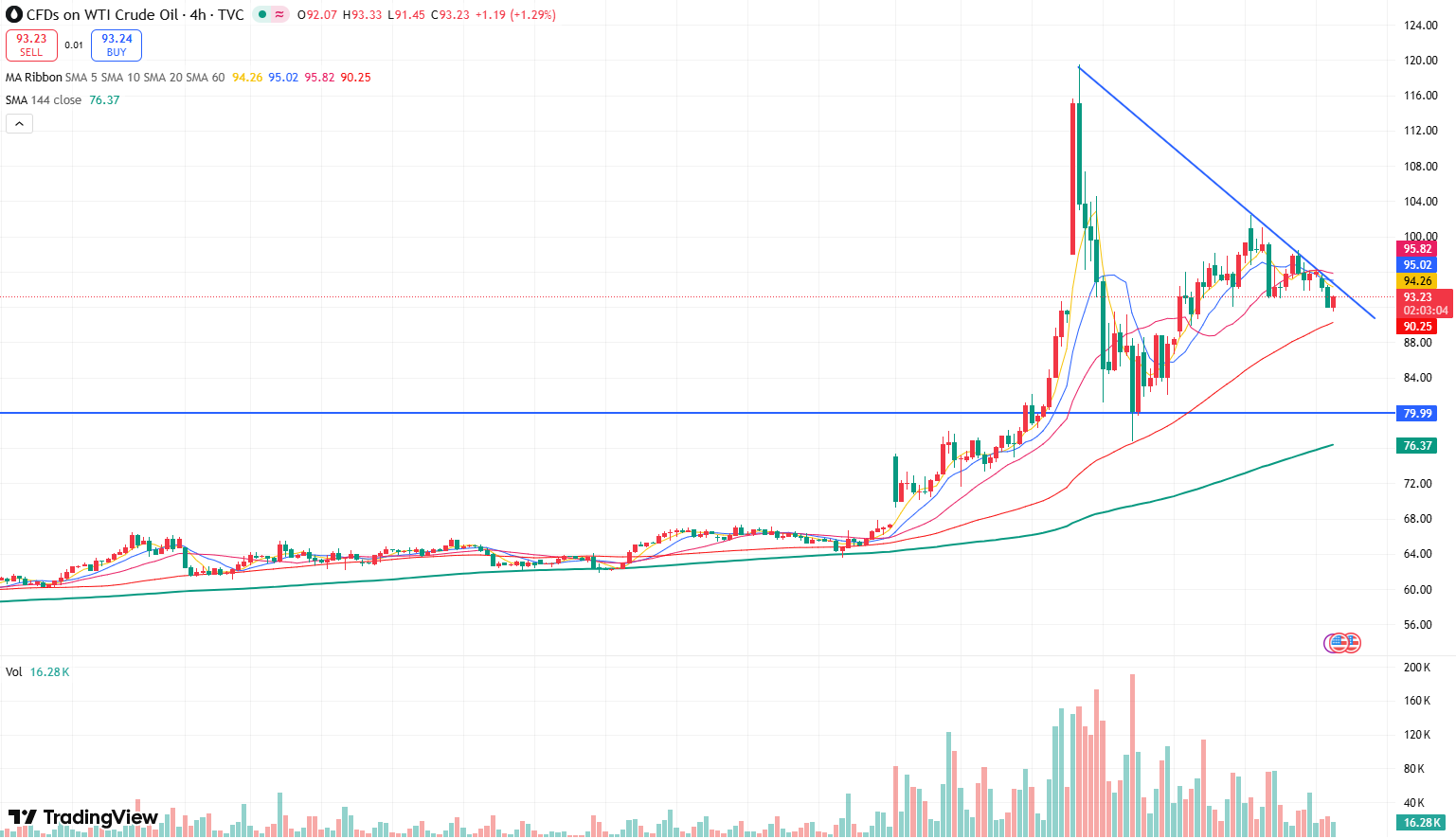
On the 4-hour chart, WTI(USOIL)'s short-term movement is poised to form a symmetrical triangle consolidation. As short-term highs have gradually lowered, they have formed a clear resistance line, forcing prices down to seek support. Short-term momentum indicators have retreated from overbought territory. Key support levels to watch include the 60-period SMA on the 4-hour chart near the $90.00 mark. If this level fails to hold, prices may further test the support zone between $80.00 and $76.70.
To the upside, watch the $95.00 resistance level. A breakout with high volume above this point would see prices retest the $100.00 psychological barrier. If it can sustain a position above $100.00, the path toward the $115.00 level would open up.
For short-term traders, the recommendation is to enter positions in batches with strict stop-losses. Medium-term investors should monitor whether the situation evolves into a permanent transportation bottleneck; otherwise, the risk of the "premium being diluted" remains very real.
Support Levels: 90.00, 80.00
Resistance Levels: 100.00, 115.00
Recommended Articles









Comments (0)
Click the $ button, enter the symbol, and select to link a stock, ETF, or other ticker.