


TradingKey 2025 Markets Recap & Outlook | Crude Oil Prices Collapse, Can Oil Prices Stage a Comeback in 2026?



AI Podcast


Crude oil prices experienced significant volatility in 2025, with WTI and Brent falling over 20% overall despite two surges driven by geopolitical events. Factors influencing this downturn included global economic weakness, unstable OPEC production, and U.S. energy policy. For 2026, the IEA and EIA forecast continued oversupply, while OPEC anticipates equilibrium. Investment banks largely predict soft prices, ranging from $56 to $67 per barrel, influenced by expected oversupply and potential economic slowdowns, though some see limited upside from production cuts and demand.

TradingKey - Similar to Bitcoin prices volatility, the crude oil market experienced a 'rollercoaster' performance twice in 2025, surging in January and June, respectively. However, crude oil prices are generally on a downward trend, having cumulatively plunged over 20% in the past year. Specifically, WTI crude oil (USOIL) fell 22.36%, while Brent crude oil (UKOIL) declined by 20.53%.
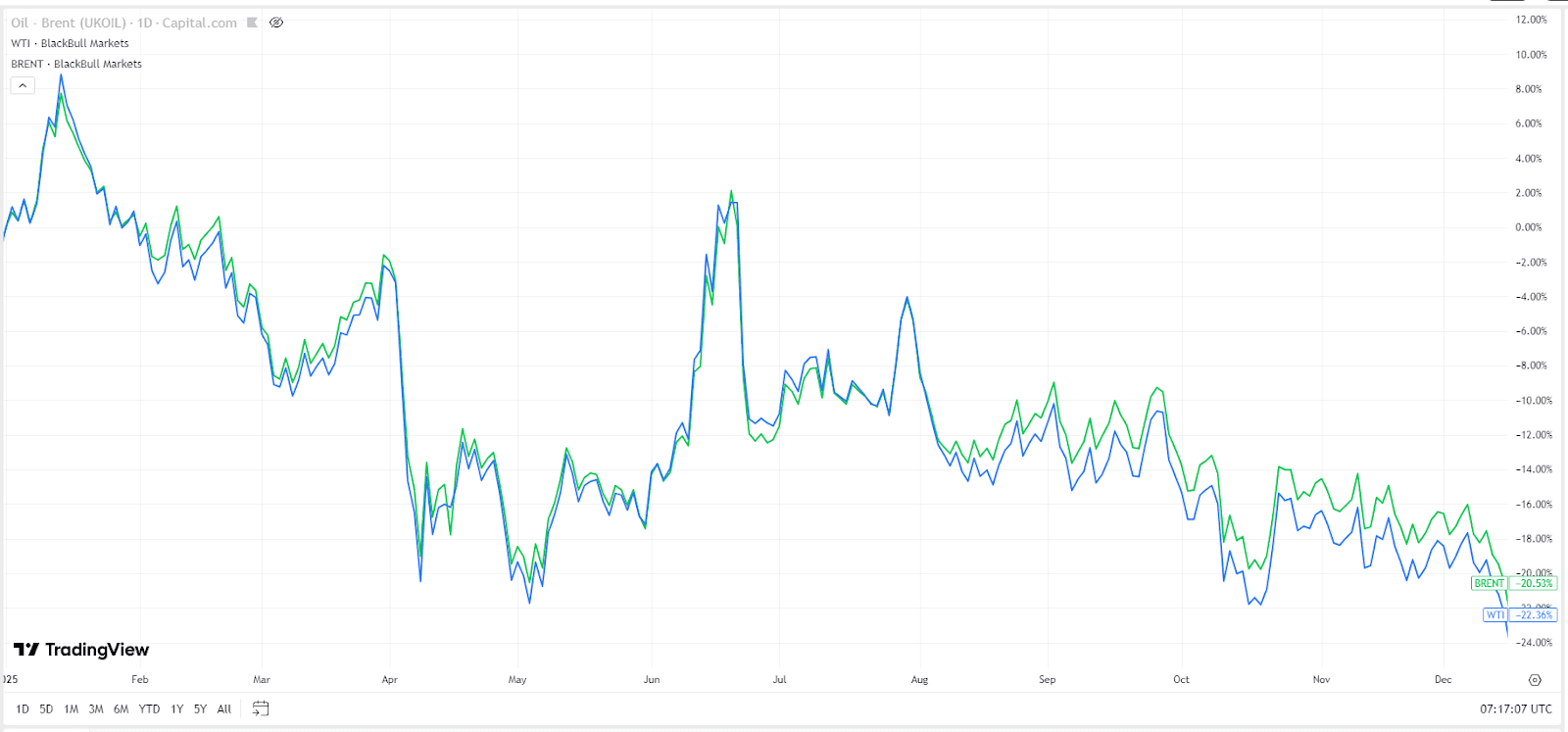 Brent Crude Oil, WTI Crude Oil Percentage Change, Source: TradingView.
The significant price volatility in crude oil during 2025 was primarily influenced by an imbalance between supply and demand, driven by multiple factors or events including global economic weakness, unstable OPEC production, U.S. energy policy, and geopolitical conflicts. As 2026 approaches, investors are anticipating a recovery in oil prices; however, how will crude oil supply and demand evolve? What is the institutional outlook for crude oil prices—will they continue to decline or rebound?
2025 Crude Oil Prices: Under Downward Pressure
In early 2025, crude oil prices surged over 10%, rising to year-to-date highs. Specifically, Brent crude rose to $83/barrel, while WTI crude increased to $79/barrel. Subsequently, oil prices continuously declined from their peak, experiencing a maximum drawdown of up to 20% and hitting a year-to-date low. On April 9, Brent crude fell to a low of $58, and WTI crude dropped to $54.
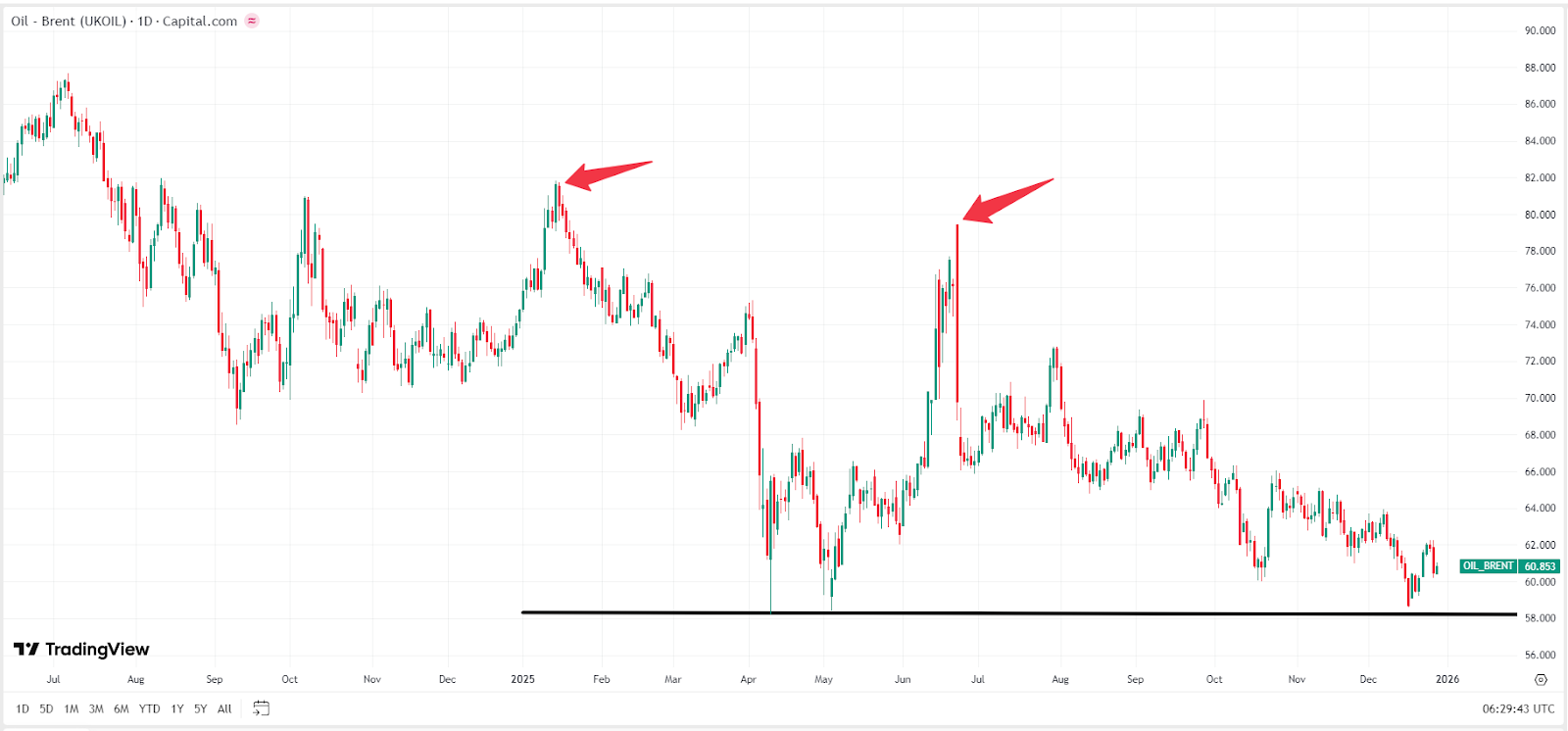 Brent Crude Price Chart, Source: TradingView.
On May 5, oil prices bottomed out for a second time and rebounded, then continued to rally. By June 23, oil prices had rebounded to near their year-to-date highs, with Brent crude approaching $80 and WTI crude prices rising to $76. However, crude oil prices could not sustain the rally, plummeting sharply on the same day. A significant bearish candlestick initiated a subsequent path of gradual declines. On December 16, crude oil prices tested a bottom for the third time but did not break below the low established in April.
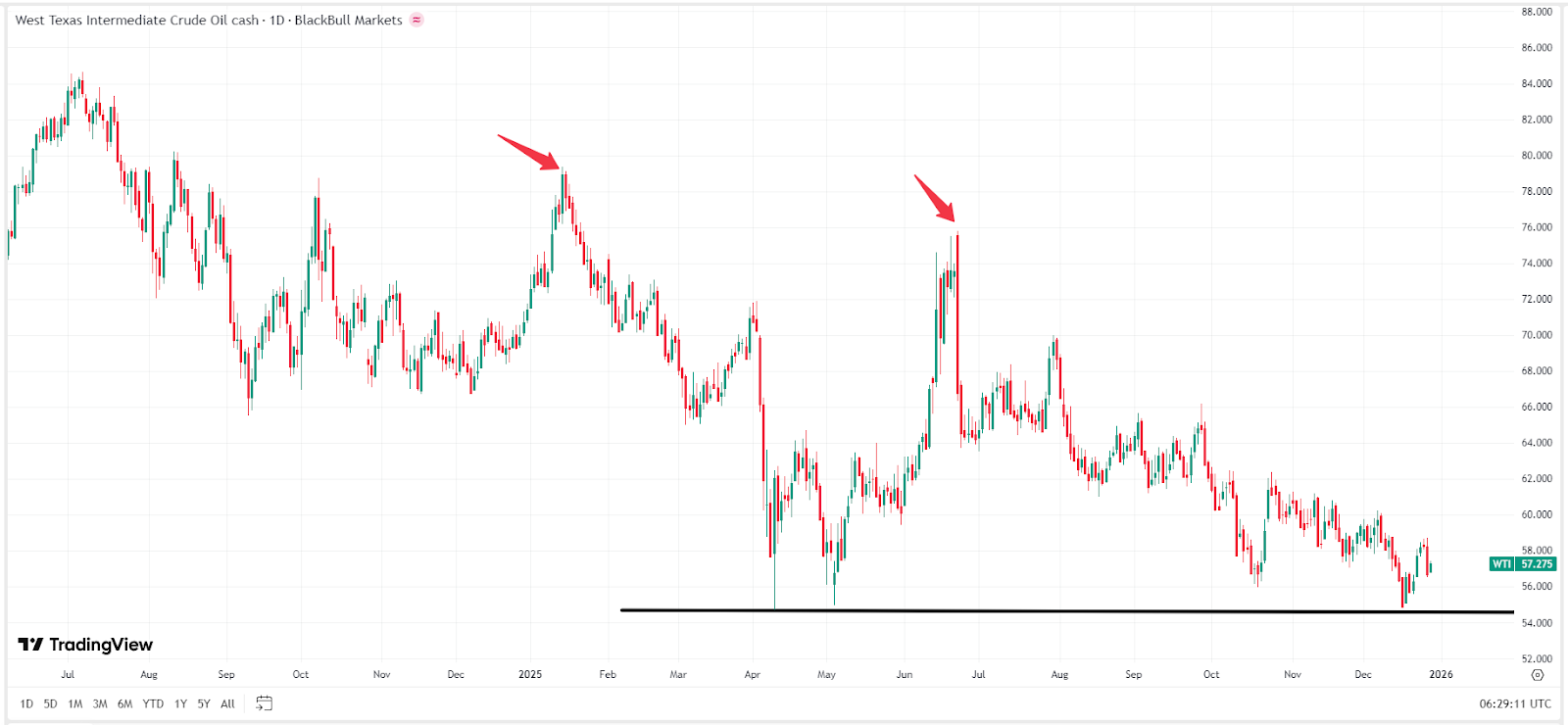 WTI Crude Price Chart, Source: TradingView.
It can be observed that crude oil price movements in 2025 exhibited a 'descending triangle' pattern, meaning that rebound highs were declining, with three probes to the downside that did not break through, reflecting localized strength from bulls; however, bears ultimately prevailed, dominating the market throughout the year.
What Factors Influence Crude Oil Prices?
Overall, A slowdown in global economic growth led to a significant decline in market demand for crude oil, causing prices to remain under sustained pressure due to diminished demand. This was precisely one of the primary reasons for the fall in oil prices in 2025. Although China, the world's second-largest economy, extensively stockpiled oil in the first half of 2025, purchasing millions of barrels of crude oil daily, demand in other major economies remained in a continuous state of contraction.
Concurrently, The global oil market experienced a surplus of 1.72 million barrels per day (bpd), with severe oversupply further suppressing oil prices. Starting in Q2 2025, OPEC+ initiated a phased and systematic production increase plan, escalating from initial increases to three-fold and then four-fold accelerations in output. Within two quarters, they completed the withdrawal of 2.2 million bpd in voluntary production cuts, leading to a substantial increase in crude oil supply. Furthermore, non-OPEC countries joined the production ramp-up, with five American nations including the United States, Canada, and Brazil boosting their combined output by as much as 2.3 million bpd throughout the year, further exacerbating the crude oil supply.
Despite the overall weakening of crude oil prices, there were two distinct periods of significant surges, primarily driven by geopolitical conflicts and sanctions imposed on Russia. In January 2025, prior to leaving office, the Biden administration imposed unprecedented sanctions on Russia, adding two key producers, Gazprom Neft and Surgutneftegas, along with over 20 of their subsidiaries and more than 180 vessels, to the sanctions list. This action instantly ignited market risk aversion, propelling oil prices to their 2025 annual high. In June 2025, a conflict between Iran and Israel disrupted navigation in the Strait of Hormuz, affecting 30% of global seaborne crude oil trade and driving oil prices back up to $80 per barrel, once again nearing the year's peak.
What Will the Crude Oil Supply and Demand Structure Be in 2026?
The International Energy Agency (IEA) slightly revised upward its forecast for global crude oil demand in 2026, adjusting it from 104.7 million barrels per day (mb/d) to 104.8 mb/d. This projection signifies a demand increase of 0.86 mb/d, driven by the gradual fading of trade tariffs and an improvement in macroeconomic conditions. On the supply side, the IEA projects that global crude oil supply will increase by 2.4 mb/d in 2026, significantly exceeding the growth in demand, indicating an oversupply.
Similarly, the U.S. Energy Information Administration (EIA) also anticipates that the crude oil market will remain in a state of supply exceeding demand. In its December 2025 report, the EIA forecasted that global oil supply in 2026 would average 107.43 mb/d, while average daily demand would be only 105.17 mb/d, resulting in a significant daily supply surplus of 2.26 mb/d.
From OPEC's perspective, for 2026, the crude oil supply and demand will largely achieve equilibrium. OPEC had previously projected in its report that global economic growth for the coming year would remain unchanged at 3.1%, believing that oil demand would remain resilient, and anticipated healthy growth in global oil demand for 2026, increasing by 1.4 mb/d, with total demand reaching 106.5 mb/d.
Investment Bank Forecast: Bearish on 2026 Oil Prices?
Given the backdrop of supply exceeding demand, Wall Street's major forecasts for 2026 crude oil prices lean towards continued weakness, although specific price targets vary. The average price is projected to remain between $50-$70 per barrel.
UBS believes that the supply contraction from low-cost shale oil producers and the sustained growth in petrochemical demand will drive a recovery in crude oil prices, forecasting that by the end of 2026, Brent crude will rise to $67/barrel, while WTI crude will increase to $64/barrel.
According to Barclays, geopolitical tensions could boost crude oil prices, but a slowdown in cyclical demand may pose downside risks. They anticipate Brent crude will hover around $65 per barrel on average in 2026.
Morgan Stanley identifies three key factors supporting crude oil prices: widespread market expectations of an oversupply, decreasing oil inventories, and OPEC+ production cuts. These factors are expected to keep Brent crude prices at $60/barrel .
JPMorgan is more conservative, predicting that oil prices will fall below the $60 mark in 2016, potentially dropping to $30 in 2027. Currently, JPMorgan forecasts an average Brent crude price of $58/barrel and WTI crude at $54/barrel for 2026.
Among all investment banks, Goldman Sachs holds the most pessimistic outlook, forecasting an average Brent crude price of $56/barrel and an average WTI crude price of $52/barrel in 2026. Goldman Sachs identifies two primary drivers for weak crude oil prices in 2026: a global economic slowdown and increased OPEC+ supply.
Investment Bank | Brent Crude Price ($/barrel) | WTI Crude Price ($/barrel) |
UBS | 67 | 64 |
Barclays | 65 | - |
Morgan Stanley | 60 | - |
JPMorgan | 58 | 54 |
Goldman Sachs | 56 | 52 |
Conclusion
The crude oil market experienced severe turbulence in 2025, trending downwards overall after two peaks during the year, with WTI and Brent both falling over 20%. These sharp fluctuations in crude oil prices were primarily event-driven, propelled by factors such as soft demand, oversupply, and the interplay of geopolitical developments. Looking ahead to 2026, both the IEA and EIA anticipate that supply growth will exceed demand, suggesting the market may remain under pressure, whereas OPEC expects a move towards equilibrium. According to major Wall Street investment banks, crude oil prices are projected to remain soft, fluctuating between $56 and $67 per barrel.
This content was translated using AI and reviewed for clarity. It is for informational purposes only.
Recommended Articles









Comments (0)
Click the $ button, enter the symbol, and select to link a stock, ETF, or other ticker.