


Gold Price Set to Return to $4,100: Gold Bull Market Not Over Yet, Trend Inflection Point May Be Gradually Approaching.



AI Podcast


Gold has faced downward pressure, breaking below $4,000 as a hawkish Fed pivot shifts focus toward real interest rates and rising opportunity costs, prompting major banks to lower price targets. Despite recent ETF outflows and reduced geopolitical premiums, the metal shows resilience, rebounding toward $4,100. Analysts suggest the pullback is a temporary correction rather than a trend reversal. With cooling US labor markets and potential rate cuts on the horizon, gold remains a critical hedge. As liquidity pressures peak, a policy shift could catalyze a recovery, supported by gold’s enduring role in risk diversification against broader asset volatility.

TradingKey - Under the hawkish pivot of the Federal Reserve's new Chair, Kevin Warsh, the trading dynamics of gold have undergone a consequential shift, leading multiple major Wall Street investment banks to collectively lower their gold price forecasts. Spot gold recently broke below the $4,000 threshold, touching a low of $3,959.49.
Among them, Goldman Sachs lowered its year-end gold price target to $4,900, while Deutsche Bank estimated that under an extreme scenario, gold prices could drop to as low as $3,800.
Deutsche Bank noted that since mid-May, the correlation between gold price movements and Fed rate hike expectations has significantly deepened, while the linkage between gold and energy prices, which had persisted since the Middle East conflict, has visibly weakened. This means gold is shedding some of its geopolitical and energy inflation premiums, returning to the core framework of pricing based on real interest rates.
The institution further pointed out that under the Fed's hawkish stance, the opportunity cost of holding gold has risen significantly, and this impact will be primarily reflected through ETF outflows. Since ETF flows are highly sensitive to changes in interest rate expectations, real yields, and the US dollar's trajectory, rising Treasury yields are forcing some marginal capital to exit the gold market.
However, shortly after hitting a recent low, spot gold regained its upward momentum, rising over 1.49% to $4,086 and briefly testing the $4,100 threshold intraday.
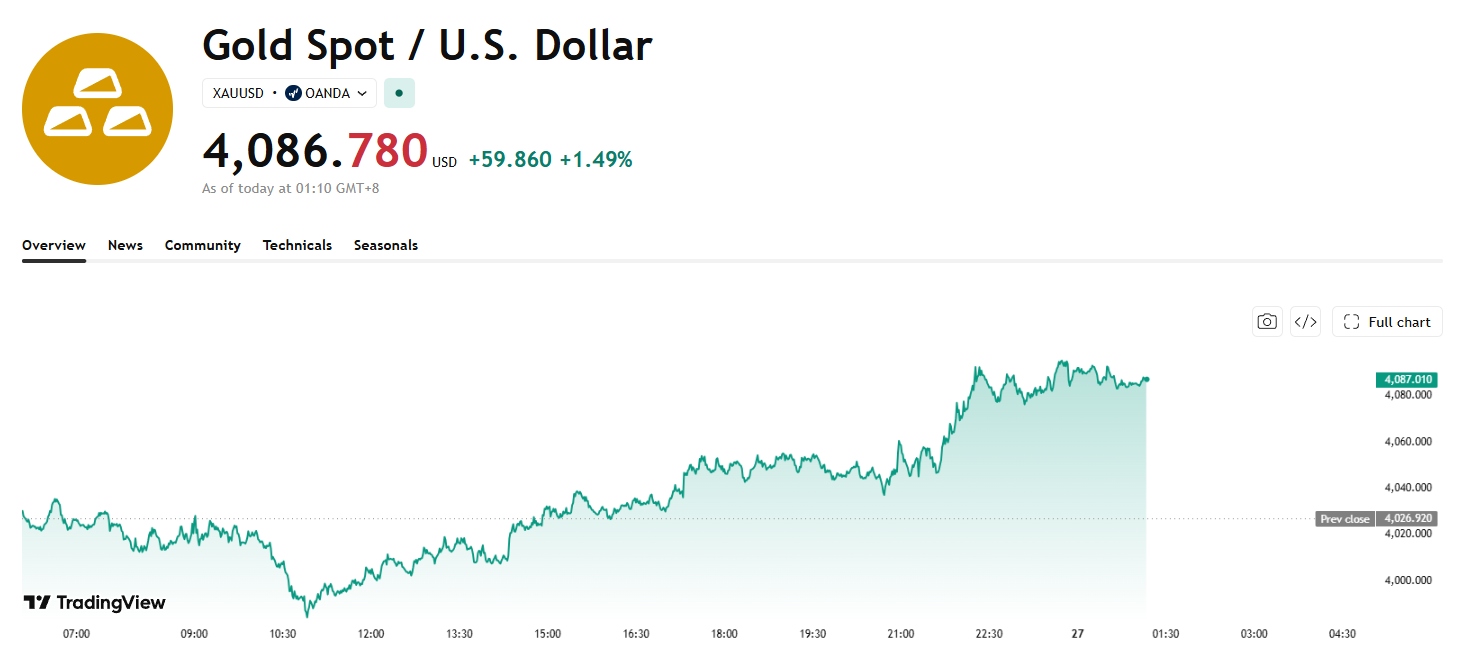
[Source: TradingView]
Market analysis suggests that the pullback in gold prices is a normal phenomenon, and the current gold bull market has not yet come to an end.
CICC stated that US inflation is highly likely to peak this summer and the labor market is cooling. Warsh's reforms leave room for future Fed policy to ease, and Fed policy will not pivot entirely toward tightening.
As geopolitical and inflationary pressures gradually ease in the second half of the year, the probability of a Fed rate hike remains very low. Conversely, the timing and pace of rate cuts may exceed market expectations, driving a return to loose USD liquidity and providing fresh support for assets like gold and equities.
In June, the upward shift in global baseline inflation, coupled with multiple central banks advancing their rate-hiking cycles, marked a temporary peak in global liquidity pressure, making the accelerated correction in gold prices reasonable. Moving into July and August, as US inflation and economic growth data pull back marginally, if Warsh delivers new policy guidance, the Fed's tightening narrative could pivot rapidly, and a trend reversal in the gold market may be gradually approaching. Furthermore, as a potential hedge against an AI asset bubble, gold can effectively play its asset allocation role for risk diversification.
This content was translated using AI and reviewed for clarity. It is for informational purposes only.
Recommended Articles










Comments (0)
Click the $ button, enter the symbol, and select to link a stock, ETF, or other ticker.