


OpenAI IPO Delay Sends SoftBank Shares Plunging Over 12%, Masayoshi Son Prepares Roze for $100 Billion IPO



SoftBank Group shares fell 12.53% on June 26 following reports that OpenAI postponed its IPO to 2027 due to widening financial deficits and market skepticism. As OpenAI’s second-largest external shareholder, SoftBank faces significant cash flow pressure and stalled collateralized loan negotiations. Despite this, SoftBank continues pushing its "Roze" AI and robotics venture, targeting a $100 billion valuation. CEO Masayoshi Son remains committed to his trillion-dollar AI thesis, yet the reliance on high-valuation exits for these capital-intensive bets creates substantial financial risk, testing the sustainability of his broader AI empire amid cooling market sentiment.
TradingKey - During Asian trading hours on June 26, SoftBank Group's share price plummeted by more than 14% intraday, closing at 6,226 yen, down over 12%, wiping out nearly 5.6 trillion yen in market value in a single day. The drop was attributed to reports that OpenAI, in which SoftBank has a heavy $65 billion stake, has postponed its IPO while its financial deficit continues to widen. Just recently, SoftBank CEO Masayoshi Son asserted in an exclusive interview with CNBC: 'The next golden track to spawn a trillion-dollar market cap company will be Physical AI and humanoid robotics.'
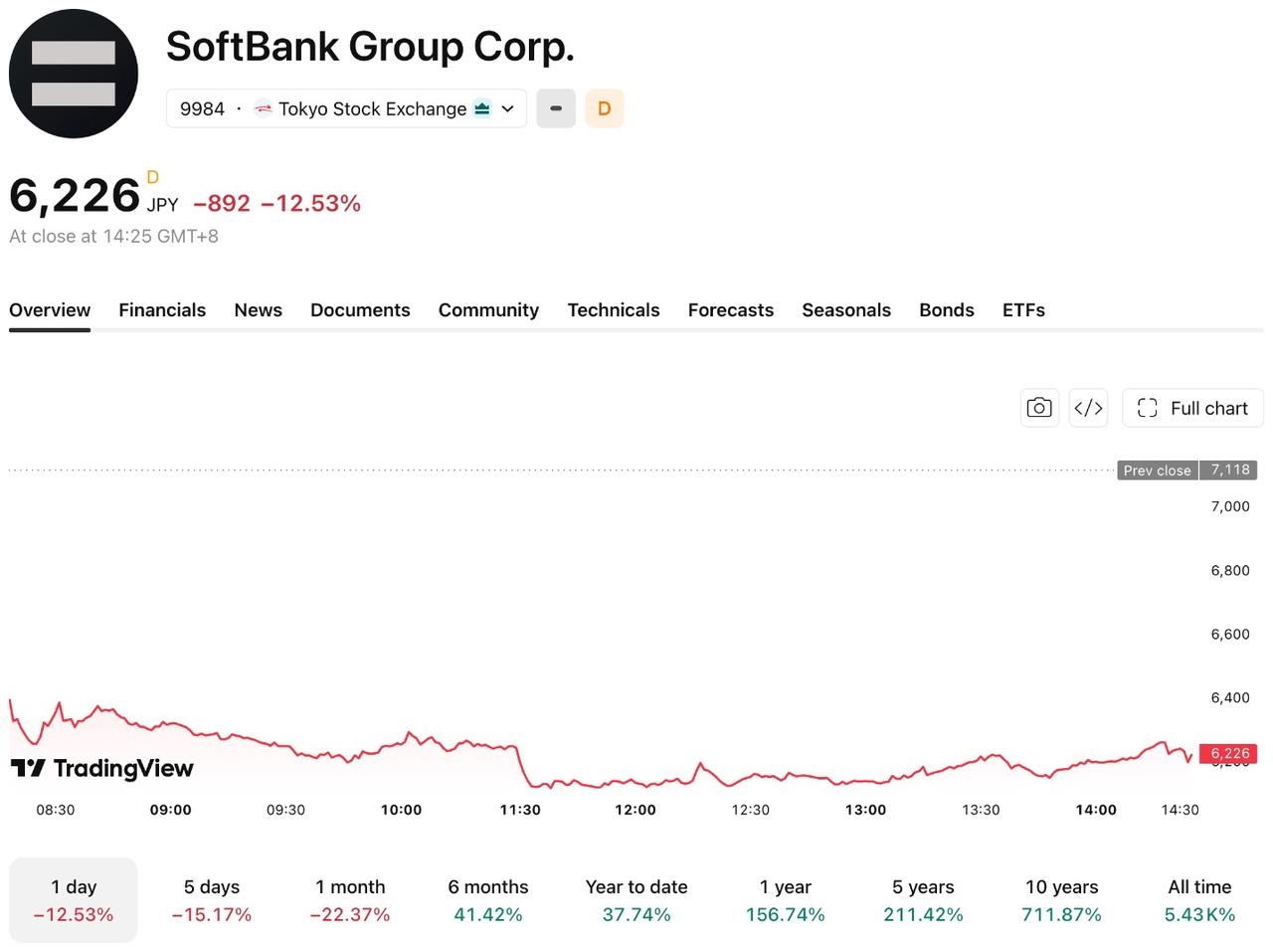
[Source: TradingView]
Roze Sprints Toward 100-Billion-Yuan IPO
According to a Financial Times report on April 30, SoftBank is establishing an AI and robotics company named Roze in the U.S., planning to consolidate some of its AI and robotics assets, with a listing expected as early as the second half of 2026 at a target valuation of $100 billion. SoftBank will host an analyst day in Texas this July, has hired KPMG to prepare financial statements, and Arm's ( ARM) Vice President of Finance serving as interim Chief Financial Officer.
The establishment of Roze is not a simple business spinoff, but rather SoftBank's deep integration of its physical AI infrastructure, "packaging" its fragmented investments in AI hardware, energy supply, and automation in recent years to build a complete closed-loop AI ecosystem.
SoftBank has invested tens of billions of dollars over the past year, including completing an equity investment of over $41 billion in OpenAI, as well as acquiring ABB's robotics business. If Roze successfully goes public, it will become the second key piece of Masayoshi Son's AI empire.
OpenAI IPO Hits Roadblocks: A "Speed Bump" for Its Trillion-Dollar Valuation Dream
However, before Roze has even embarked, the OpenAI flagship has already run into rough seas.
According to The New York Times, three people familiar with the discussions surrounding OpenAI's listing preparations revealed that OpenAI is leaning toward postponing its IPO to 2027. The company had previously hired investment banks and law firms, planning to go public as early as the third or fourth quarter of this year, and confidentially filed an S-1 prospectus with the SEC this month, though it did not commit to any timeline.
The core reason for the postponement is the cautionary tale of SpaceX's stock performance post-listing: priced at $135 per share on June 12, its closing valuation reached as high as $2.1 trillion on its first trading day, with the stock price later climbing near a peak of $225 before embarking on a downward trend, falling to $153 by June 26. Additionally, recent volatility in global stock markets has intensified, and investor skepticism over whether AI capital expenditures will pay off is on the rise.
OpenAI's advisory team presented management with two options: either wait until 2027 to go public at a $1 trillion valuation, or lower the target valuation to accelerate the process. CEO Sam Altman made it clear that any proposal below a trillion-dollar valuation is unacceptable. The advisory team also warned that retail investors are highly unlikely to show much enthusiasm for OpenAI's stock.
Even more troublesome are the financial fundamentals. According to The Information, OpenAI's prospectus shows a net loss of approximately $8.5 billion as of the first quarter of 2026, which does not yet include non-cash accounting expenses for warrants, while its cost of revenue reached $3.5 billion. Other reports indicate that OpenAI's 2025 revenue was $13.07 billion, with a net loss of $38.53 billion.
OpenAI Delays IPO: Why Did SoftBank Plunge?
SoftBank has invested a cumulative total of approximately $65 billion in OpenAI, holding about a 13% stake, second only to Microsoft's 27% among external shareholders. In March 2026, SoftBank co-led OpenAI's $122 billion funding round. The market had previously widely expected that OpenAI's IPO would bring substantial financial returns to SoftBank.
The delay of OpenAI's IPO means an extended monetization cycle. SoftBank had previously sought a margin loan of at least $6 billion backed by its OpenAI equity, but negotiations have stalled. If OpenAI's listing is delayed until 2027, SoftBank's liquidity pressure during this interim period will become even more severe.
Market reaction was intense. SoftBank Group's share price plummeted on the day, with intraday losses once exceeding 14% before ultimately closing down 12.53%. SoftBank's sharp decline weighed on overall sentiment for Asian tech stocks, serving as one of the primary heavyweight factors dragging down the Nikkei 225 index that day.
Just two days prior at the annual general meeting, Masayoshi Son refuted the AI bubble narrative, stating that artificial intelligence is still in its early stages and that any talk of a bubble is an "insult to AI." He also revealed that he intends to lead the company into his 70s, dedicating himself to developing "artificial superintelligence," which he defined as being 10,000 times smarter than humans.
Where is Masayoshi Son's AI empire headed?
Masayoshi Son is facing an unprecedented dilemma. Roze's $100 billion IPO requires market enthusiasm for AI to support its valuation, while OpenAI's massive losses and delayed public debut are doing exactly the opposite—dampening this enthusiasm. The worse OpenAI performs, the weaker market confidence in the AI sector becomes, making Roze's IPO increasingly difficult. Conversely, if Roze successfully lists, it could open new financing channels for SoftBank and alleviate the financial strain brought on by its OpenAI investment.
SoftBank is not without internal skepticism. Bloomberg previously cited people familiar with the matter as saying that during the early stages of SoftBank's aggressive push into OpenAI, an internal executive asked Masayoshi Son: What happens to SoftBank if OpenAI ultimately fails? Son did not answer directly. The Financial Times also reported, citing senior SoftBank sources, that Son's dealings with Sam Altman and OpenAI have unnerved some within the company and left the group's balance sheet stretched.
The sheer scale of Masayoshi Son's bets is staggering. He previously sold portions of his stakes in Nvidia and T-Mobile US, and secured loans backed by Arm shares to continue doubling down on OpenAI. The 68-year-old Son clearly has no intention of slowing down; with the OpenAI chess game still undecided, he is already pushing his chips toward physical AI and humanoid robotics.
Will Roze be able to list in the U.S. in the second half of this year at a $100 billion valuation as scheduled? Can OpenAI complete an IPO at a $1 trillion valuation by 2027? The answers to these two questions will determine whether Masayoshi Son achieves a second legendary milestone in his career or repeats the debacle of WeWork.
This content was translated using AI and reviewed for clarity. It is for informational purposes only.
Recommended Articles







Comments (0)
Click the $ button, enter the symbol, and select to link a stock, ETF, or other ticker.