


Gold Slumps $800 Over 4 Consecutive Days: Safe-Haven Demand Remains, Why Are Gold Prices Still Falling?



AI Podcast


Gold is experiencing a deep correction, driven by a strong US dollar and rising Treasury yields, despite geopolitical risks. Prices have fallen significantly, with a weekly decline of 10.44% and a daily drop exceeding 4% on March 23, hitting a low of $4,319.53. Higher yields increase the opportunity cost of holding non-yielding gold, while delayed Fed rate cut expectations reduce support. Geopolitical tensions have paradoxically failed to bolster gold prices. Technically, gold has broken below $4,400 and the 144-day moving average, indicating a bearish sentiment. Support is eyed at $4,270, with potential further declines to $4,000 and $3,900 if breached.

TradingKey - Gold continued its weak correction today, as the market remains under pressure from the combined squeeze of geopolitical risks, a strengthening US dollar, and rising Treasury yields. While the market does not lack safe-haven sentiment, capital is clearly more inclined to avoid the pressure brought by a high-interest-rate environment for now, leaving short-term gold price action appearing weak.
According to TradingView, as of press time, gold prices hit a daily low of $4,277.69 today (March 23), with a maximum single-day drop exceeding 4%. Looking further back, gold fell by more than $500 last week, marking a weekly decline of 10.44%—its worst weekly performance in over 14 years. In other words, gold's current momentum is no longer "high-level consolidation" but has entered a deeper correction following its previous surge.
Fundamentals
From a fundamental perspective, the US dollar and Treasury yields remain the primary factors weighing on gold. The US Dollar Index rose near 99.80 today as capital continued to concentrate in safe-haven assets like the dollar; meanwhile, US Treasury yields are also trending upward, having reached an eight-month high. This environment is unfavorable for gold because it is a non-yielding asset—the higher the yield, the greater the opportunity cost of holding gold. Compounding the issue, market expectations for rate cuts are being pushed back; with the Federal Reserve maintaining rates and providing minimal hints of easing, the support line that gold relies on most has effectively been shifted further out.
Notably, geopolitical risks have not disappeared, but their support for gold prices has not been as strong as imagined . Conventionally, an escalation in Middle East tensions should make it easier for gold to strengthen, but the market reaction this time has been somewhat anomalous. Recent conflicts involving the US, Israel, and Iran continue to simmer, with security risks in the Strait of Hormuz, damage to energy infrastructure, and surging oil prices all driving inflation concerns. The problem is that as inflation rises, the market instead amplifies the logic that "the Fed will maintain high interest rates for longer." Consequently, gold is caught in a subtle state: safe-haven buying does exist, but while it is supported by war risks on one side, it is dragged down by interest rates and the dollar on the other. In recent market trading, the latter has clearly gained the upper hand over the past few days.
Technicals
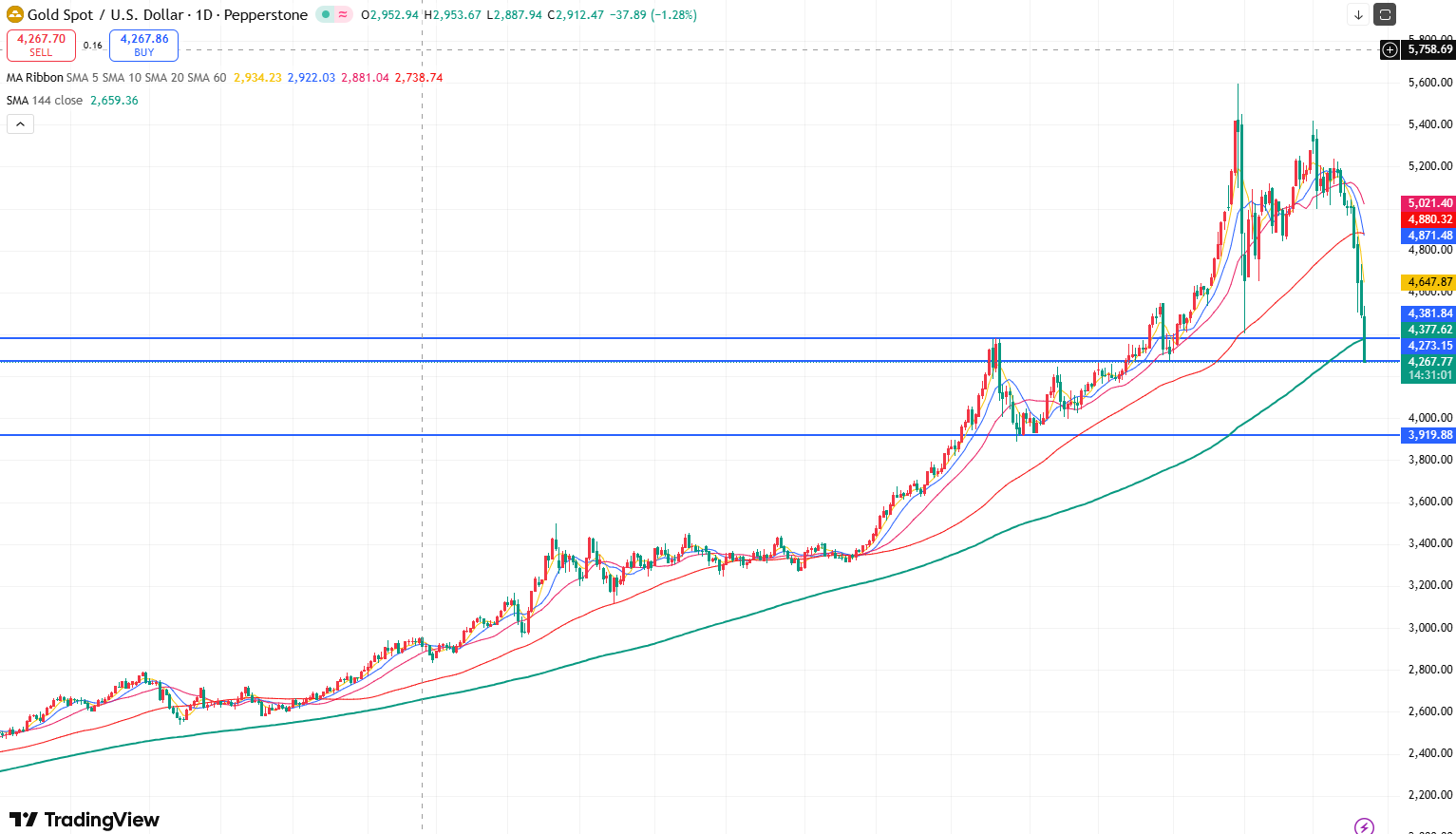
From a technical perspective, gold's current structure is bearish, characterized by a "weak rebound after a breakdown."
Source: TradingView
Gold's daily chart shows that prices have currently broken below the $4,400 mark and the 144-day moving average. Despite some intraday recovery and attempts to reclaim the $4,400 level, the lack of bullish strength indicates that market sentiment remains skewed to the downside.
Attention now needs to be paid to whether today's closing price can hold above $4,380. This level is a support point formed by previous highs and coincides with the 144-day moving average, creating a confluence of support.
If today's closing price is above $4,380, it means the $4,380 level still provides strong support, and the intraday breach can be viewed as a market shakeout. Conversely, if today's close is below $4,380, gold's recent consolidation range will be broken to the downside, further opening up room for a decline.
At present, gold continues to move lower to test the 4,270 support level. If this level is breached, gold will move to test the $4,000 mark and may even drop below that to explore $3,900.
For short-term trading, it is recommended to use the 4,270 level as a defensive line for long positions, buying on dips and stopping loss if it breaks below that point. Regarding short positions, chasing the decline is not advised; as the current drop is quite deep and the Relative Strength Index (RSI) shows the asset has entered oversold territory, the likelihood of a technical corrective rebound is increasing, making the risk of shorting too high.
Support Levels: 4270, 4000, 3920
Resistance Levels: 4400, 4660, 4840
Recommended Articles







Comments (0)
Click the $ button, enter the symbol, and select to link a stock, ETF, or other ticker.