


Gold: Bullish Trend to Continue, with Caution on Short-Term Overheating Risks



AI Podcast


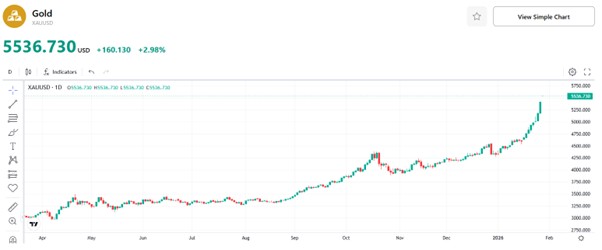
On January 29, 2026, the international gold price reached a record high above $5,500 per ounce. Central bank purchases are a primary driver, optimizing reserves and hedging geopolitical risks. The price rally is shifting from an "interest rate anchor" to a "credit anchor," reflecting market revaluation of the global monetary system and US fiscal credit due to rising deficits. In the short term, accommodative policies and risk appetite will likely sustain the upward trend, though US economic overheating in H1 2026 poses a bearish risk. Long-term upside potential remains substantial, contingent on shifts in Federal Reserve policy and US economic fundamentals.

On January 29, 2026, the international gold price hit a new all-time high, breaking through the $5,500 per ounce mark. Theoretically, gold is inherently different from ordinary investment products, boasting three core attributes: commodity, financial asset and investment instrument. Its price movement is not merely driven by supply and demand fundamentals; multiple factors including monetary policy orientation, demand for risk hedging and the need for inflation protection all exert a significant impact.
From the demand perspective, the current rally in gold prices stands in stark contrast to historical upward cycles, with central banks around the world ramping up gold purchases emerging as one of the core driving forces. The move by central banks of many countries to increase their gold holdings is not only an effort to optimize the structure of foreign exchange reserve assets and preserve and enhance the value of reserve assets, but also a crucial measure taken based on long-term strategic considerations to hedge against geopolitical risks.
Figure: Gold Price (USD/oz)
Source: TradingKey
Specifically, the core driving logic of the current gold bull market has shifted from the traditional "interest rate anchor" to a "credit anchor". Classic gold price analysis frameworks mostly take real interest rates and the US Dollar Index as the core research and judgment dimensions, yet in the current rally, the traditional negative correlation between gold prices, real interest rates and the US Dollar Index has weakened significantly—a characteristic that signals a fundamental shift in the driving logic of gold prices.
The current "credit anchor" is centrally reflected in the market's comprehensive revaluation of the global monetary and fiscal credit system, with the market re-examining the US dollar-centric global monetary system and the sustainability of fiscal conditions in major economies. The prevailing situation of soaring US fiscal deficits and a continuously expanding debt scale has sparked widespread market concerns over the long-term purchasing power of the US dollar and US fiscal credit. As an ultimate store of value that is decoupled from sovereign credit, gold’s core attribute of "credit hedging" is experiencing a market repricing and value enhancement.
Looking ahead, in the short term, our baseline scenario for gold prices is a continuation of the upward trend, driven primarily by market expectations of accommodative policies and shifts in risk appetite. The Federal Reserve is highly likely to sustain its interest rate cut cycle this year, a move that will provide liquidity support for the upside in gold prices. Meanwhile, a rise in geopolitical risks or heightened volatility in financial markets could trigger a renewed surge in safe-haven demand for gold.
That said, caution is warranted as the US economy faces a latent risk of "phased overheating" in the first half of 2026, which stands as the core bearish factor for gold prices. This risk stems primarily from the compensatory economic effects following the government shutdown, statistical biases in key economic data such as early-year employment figures, and the implementation of potential policy stimulus—all of which may drive a phased concurrent rise in economic growth and inflation metrics. Should this scenario materialize, market expectations for a slower pace of Fed rate cuts will intensify. Coupled with gold’s current valuation at a historical high, the market will most likely see a notable wave of profit-taking, which in turn could trigger a technical correction in gold prices.
From a long-term perspective, gold prices still have substantial upside potential. A key question dominating current market focus is when the ongoing gold bull market will draw to a close. Drawing on the patterns of historical price movements, two core signals serve as definitive indicators for the end of a bull market: first, a substantive shift in the Federal Reserve’s monetary policy to a tightening cycle, with a complete exit from the current accommodative monetary policy framework; second, the emergence of a pivotal inflection point marking a broad-based improvement in US economic fundamentals, with a clear entry into a phase of robust growth driven by economic recovery or reflation.
Until the aforementioned two fundamental reversal signals materialize, factors such as issues stemming from the expansion of US debt and phased adjustments to the pace of gold purchases by global central banks will only exert a marginal impact on gold prices at the level of equilibrium pricing, and will not be sufficient to drive a shift in the bull-bear cycle of the gold market. In summary, the underlying logic and fundamentals supporting the long-term uptrend of gold assets remain solid for the time being.
Recommended Articles






Comments (0)
Click the $ button, enter the symbol, and select to link a stock, ETF, or other ticker.