How Long-Term Investors Should Think About Market Volatility Right Now



Key Points
The market has been up and down in response to crude oil price movements.
Selling when the market is down leads to losses when a rebound could be just around the corner.
Long-term investors should welcome price fluctuations because they let you buy stocks at lower prices.
After sinking earlier this year, the S&P 500 (SNPINDEX: ^GSPC) has made a major rebound to make up its losses and reach a new high. As of this writing, the index is up 4% year to date.
The market typically moves along with important global news that may or may not directly impact how companies will perform. In this instance, market volatility has been closely tied to the price of oil. While there have been loads of efforts to expand the general use of natural energy, oil remains the dominant source of energy. Increasing oil prices can trickle down to increasing prices everywhere. Although crude oil prices have receded to less than $90, from a high of $113, they remain above pre-Iran war levels, meaning market highs are quite optimistic.
Will AI create the world's first trillionaire? Our team just released a report on the one little-known company, called an "Indispensable Monopoly" providing the critical technology Nvidia and Intel both need. Continue »
There's a chance the market could dive further if the situation with Iran doesn't fully resolve. But that's par for the course in the markets, and long-term investors should get comfortable with market volatility.

Image source: Getty Images.
Volatility is part of the process
It can be scary to see your investments fall when there's a market dip, correction, or crash. But investors who sold in the initial Iran war panic realized their losses when a rebound was only a few weeks away. There will always be market cycles, and successful investing requires sticking it out.
Consider the 2022 market correction. The S&P 500 lost 19% of its value, and both Nvidia and Amazon lost 50% of their value. In general, high-growth tech stocks will fall harder than the broader index -- the Nasdaq-100 lost 32% that year.
However, investors who sold have missed out on incredible gains over the past three years.
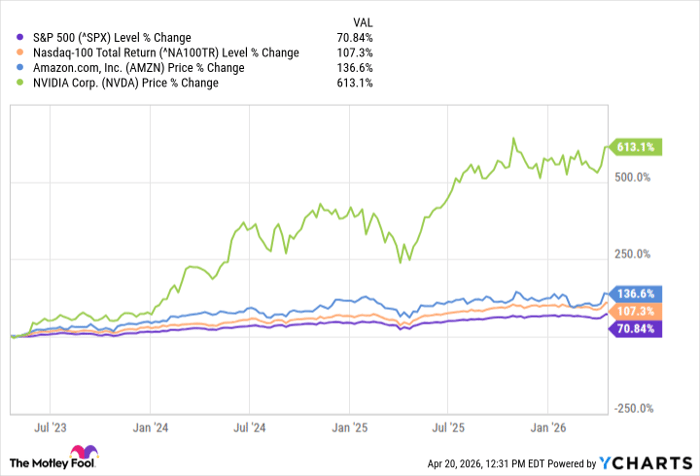
Over time, letting your investments compound can lead to significant wealth creation. Successful investors view market volatility as a chance for the market to reset and to find opportunities to buy excellent stocks at bargain prices.
This is how Warren Buffett once explained Berkshire Hathaway's approach. "The best thing that can happen from Berkshire's standpoint," he said during the company's 1994 annual meeting, "is that over time is to have markets that go down a tremendous amount." He added: "We buy pieces of businesses: stocks. And we're going to be much better off if we can buy those things at an attractive price than if we can't. So we don't have any fear at all."
Long-term investors, those who plan to buy and hold over a long period, should welcome market volatility and use it to their advantage.
Should you buy stock in S&P 500 Index right now?
Before you buy stock in S&P 500 Index, consider this:
The Motley Fool Stock Advisor analyst team just identified what they believe are the 10 best stocks for investors to buy now… and S&P 500 Index wasn’t one of them. The 10 stocks that made the cut could produce monster returns in the coming years.
Consider when Netflix made this list on December 17, 2004... if you invested $1,000 at the time of our recommendation, you’d have $500,572!* Or when Nvidia made this list on April 15, 2005... if you invested $1,000 at the time of our recommendation, you’d have $1,223,900!*
Now, it’s worth noting Stock Advisor’s total average return is 967% — a market-crushing outperformance compared to 199% for the S&P 500. Don't miss the latest top 10 list, available with Stock Advisor, and join an investing community built by individual investors for individual investors.
*Stock Advisor returns as of April 25, 2026.
Jennifer Saibil has no position in any of the stocks mentioned. The Motley Fool has positions in and recommends Amazon, Berkshire Hathaway, and Nvidia. The Motley Fool has a disclosure policy.
Recommended Articles