VanEck Rare Earth and Strategic Metals ETF Is Focused on a Hot Sector, Which is Good and Bad

Key Points
Rare-earth metals are vital to modern technology and, thus, vital for the world.
VanEck Rare Earth and Strategic Metals ETF provides a diversified portfolio of rare-earth stocks with one investment.
Idiosyncratic risk is, basically, the risk associated with picking just one stock. There's no way to know exactly what could go wrong with one business. Which is why exchange-traded funds (ETFs) like VanEck Rare Earth and Strategic Metals ETF (NYSEMKT: REMX) exist.
Diversified ETFs let you buy a portfolio of stocks so you don't have to worry about the risk of owning just one company. But highly focused ETFs like VanEck Rare Earth and Strategic Metals ETF don't avoid all of the problems you may face. Here's why this rare-earth focused ETF is good and why many investors may still be better off avoiding it.
Will AI create the world's first trillionaire? Our team just released a report on the one little-known company, called an "Indispensable Monopoly" providing the critical technology Nvidia and Intel both need. Continue »
What does VanEck Rare Earth and Strategic Metals ETF do?
Without getting too deep into the details, VanEck Rare Earth and Strategic Metals ETF owns a collection of companies that produce rare-earth metals, just like its name implies. The portfolio lists 34 holdings, but some of those holdings are essentially cash. It owns a little under 30 stocks, including many foreign ones. The foreign holdings help explain the rather high expense ratio of 0.58%.

Image source: Getty Images.
That said, VanEck Rare Earth and Strategic Metals ETF allows investors to buy a basket of stocks in a highly focused investment niche. It is a good alternative for investors interested in rare-earth metals but don't want to dig in deep enough to buy an individual stock.
Diversification doesn't inherently make an ETF safe
The rare-earth story is pretty compelling, since these materials are vital to modern technology. Demand is expected to continue rising in the years ahead. This is why investors have been so hot on the sector, helping to push VanEck Rare Earth and Strategic Metals ETF's price up by over 125% in a year.
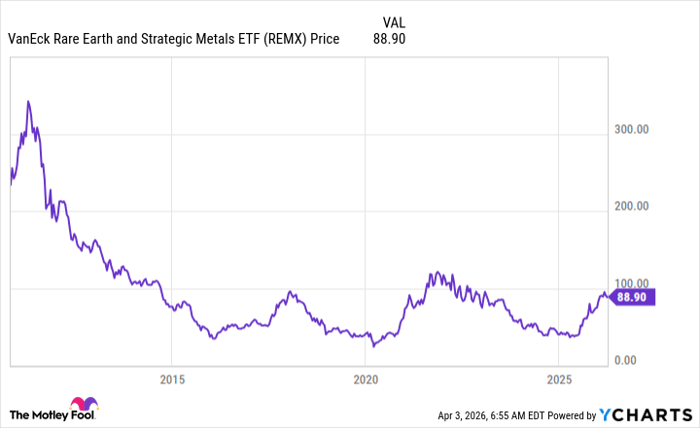
However, if you pull back further, you'll see that VanEck Rare Earth and Strategic Metals ETF has a history of being highly volatile. Rare-earth metals are commodities, and they behave like commodities, rising and falling with supply and demand. High commodity prices normally attract increased investment, leading to higher supply and lower prices. This is the long-term risk that investors should consider when buying a focused rare-earth metals investment.
VanEck Rare Earth and Strategic Metals ETF is doing very well right now. That may continue for a time. But if history is any guide, commodity markets eventually solve supply problems like the one that has investors pushing this ETF higher.
Make sure you consider the whole picture
VanEck Rare Earth and Strategic Metals ETF is a good way to invest in a basket of rare-earth metals stocks. But that only solves one of the problems you'll face if you decide to jump on the hot rare-earth metals investment trend. Most investors should tread with caution here.
Should you buy stock in VanEck ETF Trust - VanEck Rare Earth And Strategic Metals ETF right now?
Before you buy stock in VanEck ETF Trust - VanEck Rare Earth And Strategic Metals ETF, consider this:
The Motley Fool Stock Advisor analyst team just identified what they believe are the 10 best stocks for investors to buy now… and VanEck ETF Trust - VanEck Rare Earth And Strategic Metals ETF wasn’t one of them. The 10 stocks that made the cut could produce monster returns in the coming years.
Consider when Netflix made this list on December 17, 2004... if you invested $1,000 at the time of our recommendation, you’d have $532,066!* Or when Nvidia made this list on April 15, 2005... if you invested $1,000 at the time of our recommendation, you’d have $1,087,496!*
Now, it’s worth noting Stock Advisor’s total average return is 926% — a market-crushing outperformance compared to 185% for the S&P 500. Don't miss the latest top 10 list, available with Stock Advisor, and join an investing community built by individual investors for individual investors.
*Stock Advisor returns as of April 6, 2026.
Reuben Gregg Brewer has no position in any of the stocks mentioned. The Motley Fool has no position in any of the stocks mentioned. The Motley Fool has a disclosure policy.