Is Wheaton Precious Metals a Good Inflation Hedge?

Key Points
Inflation could reaccelerate due to the recent surge in oil prices.
Wheaton Precious Metals' business model insulates it from inflationary cost pressures.
The company has historically outperformed silver and gold.
The inflation rate has been slowing down this year. It grew at a 2.4% annualized rate in February, down from 2.7% last year and a peak of 7% in 2021. However, with oil prices surging due to the war with Iran, inflation could reaccelerate.
Here's a look at whether gold and silver streaming company Wheaton Precious Metals (NYSE: WPM) is a good inflation hedge.
Will AI create the world's first trillionaire? Our team just released a report on the one little-known company, called an "Indispensable Monopoly" providing the critical technology Nvidia and Intel both need. Continue »
Image source: Getty Images.
Precious metals as an inflation hedge
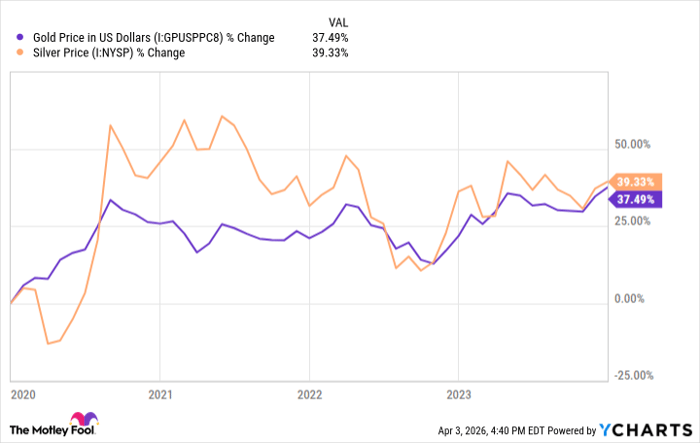
Precious metals such as gold and silver have traditionally been good inflation hedges. That's because they're finite resources that are globally recognized. Investing in gold tends to be a better inflation hedge because it offers more stability and resilience than silver. It also has strong demand from central banks, which use it as a store of value.
Silver can also be a good inflation hedge. However, it's more volatile. Silver also has greater growth potential due to its importance as an industrial metal for products such as solar panels and electronics.
Here's how the two precious metals performed during the period of high inflation caused by the pandemic:
Gold Price in US Dollars data by YCharts
Wheaton's inflationary benefits
Wheaton Precious Metals doesn't mine silver and gold. The streaming company provides capital to miners to develop and expand mines. In exchange, it receives the right to a portion of their production at a set price. The company has locked in fixed costs of $650 per ounce for gold and $2.50 per ounce for silver through 2030. As a result, it has predictable costs with no inflationary cost pressures. That enables it to cash in on the upside of silver and gold prices during inflationary periods.
In addition to those low fixed costs, Wheaton benefits from the growing production of its mining partners. The company currently expects its gold equivalent ounces to rise 11% this year and by 50% by 2030 based on recently acquired streams and mining developments by its partners. Wheaton has ample financial capacity to fund new streams that could enhance its already robust growth rate. This rising production should drive earnings and cash flow growth even if precious metals prices stagnate. That supports the company's plan to continue paying a progressive dividend (it recently hiked its payout by 18%).
A great inflation hedge
Wheaton Precious Metals' combination of inflation-protected costs, upside to higher precious metals prices, and production growth has enabled it to consistently outperform silver and gold. As a result, it has historically been an even better hedge against inflation than precious metals.
Should you buy stock in Wheaton Precious Metals right now?
Before you buy stock in Wheaton Precious Metals, consider this:
The Motley Fool Stock Advisor analyst team just identified what they believe are the 10 best stocks for investors to buy now… and Wheaton Precious Metals wasn’t one of them. The 10 stocks that made the cut could produce monster returns in the coming years.
Consider when Netflix made this list on December 17, 2004... if you invested $1,000 at the time of our recommendation, you’d have $532,066!* Or when Nvidia made this list on April 15, 2005... if you invested $1,000 at the time of our recommendation, you’d have $1,087,496!*
Now, it’s worth noting Stock Advisor’s total average return is 926% — a market-crushing outperformance compared to 185% for the S&P 500. Don't miss the latest top 10 list, available with Stock Advisor, and join an investing community built by individual investors for individual investors.
*Stock Advisor returns as of April 6, 2026.
Matt DiLallo has no position in any of the stocks mentioned. The Motley Fool has no position in any of the stocks mentioned. The Motley Fool has a disclosure policy.