Amazon's Zoox Is Building Momentum -- but Not a Business (Yet)
Key Points
Zoox is launching its self-driving car service in Austin and Miami later this year and expanding service in San Francisco and Las Vegas.
However, the company doesn't have regulatory approval to charge for rides, leaving it well behind Waymo.
Amazon investors should watch Zoox closely as the autonomous vehicle market heats up.
Amazon's (NASDAQ: AMZN) autonomous vehicle company, Zoox, recently announced a major expansion, with plans to launch its robotaxi service in Austin and Miami later this year. The company is also quadrupling its San Francisco service area and expanding further into Las Vegas.
Zoox is clearly a company on the move. The problem is that it doesn't make a dime from its services just yet.
Will AI create the world's first trillionaire? Our team just released a report on the one little-known company, called an "Indispensable Monopoly" providing the critical technology Nvidia and Intel both need. Continue »
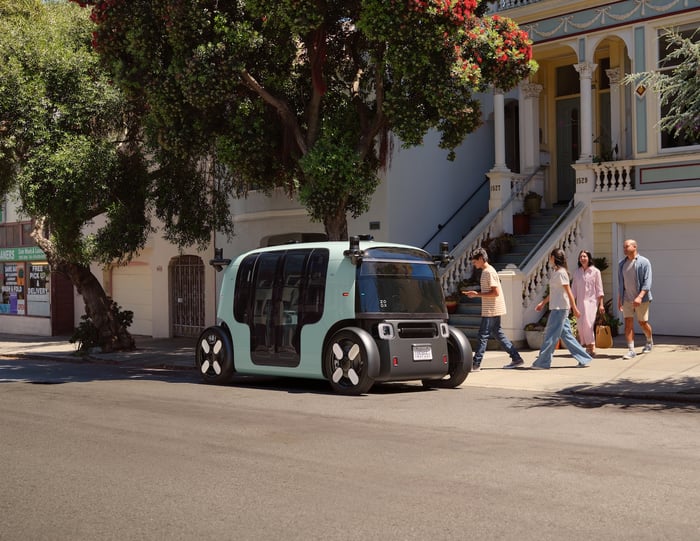
Image source: Zoox.
Zoox is gaining momentum
The Austin and Miami launches follow a familiar playbook for Zoox: offer rides to employees and their families, then open a public waitlist via its Explorer program, and, ultimately, expand to general access.
Less than a year after launching in Las Vegas, the company says it has logged nearly 2 million autonomous miles and carried over 350,000 riders, with more than 500,000 people already on its waitlist.
That's impressive growth. But one major detail missing from Zoox's press release is that all of the company's rides to date have been free. That's because Zoox still lacks federal approval to charge for rides. The company is waiting on a decision from the National Highway Traffic Safety Administration (NHTSA) to operate up to 2,500 of its vehicles commercially. That decision could come soon, though, with the agency expected to publish its decision sometime in April.
Zoox CEO Aicha Evans said recently that the company is "ready to charge" for rides once approval comes.
This is our year of growth. We are actively implementing learnings to confidently and safely scale our robotaxi service across the country and bring our differentiated experience to even more riders.
Way behind Waymo
To put Zoox's position into context, consider that Alphabet's (NASDAQ: GOOG)(NASDAQ: GOOGL) robotaxi company, Waymo, recently announced plans to launch commercial services in 10 new U.S. cities this year -- reaching at least 20 total -- as well as international expansion to London and Tokyo.
And, most importantly, Waymo already has $350 million in annual recurring revenue (ARR), according to the Financial Times. Waymo also recently raised $16 billion in its latest funding round, valuing the company at $126 billion.
Just as impressive are Waymo's ridership numbers. Waymo CEO Tekedra Mawakana said in February that his company is on track to serve "over 1 million rides per week by the end of the year."
Pedal to the metal for robotaxi services
While Zoox is behind Waymo, Amazon knows what's at stake in the robotaxi market. Autonomous vehicle services will generate $7 billion in annual sales by 2030 and take about 8% of the U.S. rideshare market, according to Goldman Sachs.
Zoox's expansion into Austin and Miami shows the company is serious about scaling as the self-driving industry takes shape. But it will face stiff competition from Waymo and will need to prove that it can start generating significant revenue quickly. Once it's allowed to start charging for rides, that is.
Don’t miss this second chance at a potentially lucrative opportunity
Ever feel like you missed the boat in buying the most successful stocks? Then you’ll want to hear this.
On rare occasions, our expert team of analysts issues a “Double Down” stock recommendation for companies that they think are about to pop. If you’re worried you’ve already missed your chance to invest, now is the best time to buy before it’s too late. And the numbers speak for themselves:
- Nvidia: if you invested $1,000 when we doubled down in 2009, you’d have $434,524!*
- Apple: if you invested $1,000 when we doubled down in 2008, you’d have $47,376!*
- Netflix: if you invested $1,000 when we doubled down in 2004, you’d have $503,861!*
Right now, we’re issuing “Double Down” alerts for three incredible companies, available when you join Stock Advisor, and there may not be another chance like this anytime soon.
*Stock Advisor returns as of March 29, 2026.
Chris Neiger has no position in any of the stocks mentioned. The Motley Fool has positions in and recommends Alphabet, Amazon, and Goldman Sachs Group. The Motley Fool has a disclosure policy.