


Morgan Stanley Stock (MS) Moved Down by 3.13% on Mar 5: What Signal Does It Send?



Morgan Stanley (MS) moved down by 3.13%. The Banking & Investment Services sector is down by 1.68%. The company underperformed the industry. Top 3 stocks by trading volume in the sector: JPMorgan Chase & Co (JPM) down 1.39%; Goldman Sachs Group Inc (GS) down 3.87%; SoFi Technologies Inc (SOFI) up 1.04%.
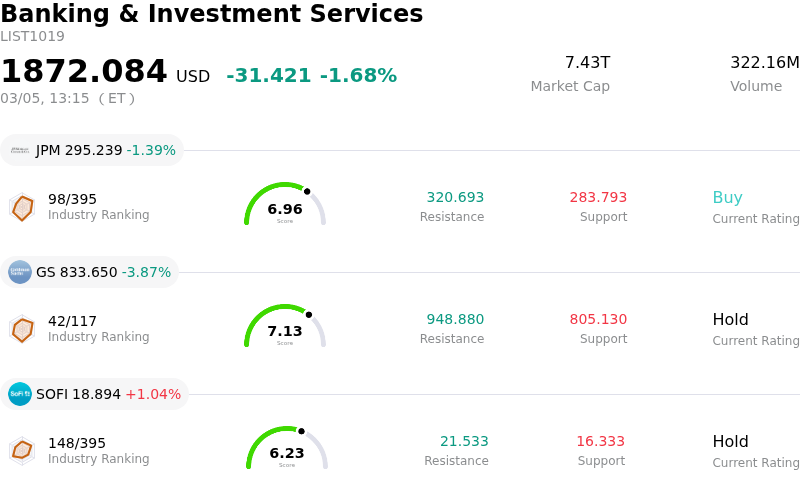
What is driving Morgan Stanley (MS)’s stock price down today?
Morgan Stanley's stock experienced a decline, primarily influenced by a combination of company-specific restructuring and broader market pressures. The financial services giant announced a significant reduction of its global workforce, eliminating approximately 2,500 jobs across its investment banking, trading, wealth management, and asset management divisions. This represents about three percent of its total employees and signals a strategic shift in business priorities and an effort to manage costs. Such internal reorganizations often lead to investor uncertainty regarding future growth prospects and operational stability, contributing to negative sentiment.
Concurrently, the wider market environment was unfavorable, exerting additional downward pressure on the stock. US equities broadly fell today due to escalating geopolitical tensions in the Middle East, particularly concerns about an extended conflict in Iran. This heightened risk perception led to a general market pullback, as investors grew wary of the potential negative impact on the global economy.
Furthermore, persistent inflation concerns continue to shape investor expectations regarding monetary policy. Following an earlier report this week on a stronger-than-anticipated Producer Price Index, the market is adjusting to the possibility of fewer interest rate cuts by the Federal Reserve, or interest rates remaining elevated for a longer period. This "higher for longer" interest rate outlook typically weighs on financial institutions like Morgan Stanley, affecting their lending and investment activities. Technical analysis from earlier in the week also indicated that the stock faced ongoing downside pressures, suggesting a continuation of bearish momentum.
Technical Analysis of Morgan Stanley (MS)
Technically, Morgan Stanley (MS) shows a MACD (12,26,9) value of [-2.63], indicating a sell signal. The RSI at 42.39 suggests neutral condition and the Williams %R at -59.50 suggests oversold condition. Please monitor closely.
Fundamental Analysis of Morgan Stanley (MS)
Morgan Stanley (MS) is in the Banking & Investment Services industry. Its latest annual revenue is $114.74B, ranking 3 in the industry. The net profit is $16.25B, ranking 2 in the industry. Company Profile
Over the past month, multiple analysts have rated the company as Buy, with an average price target of $196.58, a high of $221.00, and a low of $145.00.
More details about Morgan Stanley (MS)
Company Specific Risks:
- Morgan Stanley is executing significant layoffs, cutting approximately 2,500 employees (3% of its global workforce) across all major divisions, including investment banking, wealth management, and investment management, reflecting a strategic shift towards efficiency and potential AI-driven displacement despite recent record revenues.
- Technical indicators and multiple financial algorithms currently show a bearish trend and a "Strong Sell" evaluation for MS stock, with warnings of potential near-term weakness and a falling trend in the short term.
- Current analyst commentary points to concerns regarding Morgan Stanley's wealth management net interest income (NII) having previously fallen short of expectations and a decreased Common Equity Tier 1 (CET1) ratio, indicating a potential weakening of the bank’s capital position and ongoing NII sensitivity.
- The company maintains a "strongly negative Insider Power Score" due to a pattern of significant open-market selling by key executives over the past year, with high-impact insider sales vastly outweighing purchases.
This article may include AI-generated content that is human-reviewed, which is for reference and general information purposes only and does not constitute investment advice.
Recommended Articles








Comments (0)
Click the $ button, enter the symbol, and select to link a stock, ETF, or other ticker.