


Banco Bilbao Vizcaya Argentaria SA Stock Moved Down by 4.09% on Mar 2: What Signal Does It Send?



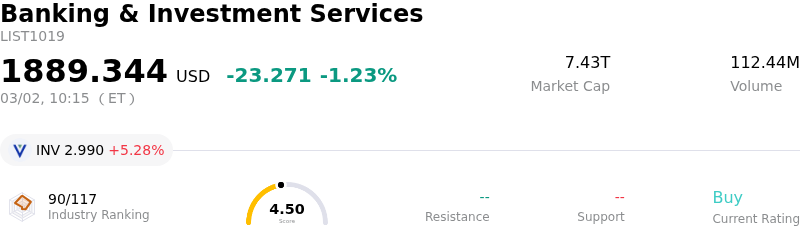
Banco Bilbao Vizcaya Argentaria SA (BBVA) moved down by 4.09%. The Banking & Investment Services industry is down by 1.23%. The company underperformed the industry. Top 3 gainers of the industry: Innventure Inc (INV) up 5.28%; Marathon Bancorp Ord Shs (MBBC) up 5.06%; Sentage Holdings Inc (SNTG) up 3.14%.
The significant intraday volatility and a downward movement for BBVA on March 2, 2026, appear to be influenced by a confluence of factors, including market sentiment regarding geopolitical risks, broader banking sector trends, and company-specific news regarding its share buyback program.
Global market sentiment on this date was affected by geopolitical tensions, specifically an operation launched by the US and Israel against Iran, leading to heightened concerns and initial losses across various global stock markets, including the S&P500, DAX, and MSCI Emerging Markets indices. This general risk-off environment likely contributed to downward pressure on individual stocks, including BBVA. Additionally, broader macroeconomic concerns such as sticky inflation and weaker-than-expected US GDP growth further amplified market unease.
In the banking sector, there is a developing trend of regulators across several markets easing capital requirements, which could be seen as both a positive for operational flexibility and a potential indicator of underlying economic pressures on banks' profitability and capital. While some reports highlighted a positive outlook for the Spanish economy in 2026 with an anticipated reduction of interest rates and continued growth driven by domestic demand, the broader international context for Spain's main trading partners remains challenging. Similarly, the economic outlook for Latin America, a key region for BBVA's operations, suggests modest recovery with persistent structural challenges, despite some benefiting from higher commodity prices. This mixed economic backdrop in BBVA's core markets could contribute to investor caution.
Specifically for BBVA, the company announced a new share buyback program and released a periodic report on its ongoing buyback, indicating efforts in capital management and shareholder returns. While share buybacks are generally positive, the market's reaction suggests that other concerns might have overshadowed this news. Prior analyst reports indicated that BBVA's shares were trading at a "full-ish" valuation relative to European peers, leading some to downgrade their ratings and shift preference to rivals, citing limited upside potential. Earlier in February, BBVA's shares also saw a decline after its fourth-quarter results, despite record profits, due to lower-than-expected capital levels, higher operating costs, and a cautious outlook provided by management for 2026. These prior concerns about capital absorption, cost discipline, and conservative guidance, combined with the current geopolitical and macroeconomic climate, likely influenced the observed intraday downward movement.
Technically, Banco Bilbao Vizcaya Argentaria SA (BBVA) shows a MACD (12,26,9) value of [-0.14], indicating a sell signal. The RSI at 43.01 suggests neutral condition and the Williams %R at -71.23 suggests oversold condition. Please monitor closely.
Banco Bilbao Vizcaya Argentaria SA (BBVA) is in the Banking & Investment Services industry. Its latest annual revenue is 44.16B, ranking 11 in the industry. The net profit is 11.40B, ranking 9 in the industry. Company Profile
Over the past month, multiple analysts have rated the company as STRONG BUY, with an average price target of 28.56, a high of 28.56, and a low of 28.56.
Company Specific Risks:
- BBVA's Turkish unit reported disappointing performance in the last quarter, characterized by weakening credit quality, sharply increased provisioning charges, and rising non-performing loans (NPLs), which negatively impacted consolidated earnings.
- Several analysts, including RBC Capital Markets and Seeking Alpha, have recently downgraded BBVA's stock to "sector perform" or "hold," citing full valuation and limited upside potential, despite the company's strong underlying metrics.
- Significant institutional investors, such as Fisher Asset Management LLC and Marks Group Wealth Management Inc, have recently decreased their holdings in BBVA by reducing their stakes in the company.
- BBVA's considerable exposure to its Turkish operations, which account for approximately 10% of its profits, introduces significant political uncertainty due to elections scheduled for May 2028 in the region.
This article may include AI-generated content that is human-reviewed, which is for reference and general information purposes only and does not constitute investment advice.
Recommended Articles







Comments (0)
Click the $ button, enter the symbol, and select to link a stock, ETF, or other ticker.