


Today’s Market Recap: Nvidia Slump Weighs on Tech Indices While Dell and Baidu Surge on AI Momentum



Track the Market Trend
TradingKey - On Feb. 26, 2026, tech-heavy U.S. benchmarks faced downward pressure as Nvidia (NVDA) slumped more than 5%, overshadowing a strong earnings report released just a day prior. This decline triggered broader volatility across the sector, dragging the Nasdaq Composite down 1.18% to 22,878.38 and the S&P 500 down 0.54% to 6,908.86. Conversely, the Dow Jones Industrial Average, which carries less exposure to the technology industry, managed a slight gain of 0.03% to close at 49,499.20.
Despite posting another earnings beat after yesterday's closing bell, Nvidia saw its shares plummet as investors began to question the sustainability of its rapid growth. This skepticism, coupled with aggressive profit-taking, led to the stock's sharpest single-day decline since April 2025. Other megacap tech leaders, including Alphabet (GOOG), Amazon (AMZN), and Apple (AAPL), also finished the session in the red.
Beyond the semiconductor space, industrial contractor EMCOR Group (EME) fell 7% due to cautious guidance for 2026, while Eos Energy (EOSE) saw nearly 40% of its market value evaporate after missing revenue estimates.
Nvidia’s influence on the market remains so significant that its individual retreat effectively negated gains made by the majority of S&P 500 components today. This cooling sentiment is also driving a rotation out of service sectors perceived as vulnerable to automation. While AI jitters are prevalent, some analysts view these rolling selloffs as potential entry points for long-term investors.
Industry leaders continue to signal massive long-term potential despite the immediate volatility. Nvidia’s CEO recently suggested that an upcoming breakthrough could generate unprecedented wealth, while Jeff Bezos described the potential impact of AI as difficult to overstate. Furthermore, Cathie Wood projects that the AI sector could evolve into an $80 trillion opportunity by 2030 — a figure dwarfing the current valuations of today's largest tech giants.
Market Headline
German Chancellor Friedrich Merz visited the Chinese robotics firm Unitree during his official trip to China. Unitree founder Wang Xingxing hosted the Chancellor, showcasing the capabilities of Chinese robotics through live demonstrations of robot boxing and dancing. Wang emphasized that Germany remains a vital market for the company, expressing a strong interest in deepening partnerships with German enterprises to accelerate the growth of the global intelligent robotics industry.
In central banking news, Federal Reserve Governor Milan reaffirmed on Thursday that a 100-basis-point interest rate cut will be necessary in 2026, advocating for an early start to the easing cycle. While noting improvements in the labor market, Milan warned that excessive regulation is driving up bank credit costs and fueling a surge in private credit. Although he does not currently view this as a systemic risk, he maintained a cautious stance on employment and suggested that weak inflationary pressures support a more aggressive dovish turn.
Hong Kong tycoon Li Ka-shing is divesting major UK assets, with three CK Group entities — CK Infrastructure, Power Assets, and CK Asset — announcing the sale of their 100% stake in UK Power Networks. The business will be acquired by a subsidiary of the French utility giant Engie for over HK$110 billion. The three companies, which hold 40%, 40%, and 20% stakes respectively, intend to redeploy the proceeds into future investments and strategic acquisitions.
Within the technology supply chain, Samsung’s semiconductor division has reportedly asserted its pricing power by securing a 100% price increase for memory components supplied to Apple. This aggressive pricing strategy has forced Samsung’s own mobile division to diversify its supply chain. For the initial mass production of the Galaxy S26, Samsung Mobile has shifted 50% of its LPDDR5X memory orders to Micron to manage costs. Despite these efforts and the introduction of the in-house Exynos 2600 chip, Samsung has raised the starting price of the Galaxy S26 to $899 to offset rising component expenses.
Dell Technologies (DELL) delivered a stellar fourth-quarter earnings report, with revenue, profit, and cash flow hitting record highs. Driven by robust demand for AI-optimized servers, the company provided an optimistic outlook for fiscal year 2027, projecting revenue up to $142 billion. Dell expects AI server revenue to double year-over-year to approximately $500 billion, a forecast that sent shares surging over 12% in after-hours trading.
Baidu (BIDU) reported fourth-quarter revenue of 327.4 billion yuan, exceeding market expectations. Revenue from AI-related new business segments rose to 11.3 billion yuan, now accounting for 43% of total quarterly revenue. For the full year, Baidu’s total revenue reached 129.1 billion yuan, with AI initiatives surpassing 40 billion yuan — a 48% year-over-year increase. Highlighting its financial recovery, the company reported a positive operating cash flow of 3.9 billion yuan for the second half of the year. Baidu also announced a $5 billion share buyback program, its first-ever dividend policy, and plans to spin off its Kunlun chip unit for a separate listing.
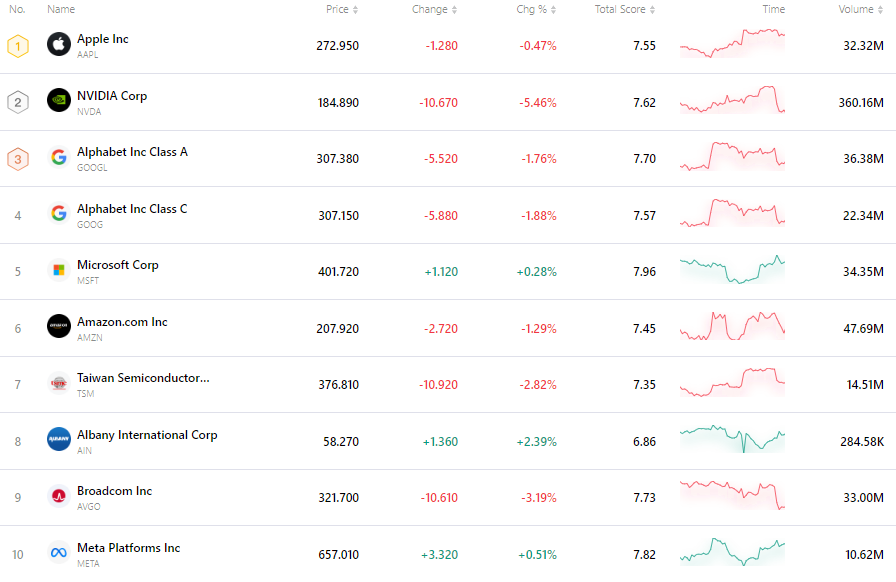
Top 10 Most Traded Stocks
The chart below lists the ten most actively traded stocks in the market. Due to their massive trading volumes and high liquidity, these stocks serve as critical benchmarks for tracking global market dynamics.
Recommended Articles




Comments (0)
Click the $ button, enter the symbol, and select to link a stock, ETF, or other ticker.