EXPLAINER-Are the US attacks on Iran legal?

By Tom Hals
March 4 (Reuters) - The U.S. military has joined Israel and attacked more than 1,000 targets in Iran and killed many of its top officials, including Supreme Leader Ayatollah Ali Khamenei. On Wednesday, a U.S. submarine sunk an Iranian navy vessel near Sri Lanka.
Below is a look at the legality of the U.S. attacks, which critics say exceed the president's authority and fails to comply with international law.
WHAT HAS TRUMP SAID?
President Donald Trump has provided varying objectives and justifications. He has said he felt Iran was going to strike first and the attack was meant to eliminate imminent threats to the United States, its military bases overseas and allies, although he did not provide details and some claims were not backed by U.S. intelligence reports. Trump also said Iran could obtain a nuclear weapon within one month but he did not provide evidence and this contradicted his claims in June that the U.S. military had "obliterated" Iran's nuclear program.
PRESIDENTIAL POWER TO USE THE MILITARY
The attacks on Iran are pushing the boundaries of Trump's constitutional authority, according to legal experts.
Under the U.S. Constitution, the president commands the armed forces and directs foreign relations but only Congress has the power to declare war.
Presidents of both parties have conducted military strikes without congressional approval when it was in the national interest but less intense in duration and scope than what would be considered a war -- a limit that Trump may be testing.
Trump and Defense Secretary Pete Hegseth have both described the action as a war and Hegseth called it "the most lethal, most complex and most-precision aerial operation in history." Trump said it could last five weeks or more and cautioned that there will be more U.S. casualties.
Congress has provided authorization for large military operations, such as President George W. Bush's invasions of Afghanistan in 2001 and Iraq in 2003.
WAR POWERS RESOLUTION
The War Powers Resolution (WPR) of 1973 acts as a check on presidential power.
Under the WPR, the president can only involve the military in an armed conflict when Congress has declared war or provided specific authority or in response to an attack on U.S. territory or its military. It requires the president to report regularly to Congress, which the administration started to do on Monday.
The WPR also requires unauthorized military actions to be terminated within 60 days unless the deadline is extended.
It provides a procedure for Congress to withdraw the military from a conflict and members of both parties have said they plan to put such legislation to a vote this week.
It's highly unlikely such a vote would garner a two-thirds majority needed to override a Trump veto but some lawmakers said it would put members on the record in an election year. Legal experts said popular opposition might be the main check on Trump's ability to continue the attacks.
WHAT DOES INTERNATIONAL LAW SAY?
Legal experts said many countries will consider the attacks unjustified under the United Nations Charter, which states that member states must refrain from using force or the threat of force against other states. There are exceptions when force is authorized by the U.N. Security Council or used in self-defense in response to armed attack, neither of which applies.
There is also the concept of pre-emptive self-defense, which would arguably allow the United States to attack Iran if it had proof of an imminent, overwhelming attack.
The United States has a veto at the U.N. Security Council, shielding Washington.
Legal experts said violating international law still carries a cost and both the United Kingdom and Spain have limited the use of their bases in the attacks, citing the lack of justification for the conflict.
WAS THE SUBMARINE ATTACK NEAR SRI LANKA LEGAL?
Wednesday's submarine attack appeared to comply with the law of war, according to legal experts. The attack occurred in international waters and the target was a military ship which was not disabled. However, it could be argued that if Washington is attacking Iran to eliminate an imminent threat, a warship far from Iran would not be justified target unless it could be connected to those threats.
WAS THE KILLING OF KHAMENEI LEGAL?
Legal experts said it is not clear cut.
Israel is reported to have carried out the actual strike that killed Khamenei, while the U.S. offered intelligence and operational support.
Republican President Ronald Reagan in 1981 signed Executive Order 12333 which prohibited anyone working for the U.S. government or acting on its behalf from engaging in assassination. It also barred participation in assassination by the U.S. intelligence community.
However, the killing of a leader which might qualify as assassination in peacetime could be a legitimate act of war during an armed conflict, legal experts said.
In Khamenei's case, legality would partly depend on whether the U.S. was at war when he was killed and whether he was considered a military leader.
Related Articles
Is GE Vernova an Energy Stock You Should Buy in 2026?
TradingKey - GE Vernova (GEV), the global energy infrastructure company, was spun off from General Electric (GE) in 2024. It develops, produces, and services equipment for the generation and transmission of electricity, including gas and steam turbines, wind turbines, as well as grid infrastructure
Here Are US Stock Winners Following the Iran Attacks
Tradingkey - On Tuesday, U.S. equities extended their slide as rising oil prices and the specter of war in Iran rippled through global markets. The Dow Jones Industrial Average at one point plunged more than 1,000 points.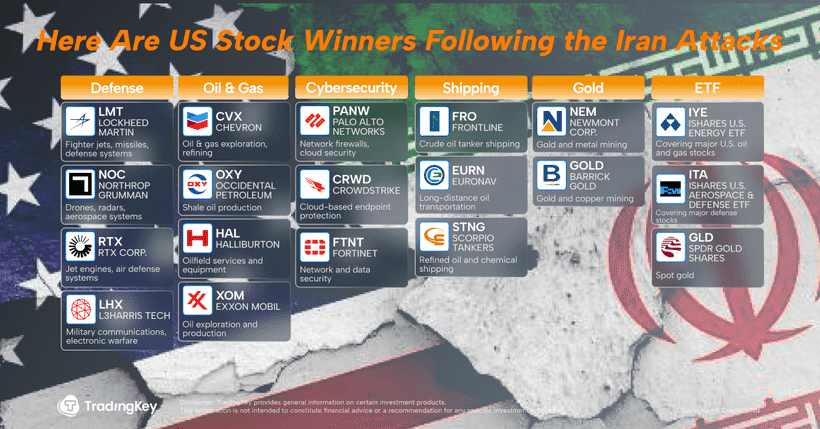
Middle East Conflict Escalates, Global Stocks and Bonds Fall, Was It Really Caused by One Sentence From Trump?
TradingKey - On Tuesday local time, the escalation of conflict in the Middle East triggered intense global market volatility. Gold (XAUUSD), bonds, and stocks fell in tandem, an unconventional movement that shattered the conventional logic of "buying safe havens during turmoil and trading stocks during stability."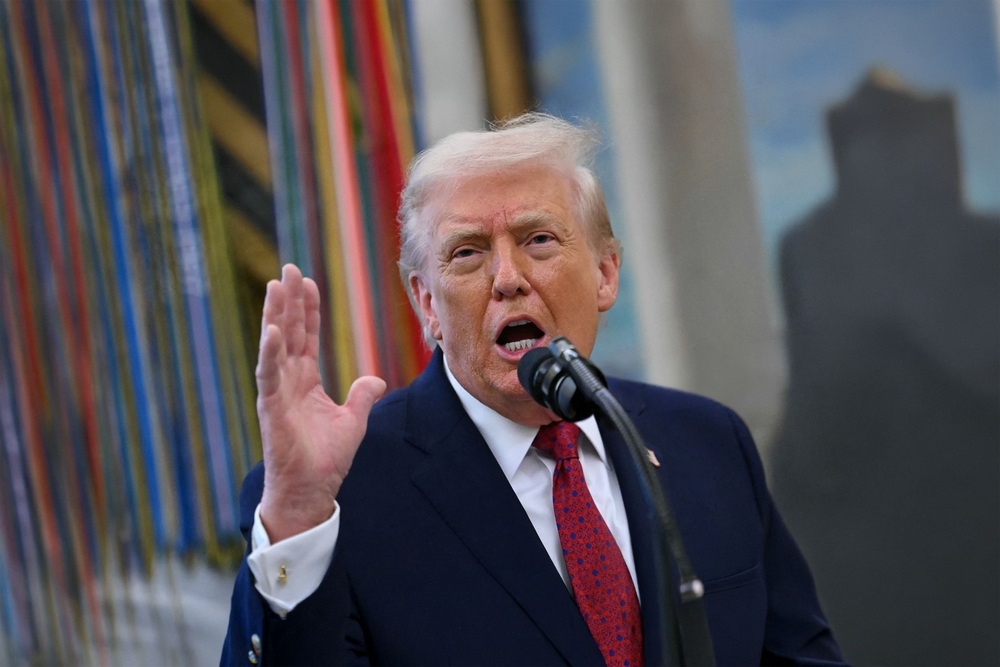
Gold’s $5,000 Breaking Point: Why the Middle East Crisis Isn't Saving the Bulls
As US-Iran tensions continue to escalate, gold prices saw a sudden plunge. Has the metal already peaked?
AGI Approaches: 2026 May Be Artificial Intelligence Turning Point, Musk Warns White-Collar Class Will Bear the Brunt
TradingKey — Have you noticed that the pace of artificial intelligence evolution is exceeding the limits of human intuitive perception? From the debut of ChatGPT to the rapid rise of multimodal AI systems, the development of AI technology has demonstrated a non-linear, exponential acceleration in ju