


Soybean Futures (SOYBEAN-F) Is up 2.05% on Jul 5: What Is Driving the Move?



Soybean Futures (SOYBEAN-F) is up 2.05% at Jul 5 22:40(ET), now at $1157.29, with a 7-day up of 3.51%.
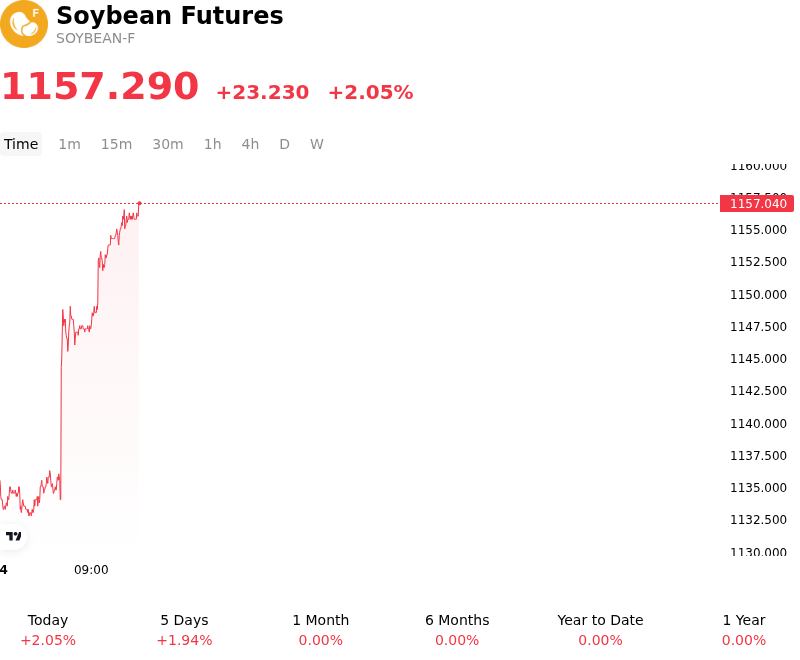
What is driving Soybean Futures (SOYBEAN-F)’s stock price up today?
The recent upward movement in Chicago Board of Trade soybean futures represents a key pivot point for the agricultural complex, driven primarily by bullish domestic consumption data and tightening supply signals that overshadowed long-term production forecasts.
While the market spent much of the preceding period weighing the prospects of a record-setting global soybean crop, the release of the U.S. Department of Agriculture Quarterly Grain Stocks report fundamentally shifted near-term expectations. The report revealed stronger-than-expected domestic soybean usage through the spring, signaling robust demand. This rapid pace of consumption was heavily supported by soaring domestic crush margins, as industrial demand for soybean oil—particularly for renewable fuel production—expanded significantly.
This demand-side momentum was further supported by a constructive shift in international trade dynamics. Following the resolution of previous trade friction, buying interest from major Asian importers has steadily returned to the market, providing a firmer floor for global export expectations. Although overall weekly export sales figures showed some near-term volatility, the underlying commitment from key structural importers has kept market participants highly sensitive to supply disruptions.
Weather risks have also re-emerged as a major trading catalyst. As the Northern Hemisphere enters the critical mid-summer growing season, soybean crop development relies heavily on favorable moisture levels. Market participants are increasingly monitoring a shift toward high temperatures and mixed rainfall patterns across key portions of the U.S. Midwest. With the market moving past the planting phase, focus has shifted entirely to yield potential. Any persistent threat of heat stress or regional dryness is expected to risk crop yields, driving short-sellers to cover positions and encouraging asset managers to rebuild risk premium.
In the broader macroeconomic environment, fluctuations in the U.S. dollar and shifting expectations for central bank interest rate policies continue to influence institutional capital flows into agricultural commodities. However, the immediate upside in soybean prices remains a clear reflection of localized weather anxieties and the surprisingly fast depletion of domestic stockpiles, which have temporarily eclipsed the broader, supply-heavy outlook for the upcoming marketing year.
More details about Soybean Futures (SOYBEAN-F)
Recent Events and Risks:
- Substantial Acreage and Production Expansion: The USDA’s June 30, 2026 Acreage Report confirmed that U.S. soybean plantings have expanded by 5% year-over-year to 85.4 million acres (up 665,000 acres from March projections). Assuming trendline yields, the U.S. is on track for a potentially record-breaking harvest of approximately 4.473 billion bushels, which is severely limiting upward price potential and exerting structural downside pressure on the futures curve.
- Bearish Quarterly Stock Pileup: The USDA Quarterly Grain Stocks report released on June 30, 2026, revealed that U.S. old-crop soybean inventories as of June 1, 2026, jumped 5% year-over-year to 1.061 billion bushels, exceeding average analyst expectations of 1.046 billion bushels and indicating a comfortable, non-acute domestic supply cushion.
- Deteriorating Export Demand and Canceled Shipments: Weekly export sales data released ahead of the July 4th holiday weekend disappointed the market by hitting a marketing year low of just 42,000 metric tons for old-crop soybeans, far below the expected trade range of 300,000 to 650,000 metric tons. Additionally, new-crop sales underperformed at 183,000 metric tons, and old-crop totals were weighed down by a significant cancellation from "unknown destinations".
- Speculative Position Trimming: Commodity Futures Trading Commission (CFTC) Commitment of Traders data shows managed money and speculative traders actively trimming their net long exposure, reducing their net long position by 16,139 contracts down to 36,679 contracts. This positioning liquidation reflects a broader macro risk-off sentiment and a lack of conviction in near-term demand.
This article may include AI-generated content that is human-reviewed, which is for reference and general information purposes only and does not constitute investment advice.
Recommended Articles









Comments (0)
Click the $ button, enter the symbol, and select to link a stock, ETF, or other ticker.