


Taiwan Semiconductor Manufacturing Co Ltd Stock (TSM) Opened Down by 3.23% on Jun 5: What Investors Need To Know



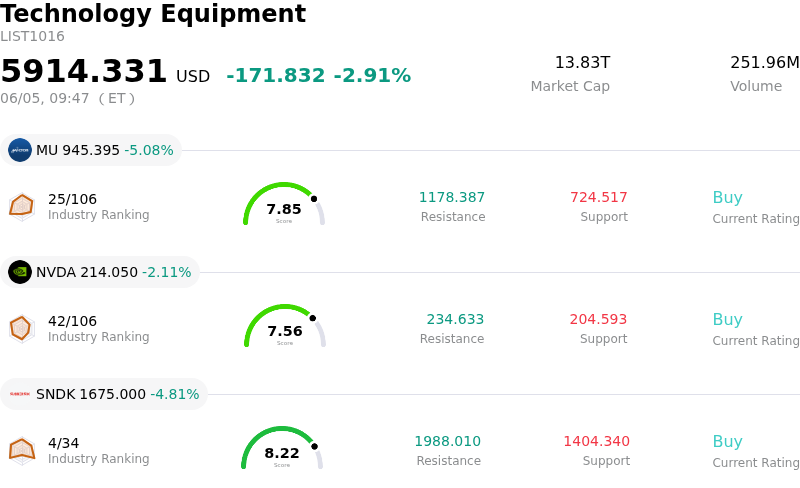
Taiwan Semiconductor Manufacturing Co Ltd (TSM) opened down by 3.23%. The Technology Equipment sector is down by 2.91%. The company underperformed the industry. Top 3 stocks by turnover in the sector: Micron Technology Inc (MU) down 5.08%; NVIDIA Corp (NVDA) down 2.56%; SanDisk Corporation (SNDK) down 4.81%.
What is driving Taiwan Semiconductor Manufacturing Co Ltd (TSM)’s stock price down today?
Taiwan Semiconductor Manufacturing Company (TSM) experienced a decline today, primarily influenced by a broader downturn in the technology and semiconductor sectors and escalating geopolitical tensions. The general market sentiment showed a risk-off shift, with large-cap technology stocks and equity futures facing headwinds.
A significant contributing factor was the negative investor reaction to a peer's earnings report, specifically Broadcom Inc.'s unchanged long-term artificial intelligence (AI) revenue outlook. This prompted widespread profit-taking across the AI chip sector, impacting TSM which has seen a strong performance leading up to today. Given TSM's position near its 52-week high and premium valuation, it was particularly susceptible to such profit-taking when market sentiment weakened. The Philadelphia semiconductor index also registered losses, further illustrating the industry-wide pressure.
Adding to market jitters are recent developments in U.S.-China technology relations. The U.S. Department of Commerce recently expanded AI chip export controls to target Chinese-owned firms globally, aiming to close perceived loopholes that allowed high-performance semiconductors to reach Chinese entities through third-party jurisdictions. This move has drawn sharp criticism from China's Ministry of Commerce, which views it as an abuse of export controls that destabilizes the global semiconductor supply chain and harms Chinese companies. Such regulatory uncertainty and the potential for disruptions in a major market like China can weigh on investor confidence for global chip manufacturers like TSM.
Despite these immediate pressures, TSM's CEO, C.C. Wei, reiterated a strong long-term outlook for AI demand, expecting it to outpace supply for several years, and projected significant revenue growth for the current year. Analyst forecasts generally remain bullish for TSM, expecting substantial earnings and revenue growth for the upcoming quarter. However, these positive company-specific fundamentals were overshadowed by the wider market correction and geopolitical concerns affecting the sector today.
Technical Analysis of Taiwan Semiconductor Manufacturing Co Ltd (TSM)
Technically, Taiwan Semiconductor Manufacturing Co Ltd (TSM) shows a MACD (12,26,9) value of [11.35], indicating a buy signal. The RSI at 65.76 suggests neutral condition and the Williams %R at -8.05 suggests oversold condition. Please monitor closely.
Fundamental Analysis of Taiwan Semiconductor Manufacturing Co Ltd (TSM)
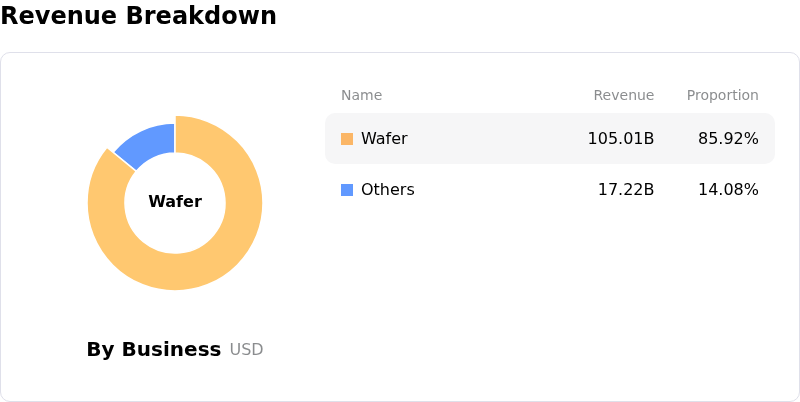
Taiwan Semiconductor Manufacturing Co Ltd (TSM) is in the Technology Equipment industry. Its latest annual revenue is $122.22B, ranking 2 in the industry. The net profit is $55.12B, ranking 2 in the industry. Company Profile
Over the past month, multiple analysts have rated the company as Buy, with an average price target of $458.87, a high of $600.00, and a low of $351.00.
More details about Taiwan Semiconductor Manufacturing Co Ltd (TSM)
Company Specific Risks:
- Operational bottleneck due to CEO's warning that AI chip supply will not meet demand for several years, potentially capping revenue growth despite strong market opportunity.
- Execution challenges in expanding U.S. manufacturing capacity, including permitting delays and labor shortages, which could hinder the company's ability to capitalize on future demand.
- Vulnerability to significant profit-taking and market corrections given the stock's current high valuation (P/E ratio near 10-year high) and position near its 52-week high, especially during broader tech sector pullbacks.
- Potential for margin compression stemming from rising component costs and the company's stated intent to avoid aggressive price increases to maintain business stability.
This article may include AI-generated content that is human-reviewed, which is for reference and general information purposes only and does not constitute investment advice.
Recommended Articles









Comments (0)
Click the $ button, enter the symbol, and select to link a stock, ETF, or other ticker.