


Oracle Stock Price Forecast: AI Order Growth Is Strong But Stock Price Falls, Can the Stock Price Still Rise?



AI Podcast


As of July 20, Eastern Time, Oracle shares hit a year-to-date low of $120.03, falling 39.54% since June 10. Despite strong AI cloud demand and increased RPO, investors are concerned over mounting capital expenditures, debt pressure, and customer concentration. A recent S&P Global credit rating downgrade to BBB- has further heightened financial risk sentiment. Recovery hinges on converting cloud backlogs into realized revenue, stabilizing free cash flow, and reducing reliance on major clients like OpenAI. Technically, a breach of the $118.86 support level could trigger further downside toward $100, while a rebound requires clearing $135–$140 resistance.
TradingKey - As of July 20, Eastern Time, Oracle ( ORCL) shares fell 3.98% on the day, hitting a new year-to-date low of $120.03 and approaching last year's low of $118.86. Although Oracle's latest earnings report showed that its cloud business and AI infrastructure orders remain strong, market concerns over the company's high capital expenditures, debt pressure, customer concentration, and free cash flow continue to rise, causing the stock price to pull back significantly from its previous highs driven by the AI cloud rally. Since reporting earnings on June 10, Oracle's stock has cumulatively fallen 39.54%.
Why Is Oracle Stock Falling?
The core reason for the recent continuous decline in Oracle's stock price is that the market has begun to worry about the financial risks brought by its AI cloud expansion. Although the company's cloud orders are strong, building AI data centers requires extremely high upfront investment. To meet the demands of major customers like OpenAI, Oracle must continuously increase capital expenditures, thereby squeezing free cash flow and driving up debt pressure.
S&P Global's recent downgrade of Oracle's credit rating to BBB- has also amplified market concerns. BBB- is just one notch away from high-yield status, meaning that the bond market has already begun to focus on the financing pressures behind Oracle's AI infrastructure expansion. For equity investors, a credit rating downgrade not only affects financing costs but also weakens market confidence in the safety of the company's balance sheet.
Another source of pressure comes from customer concentration. Market reports indicate that contracts related to OpenAI account for a significant portion of Oracle's massive backlog. While contracts with major customers can rapidly boost RPO and revenue expectations, they also introduce concentration risk. If OpenAI's subsequent computing demand, financing capabilities, or contract execution pace change, the realization of Oracle's cloud revenue could be affected, thereby putting downward pressure on the stock price.
Can Oracle Stock Price Still Rise?
Whether the stock price can resume its upward trend hinges on three key variables. First, whether AI cloud contracts can be steadily converted into revenue. While the massive RPO size is a positive sign, the market needs to see these contracts transition into revenue quarter-over-quarter rather than remaining at the order stage. Second, whether capital expenditures remain under control. If Oracle can prove that data center investments will not continue to consume free cash flow, market pressure on its valuation will ease significantly. Third, whether contracts with major customers like OpenAI can be executed reliably. If customer concentration risk declines, investor confidence in Oracle's AI cloud growth will also strengthen.
According to the latest earnings report, Oracle's remaining performance obligations (RPO) increased from $553 billion to $638 billion, representing a single-quarter increase of $85 billion, which indicates that the company's future revenue visibility has improved significantly. Growth in RPO typically implies an increase in long-term contracts that have been signed by customers but not yet recognized as revenue, supporting Oracle's medium- to long-term revenue growth.
In terms of business structure, Oracle is transitioning from a traditional database and enterprise software company to an AI cloud infrastructure provider. Compared to its past reliance primarily on revenue from databases, ERP, and enterprise application software, Oracle is now more heavily involved in AI training, AI inference, and the infrastructure buildout for large model computing power. As demand for computing power from enterprises and AI companies continues to grow, Oracle's cloud infrastructure business still has significant room for growth.
In terms of the impact on the stock price, if Oracle's upcoming earnings reports show that cloud revenue continues to grow rapidly, while free cash flow improves, capital expenditure growth slows down, or management provides clearer earnings guidance, the stock price is expected to stage a recovery.
Oracle Stock Price Trend Technical Analysis
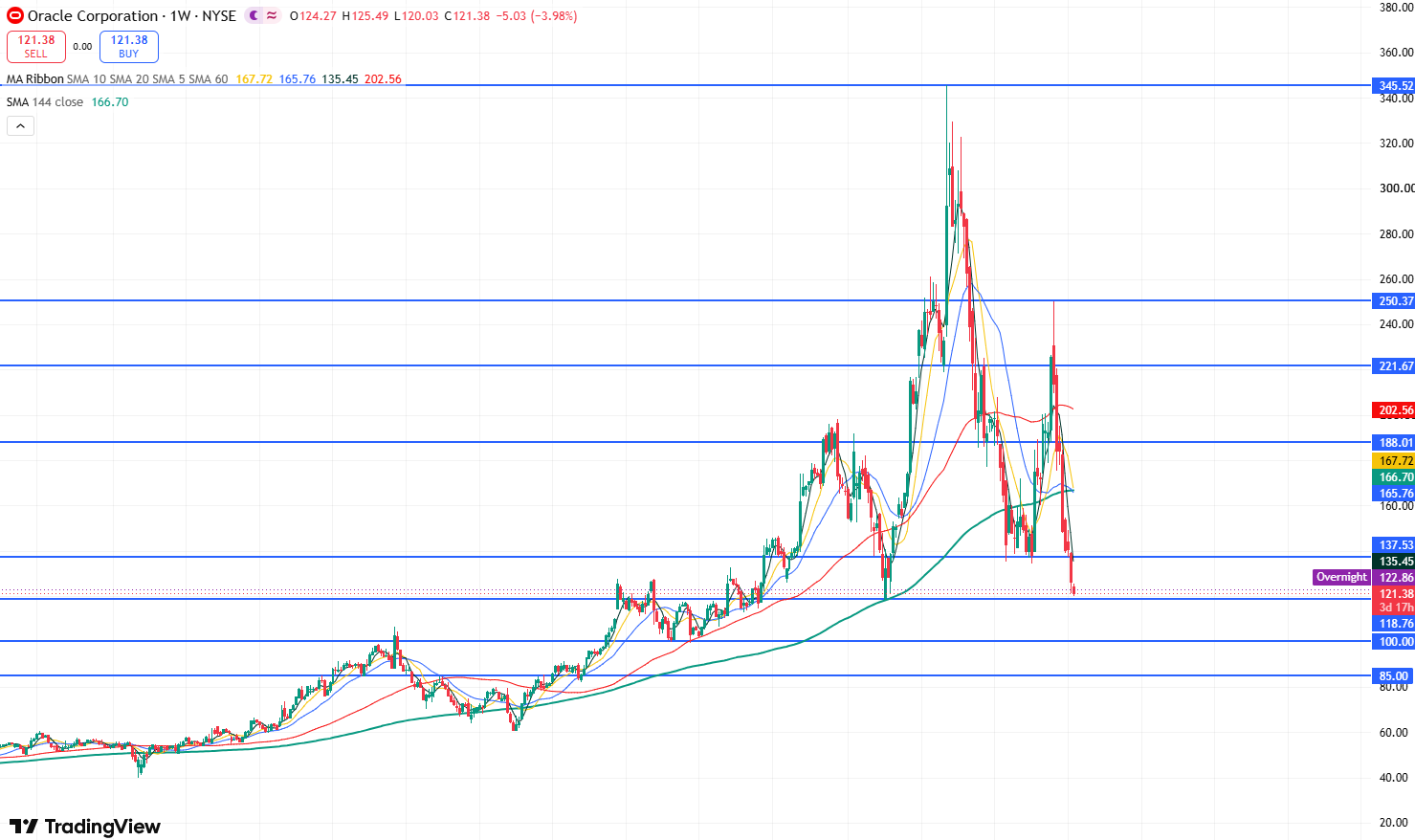
Oracle's weekly stock price chart, Source: TradingView
Looking at Oracle's weekly stock price chart, the stock has weakened with seven consecutive weeks of negative closes, showing that bearish market sentiment has clearly taken the upper hand. The downward trend persisted this week, with the price at one point falling near its 2025 low of $118.86.
At present, if the stock's closing price this week confirms a break below $118.86, it will open up downside room toward the $100 mark, and a further decline could test the support level near $85.
Conversely, if the stock's closing price this week confirms a stable foothold above $118.86, the stock may stage a technical recovery rebound in the short term. The primary resistance to watch on the upside is around the $135–$140 range; a breakout above this level would further open up room for a rebound toward $188.
This content was translated using AI and reviewed for clarity. It is for informational purposes only.
Recommended Articles










Comments (0)
Click the $ button, enter the symbol, and select to link a stock, ETF, or other ticker.