


Oracle Shares Fall 4% to One-Year Low: S&P Downgrades Credit Rating to BBB-, OpenAI Named as Risk



AI Podcast


On July 20, Eastern Time, Oracle shares dropped to a multi-month low following an S&P Global credit downgrade to BBB-. The downgrade reflects significant risks stemming from extreme customer concentration, as OpenAI represents nearly half of Oracle’s $638 billion backlog. Analysts express concern over deepening free cash flow deficits, projected to hit negative $42 billion by fiscal year 2027 due to massive data center capital expenditures. Market sentiment currently favors asset-light peers, penalizing Oracle’s capital-intensive, high-debt business model. If key clients face setbacks, Oracle’s balance sheet remains vulnerable to substantial idle capacity and rising maintenance costs.
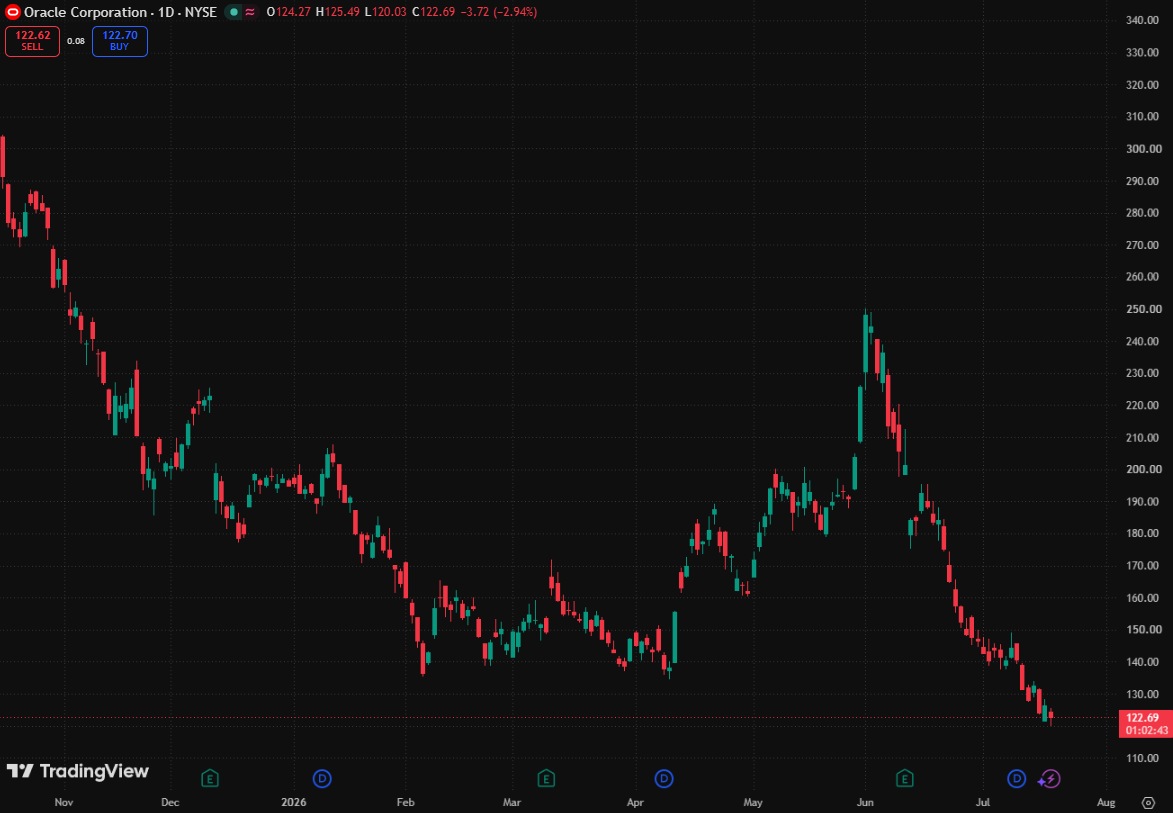
TradingKey - On July 20, Eastern Time, Oracle ( ORCL) saw its shares fall as much as 4% to a new low since April 2025. As of press time, the stock was down 2.94% at $122.69.
It is reported that S&P Global recently downgraded its credit rating to BBB-, just one notch away from junk status. Although the stock rebounded from its intraday low, market debate over this legacy tech giant continues.
Source: TradingView
S&P Downgrade: Direct Trigger for Crushing Oracle’s Stock Price
Just two weeks ago, S&P Global downgraded Oracle's credit rating to 'BBB-', leaving it just one step away from 'junk' status. The rating agency cited extreme customer concentration risk: OpenAI alone accounts for about half of Oracle's approximately $638 billion backlog of remaining performance obligations (RPO). However, OpenAI is currently facing headwinds from China's new AI model, Kimi K3, as well as pressure from a lawsuit by Apple.
Meanwhile, S&P expects its free cash flow deficit to continue to widen. Dragged down by the massive buildout of AI data centers, Oracle's free cash flow deficit is projected to reach a negative $42 billion in fiscal year 2027.
S&P's downgrade logic is clear: if OpenAI runs into trouble or even collapses, a massive amount of the data center capacity Oracle built for it will sit idle. Operations, maintenance, and depreciation expenses will continue to be incurred as usual, but with no corresponding customer revenue to cover them—leaving the balance sheet to bear the brunt.
Peer Divergence: Market Is Punishing "Asset-Heavy" Companies
In sharp contrast to Oracle's stock price hitting a one-year low, its peers have risen, with asset-light Cloudflare ( NET) and Snowflake ( SNOW) rising 40.33% and 25.66% respectively this year. This also proves that Oracle's decline is not a collective correction in the AI cloud computing sector.
Similarly, the capital-intensive CoreWeave ( CRWV) has also underperformed the market, recording a 25% decline this month. This proves once again that the market is punishing companies with 'high capex + high debt' models.
Oracle's cash flow pressure has reached an extreme level: free cash flow for fiscal year 2026 is negative $23.69 billion, while capital expenditures during the same period are as high as $55.66 billion; total liabilities have ballooned to $218.7 billion; net cash capital expenditure for fiscal year 2027 is approximately $70 billion, and if customer advances and vendor payment timing differences are included, the total capital expenditure is expected to reach $90 billion to $95 billion.
This content was translated using AI and reviewed for clarity. It is for informational purposes only.
Recommended Articles






Comments (0)
Click the $ button, enter the symbol, and select to link a stock, ETF, or other ticker.