


SpaceX Stock Price Prediction: Can Starship, Starlink and Space AI Support SpaceX’s Long-Term Valuation? Can the Stock Price Still Rise?



AI Podcast


As of July 17, Eastern Time, SpaceX (SPCX) shares have declined below their $135 IPO price, closing at $123.99. The valuation faces pressure due to high price-to-sales ratios, Starship testing delays, and significant capital expenditure on AI, which remains unprofitable. While Starlink provides a solid, growing revenue base, technical indicators suggest a persistent downtrend with support levels at $123 and $110. Additionally, the impending expiration of share lock-up restrictions and high short interest create supply-side risks. Long-term valuation hinges on Starship achieving high-frequency launches to catalyze satellite capacity and space infrastructure commercialization.

TradingKey - As of July 17, Eastern Time, SpaceX ( SPCX) stock fell 5.43% on the day to $123.99. Compared to its IPO price of $135, SpaceX has already fallen below its offering price; compared with its strong performance of once surging above $200 in the early days of its listing, the current stock price is clearly under continuous pressure. For the market, SpaceX remains a highly scarce space technology leader, but the high valuation in the early listing stage, the uncertainty of Starship testing, and investors' reassessment of the commercialization pace have pushed the stock price into a short-term de-bubbling phase.
Why SpaceX Shares Are Falling?
Overvaluation of SpaceX is the root cause behind the decline in SPCX's stock price.
Based on a rough calculation using the number of post-IPO Class A and Class B shares disclosed in the prospectus and the latest stock price of $123.99, SpaceX's current market capitalization is approximately $1.62 trillion. In comparison, the company's 2025 revenue was $18.674 billion, adjusted EBITDA was $6.584 billion, and net loss reached $4.937 billion. Based on this, SPCX's implied price-to-sales ratio is still close to 87 times, while its ratio of market cap to adjusted EBITDA exceeds 240 times.
This means that even though the stock price has fallen about 45% from its peak, SpaceX still cannot be simply viewed as a 'low-valuation stock' in the traditional sense. The current stock price still prices in a massive amount of long-term expectations, including the continued rapid growth of Starlink, the high-frequency reusability of Starship, and the ultimate commercialization of space AI data centers.
Delays in Starship's test flights have dented investor confidence in SpaceX's growth timeline
The 13th test flight of Starship was originally scheduled for July 16, but the launch was canceled at the last minute due to an anomaly during the engine ignition phase. The latest schedule shows that SpaceX has postponed the next launch attempt to July 23. This mission is planned to test Starship V3 and carry 20 next-generation Starlink satellites to verify satellite deployment and laser communication capabilities.
Starship is not just a rocket project, but the foundation of SpaceX's entire long-term valuation framework. Next-generation Starlink satellites are larger and heavier, requiring Starship to provide higher payload capacity; missions to the Moon and Mars rely on Starship; and SpaceX's proposed orbital AI computing satellites are also built on the foundation of low-cost, high-frequency launches. Therefore, any test flight failure or schedule delay will simultaneously impact Starlink's capacity expansion, commercial aerospace orders, and the space AI narrative.
Space AI is still consuming significant capital and has not yet become a source of profit for SpaceX
In the first quarter of 2026, SpaceX's AI business generated $818 million in revenue, but suffered an operating loss of $2.469 billion and an adjusted EBITDA loss of $609 million. More notably, single-quarter capital expenditures for the AI business reached $7.723 billion, accounting for approximately 76% of the company's total capital expenditures of $10.107 billion during the same period.
SpaceX plans to integrate xAI, Grok, the X platform, ground data centers, the Starlink network, and future orbital computing satellites into a vertical AI system, and expects to begin deploying orbital AI computing satellites as early as 2028. While this concept offers significant long-term potential, at this stage, the AI business primarily brings capital expenditures, depreciation, and losses rather than stable profits.
Expectations of IPO lock-up expiration are amplifying supply pressure on SPCX's stock price
In the early stages of SpaceX's listing, only about 5% of its shares entered the public market, resulting in a relatively limited free float. According to the prospectus, after the company releases its second-quarter earnings report, restrictions on shares held by some shareholders will be lifted early. Reuters estimates that the first batch of approximately 912 million shares may become eligible for sale. While eligibility for sale does not mean the shares will definitely be sold, with the stock price falling below the offering price, the market typically trades ahead of the potential risk of increased supply.
Meanwhile, data from Ortex shows that nearly 49% of SpaceX's free float was once on loan, indicating a high concentration of short positions. A small free float, high short interest, and the upcoming lock-up expiration window collectively intensify the downward pressure on SPCX's stock price.
Can SpaceX Stock Price Still Rise?
While SPCX's stock price still has room for long-term upside, the core business currently capable of truly supporting SpaceX's valuation is not space AI, but rather the already profitable Starlink.
As of the end of March 2026, Starlink's broadband and mobile connectivity users reached approximately 10.3 million, more than doubling from 5 million in the same period last year. First-quarter connectivity revenue was $3.257 billion, operating profit reached $1.188 billion, and adjusted EBITDA reached $2.087 billion. For the full year of 2025, connectivity revenue was $11.387 billion, and adjusted EBITDA was $7.168 billion, representing year-on-year growth of 49.8% and 86.2%, respectively.
This indicates that Starlink has transformed from an early-stage satellite internet project into SpaceX's most important source of profit and cash flow. With the expansion of enterprise customers, aviation, maritime, defense communications, and direct-to-cell services, Starlink still has significant room for revenue growth.
However, Starlink's average monthly revenue per user has decreased to $66 from $86 in the same period last year. Rapid growth in the subscriber base can offset the decline in ARPU, but if competition intensifies, equipment subsidies increase, or the share of low-priced markets rises in the future, Starlink's margin expansion could slow down.
Starship, meanwhile, determines whether SpaceX can upgrade from a high-growth satellite internet company to a true space infrastructure platform. The company has already invested over $15 billion in the Starship project, with related R&D expenses alone reaching $930 million in the first quarter of 2026. If Starship can successfully complete key test flights in succession and begin deploying next-generation Starlink satellites by the end of the year, the market may upwardly revise its expectations for SpaceX's launch capacity, satellite capacity, and long-term profit margins.
Space AI is better suited as a long-term option for SpaceX rather than a primary pillar of its current valuation. Orbital data centers could theoretically leverage solar energy and space cooling conditions to solve the power limitations of terrestrial AI data centers, but this model still needs to address challenges such as launch costs, chip lifespan, radiation protection, maintenance, data transmission, and commercial returns. Before Starship achieves stable, high-frequency launches, it will be difficult for space AI to independently support a trillion-dollar level of incremental valuation.
SpaceX Stock Technical Analysis: Downtrend Persists, Watch $123 and $110 Support Levels
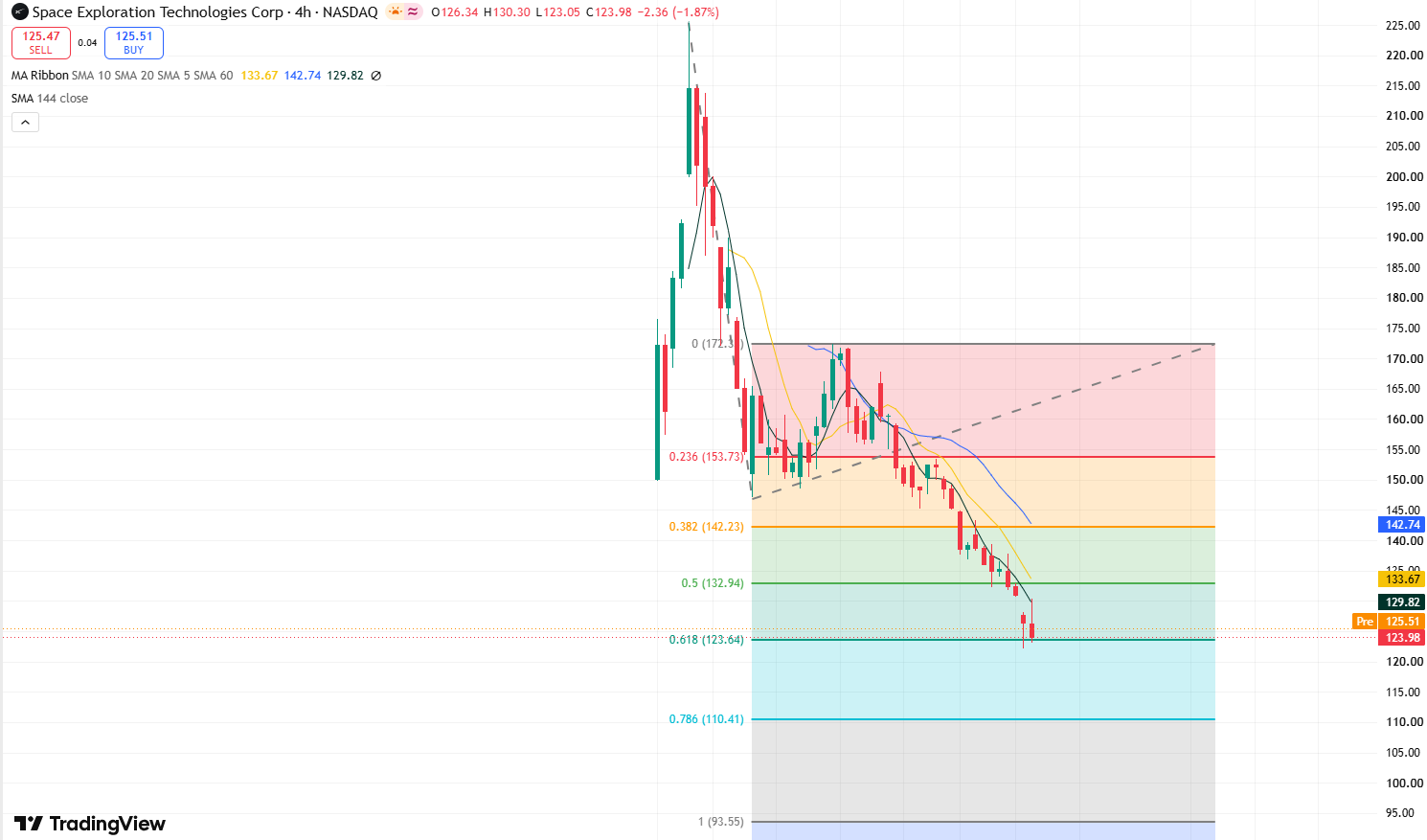
SPCX stock price 4-hour chart, Source: TradingView
According to the 4-hour chart of SPCX, the stock's recent trend shows a pattern of lower highs and lower lows in the candlesticks, indicating a clear overall downward trend. Meanwhile, after the stock price broke below the $150 support level, short-selling momentum in the market has significantly strengthened.
Currently, the SPCX stock price has fallen to near the Fibonacci 0.618 retracement level of $123, where it may find some short-term support. If the price confirms a bottom above this level, it could trigger a short-term technical rebound, potentially testing the resistance level at $132, with the $142-$150 range to watch further up.
Conversely, if the stock price breaks below $123, it may move further down to test the Fibonacci 0.786 retracement level near $110. Continued downward movement could see the price drop to the $100 mark, or even test the support level at $93.
This content was translated using AI and reviewed for clarity. It is for informational purposes only.
Recommended Articles








Comments (1)
Click the $ button, enter the symbol, and select to link a stock, ETF, or other ticker.