


Seagate Technology Holdings PLC Stock (STX) Moved Down by 3.56% on Apr 28: What Investors Need To Know



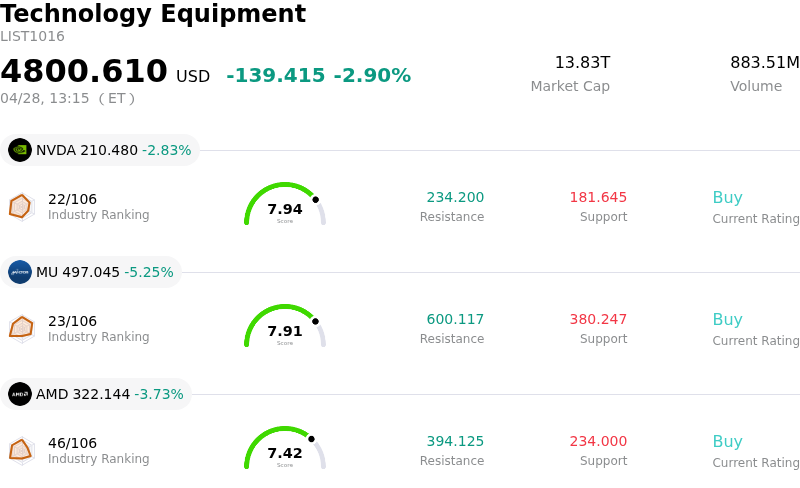
Seagate Technology Holdings PLC (STX) moved down by 3.56%. The Technology Equipment sector is down by 2.90%. The company underperformed the industry. Top 3 stocks by turnover in the sector: NVIDIA Corp (NVDA) down 2.83%; Micron Technology Inc (MU) down 5.25%; Advanced Micro Devices Inc (AMD) down 3.73%.
What is driving Seagate Technology Holdings PLC (STX)’s stock price down today?
Seagate Technology (STX) experienced an intraday decline today, with the price movement likely influenced by market reactions surrounding its upcoming earnings report and broader industry dynamics. The company is scheduled to report its fiscal third-quarter 2026 earnings after the market closes today, April 28, 2026. This proximity to a major financial announcement often leads to increased volatility as investors adjust their positions based on expectations and potential outcomes.
While recent analyst upgrades and positive sentiment regarding Seagate's role in AI-driven data center demand have been prevalent, such anticipation can also lead to profit-taking or increased scrutiny just before results are released. Barclays recently upgraded STX to overweight with a significantly raised price target, citing substantial value in storage amid AI demand and pricing power. Similarly, other firms like BofA Securities and Cantor Fitzgerald also recently lifted their price targets to $700, reflecting optimism about structural tightness in the hard disk drive market and the ramp of next-generation HAMR storage technology.
However, any concerns about whether the company can meet or exceed these elevated expectations, or whether the guidance for the next quarter will fully support the bullish analyst views, could contribute to a negative intraday shift. Reports from late 2025 indicated that HDD manufacturers, including Seagate, had sold out capacity for 2026, leading to increased pricing and elevated margins. While this is fundamentally positive, any hints of demand moderation or production challenges mentioned in the pre-earnings commentary or market whispers could trigger a downward reaction.
Furthermore, general market sentiment on the day of the earnings release can play a role. If there are broader market uncertainties or if the technology sector, in general, faces headwinds, even a stock with positive company-specific catalysts might see pressure. The data storage market remains competitive, with the ongoing interplay between HDDs and SSDs, and while HDDs maintain a cost advantage for mass-capacity storage, any perceived shift in this dynamic could impact investor confidence.
Technical Analysis of Seagate Technology Holdings PLC (STX)
Technically, Seagate Technology Holdings PLC (STX) shows a MACD (12,26,9) value of [39.31], indicating a buy signal. The RSI at 76.57 suggests buy condition and the Williams %R at -10.01 suggests oversold condition. Please monitor closely.
Fundamental Analysis of Seagate Technology Holdings PLC (STX)
Seagate Technology Holdings PLC (STX) is in the Technology Equipment industry. Its latest annual revenue is $9.10B, ranking 9 in the industry. The net profit is $1.47B, ranking 6 in the industry. Company Profile
Over the past month, multiple analysts have rated the company as Buy, with an average price target of $554.26, a high of $800.00, and a low of $381.42.
More details about Seagate Technology Holdings PLC (STX)
Company Specific Risks:
- STX exhibits a premium valuation, with its current P/E ratio of 67.4x indicating it trades significantly above historical averages and one analysis suggesting it is 15.9% overvalued, raising concerns about potential downside if earnings fail to meet heightened expectations.
- Insider activity reveals a notable selling trend, with company insiders selling approximately $46.9 million worth of shares over the past three months and no corresponding insider purchases, which may signal a lack of confidence from those closest to the company's future prospects.
- The company's financial strength indicators are concerning, with a high debt-to-equity ratio of 10.47, placing it worse than 99.59% of peers in the hardware industry, and a low cash-to-debt ratio of 0.22, indicating vulnerability to market fluctuations and over-reliance on borrowing.
- Concerns exist that the market may be overestimating structural improvements in the hard disk drive (HDD) sector compared to memory, posing a risk that demand could eventually flatten, leading to potential sharp earnings declines and intensified competition pressuring currently high margins.
This article may include AI-generated content that is human-reviewed, which is for reference and general information purposes only and does not constitute investment advice.
Recommended Articles






Comments (0)
Click the $ button, enter the symbol, and select to link a stock, ETF, or other ticker.