


Taiwan Semiconductor Manufacturing Co Ltd Stock (TSM) Opened Down by 4.47% on Apr 28: What Investors Need To Know



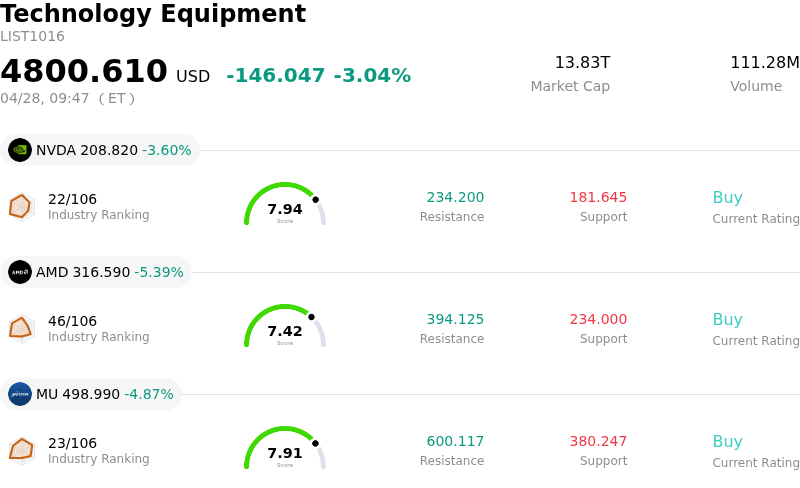
Taiwan Semiconductor Manufacturing Co Ltd (TSM) opened down by 4.47%. The Technology Equipment sector is down by 3.04%. The company underperformed the industry. Top 3 stocks by turnover in the sector: NVIDIA Corp (NVDA) down 3.60%; Advanced Micro Devices Inc (AMD) down 5.39%; Micron Technology Inc (MU) down 4.87%.
What is driving Taiwan Semiconductor Manufacturing Co Ltd (TSM)’s stock price down today?
Taiwan Semiconductor Manufacturing Company (TSM) experienced a decline on April 28, 2026, influenced by a confluence of factors, despite a backdrop of generally strong underlying business performance. A primary contributor to the downward movement appears to be growing concerns over the stock's valuation. Several independent analyses indicated that TSM was trading at a significant premium relative to its intrinsic value, with its current market price considerably higher than its calculated fair value. This perceived overvaluation may have prompted investors to take profits, particularly after a period of substantial gains in the semiconductor sector.
Adding to investor caution were recent developments regarding operational security. Just prior to the intraday volatility, a former engineer was sentenced for leaking critical advanced process technologies, including sensitive manufacturing techniques. This event underscored potential vulnerabilities within the company's highly proprietary operations, raising questions about the security of its intellectual property and potentially impacting market confidence in its long-term competitive advantages. Such incidents can lead to short-term negative sentiment as investors reassess company risks.
While the company reported robust first-quarter 2026 financial results, driven by strong demand for advanced chips in artificial intelligence and high-performance computing, and raised its full-year revenue growth guidance, some concerns remain. The extensive global expansion of fabrication facilities, though strategically important for meeting future demand, has previously been noted by management as a factor that could lead to gross margin dilution over the coming years as these new plants ramp up operations. This longer-term outlook on profitability margins could be a subtle but persistent headwind.
Furthermore, the broader market context suggests a potential for consolidation within the semiconductor industry. After a period of significant upward momentum in chip stocks, market observers noted that some correction or "breather" was likely, especially if earnings from major technology firms did not entirely meet elevated expectations. This general market sentiment, coupled with profit-taking behavior following a strong uptrend in TSM's stock price, could have amplified the intraday decline. Despite numerous analyst upgrades and positive price targets reflecting strong fundamentals and AI-driven growth, the stock's elevated valuation and specific company-related news created a ripe environment for a short-term pullback.
Technical Analysis of Taiwan Semiconductor Manufacturing Co Ltd (TSM)
Technically, Taiwan Semiconductor Manufacturing Co Ltd (TSM) shows a MACD (12,26,9) value of [8.34], indicating a buy signal. The RSI at 69.05 suggests neutral condition and the Williams %R at -17.23 suggests oversold condition. Please monitor closely.
Fundamental Analysis of Taiwan Semiconductor Manufacturing Co Ltd (TSM)
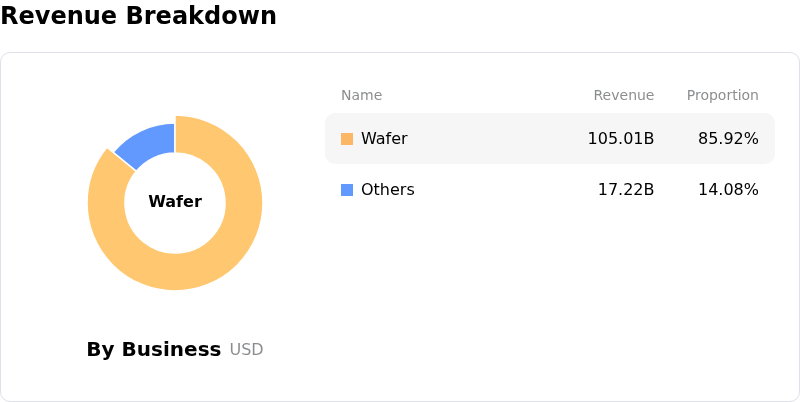
Taiwan Semiconductor Manufacturing Co Ltd (TSM) is in the Technology Equipment industry. Its latest annual revenue is $122.22B, ranking 2 in the industry. The net profit is $55.12B, ranking 2 in the industry. Company Profile
Over the past month, multiple analysts have rated the company as Buy, with an average price target of $446.18, a high of $600.00, and a low of $205.00.
More details about Taiwan Semiconductor Manufacturing Co Ltd (TSM)
Company Specific Risks:
- Persistent geopolitical tensions between China and Taiwan pose an ongoing risk to TSMC's operational continuity and global semiconductor supply chain stability, as evidenced by recent military exercises near Taiwan.
- Increased operating expenses and expected gross margin compression are anticipated in the current quarter due to higher costs associated with new fabrication facilities in the United States and Japan.
- Tightening U.S. export restrictions on advanced chip technology to China could lead to elevated compliance costs, complex client relations, and potential revenue reductions from the Chinese market.
This article may include AI-generated content that is human-reviewed, which is for reference and general information purposes only and does not constitute investment advice.
Recommended Articles







Comments (0)
Click the $ button, enter the symbol, and select to link a stock, ETF, or other ticker.