


General Electric Co Stock (GE) Opened Down by 3.99% on Apr 21: A Full Analysis



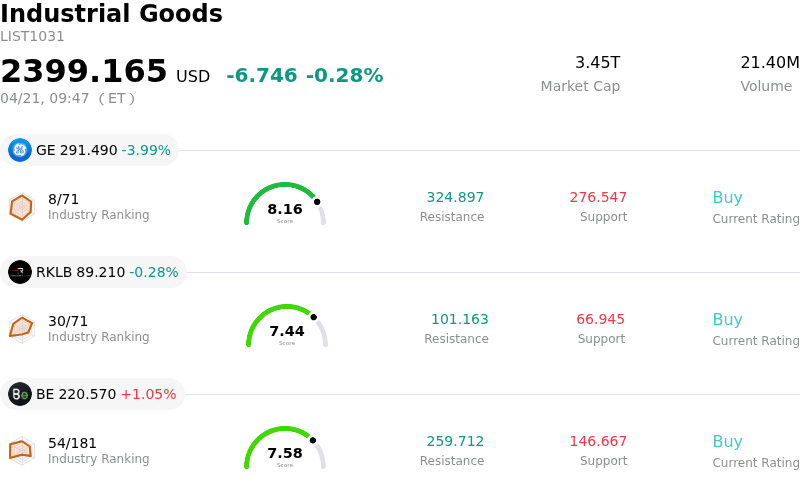
General Electric Co (GE) opened down by 3.99%. The Industrial Goods sector is down by 0.28%. The company underperformed the industry. Top 3 stocks by turnover in the sector: General Electric Co (GE) down 3.99%; Rocket Lab USA Inc (RKLB) down 0.28%; Bloom Energy Corp (BE) up 1.05%.
What is driving General Electric Co (GE)’s stock price down today?
GE Aerospace experienced significant intraday volatility today, with its stock moving lower despite reporting strong first-quarter 2026 financial results. The company exceeded analyst expectations for both adjusted earnings per share and revenue. Adjusted EPS came in at $1.86, surpassing estimates, while revenue of $12.39 billion also beat forecasts. Furthermore, total orders saw a substantial increase, and free cash flow demonstrated solid growth.
However, the primary driver for the negative stock movement appears to be related to the company's full-year outlook and certain underlying financial metrics. While GE Aerospace reiterated its 2026 adjusted earnings guidance, stating it was trending towards the higher end of the projected range, the top end of this maintained guidance still fell short of Wall Street's consensus expectations for the full year. This suggests that investors were anticipating a formal increase in the full-year forecast following the strong Q1 performance, and the lack thereof led to disappointment.
Additionally, the company issued warnings regarding potential macroeconomic headwinds. Management cited ongoing concerns about elevated oil prices, fuel supply constraints, and a slower global growth environment. They also adjusted down their forecast for global aircraft departures in 2026, now expecting flat to low single-digit growth, which is a reduction from earlier, more optimistic projections, particularly noting anticipated declines in Middle East departures. These factors likely contributed to investor apprehension about future performance.
Further contributing to the sentiment, the company's GAAP net income from continuing operations was essentially flat compared to the prior year, and GAAP profit margins experienced a notable decline, despite the robust adjusted figures. Insider selling activity over the past several months may also have added to investor caution.
Technical Analysis of General Electric Co (GE)
Technically, General Electric Co (GE) shows a MACD (12,26,9) value of [-1.90], indicating a neutral signal. The RSI at 50.01 suggests neutral condition and the Williams %R at -35.86 suggests oversold condition. Please monitor closely.
Fundamental Analysis of General Electric Co (GE)
General Electric Co (GE) is in the Industrial Goods industry. Its latest annual revenue is $45.85B, ranking 5 in the industry. The net profit is $8.70B, ranking 1 in the industry. Company Profile
Over the past month, multiple analysts have rated the company as Buy, with an average price target of $349.34, a high of $425.00, and a low of $290.00.
More details about General Electric Co (GE)
Company Specific Risks:
- GE Aerospace’s reaffirmed full-year guidance, while trending towards the high end, remained below Wall Street consensus estimates following Q1 2026 earnings, contributing to a stock decline.
- Geopolitical tensions, specifically the Iran conflict, are anticipated to result in elevated crude oil prices and reduced fuel availability, leading to a lowered outlook for global aircraft departures, especially in the Middle East.
- The company's current high Price-to-Earnings (P/E) ratio of 37.3x and recent insider selling activity of $11.7 million in shares over the past three months may signal potential overvaluation and raise investor concerns about future performance.
- Persistent supply chain complexities, including issues with material availability, labor shortages, and supplier capacity constraints across over 500 direct suppliers, continue to challenge production commitments and timely deliveries.
This article may include AI-generated content that is human-reviewed, which is for reference and general information purposes only and does not constitute investment advice.
Recommended Articles









Comments (0)
Click the $ button, enter the symbol, and select to link a stock, ETF, or other ticker.