EMERGING MARKETS-Emerging market assets slide as Middle East conflict escalates

By Twesha Dikshit
March 2 (Reuters) - Emerging market stocks, bonds and currencies fell on Monday after U.S. and Israeli strikes on Iran and Tehran's retaliation raised fears of a wider Middle East conflict, driving oil prices sharply higher and sparking a dash into havens such as gold.
The MSCI index of emerging market equities .MSCIEF dropped 1.7%, its steepest decline in a month. A corresponding gauge for currencies .MIEM00000CUS fell 0.7%, set for its biggest fall in over three years.
International bonds from a number of Middle Eastern countries, as well as riskier emerging-market economies, came under pressure.
"Current geopolitical events will have significant impact on global markets," said Luis Costa at Citi in a note to clients. "We anticipate that oil shocks could aggressively de-anchor domestic inflation expectations in emerging markets ... Frontier markets appear particularly vulnerable."
Bourses in Kuwait and the United Arab Emirates temporarily closed, citing "exceptional circumstances".
International bonds issued by Egypt tumbled more than 2 cents on the dollar, while debt from Saudi Arabia and Jordan was down almost 2 cents, Tradeweb data showed.
Elsewhere in fixed income markets, Saudi five-year credit default swaps - instruments that gauge an issuer's risk of default - jumped to a near one-year high of 88 basis points from Friday's 82 bps. Qatar's CDS rose to 33 bps from 32 bps, according to S&P Global Market Intelligence.
The conflict could weigh on global economic growth and reignite inflation, though much will depend on how long it lasts. President Donald Trump said the attacks would continue until U.S. objectives were met.
Gauging the impact on emerging economies, JPMorgan said it expected Bahrain and the UAE to suffer the biggest hit. The Wall Street bank trimmed its forecast for non-oil growth across Gulf Cooperation Council countries by 0.3 percentage points and flagged risks for larger revisions.
"Barring a situation in which the conflict impacts production of oil in the Middle East and prices increase sharply, well in excess of $100/bbl for Brent, we do not see strong reasons for significant macroeconomic implications outside of the Middle East," they said in a note.
ESCALATING CONFLICT, DOMESTIC DATA ON WATCH
Stocks and bonds in Turkey, which neighbours Iran, also came under pressure. Turkey's blue-chip equity index .XU100 slumped 3.3%, while the lira TRY= ticked lower against the greenback and its international bonds slipped more than 1 cent, with longer-dated debt suffering the biggest declines.
Separately, data showed that Turkey's economy grew 3.4% year-on-year in the fourth quarter, slightly below expectations.
Hungary's benchmark index .BUX lost 1.3%, while Poland's .WIG20 fell 1%. PMI data showed Poland's manufacturing sector faced a steep drop in new orders while input cost inflation hit a 37-month high. Hungary's PMI rose to 51.3 in February, remaining below the long-term average.
Bourses in Czech Republic .PX and Romania .BETI were down 1.6% and 1.2%, respectively.
A bright spot, Israel's equities .TA125 climbed 4.6% while its shekel ILS= appreciated 1.5% versus the dollar to 3.087, nearing a 30-year high reached last month.
Stocks in gold-exporter South Africa .JTOPI added 0.2%.
Most emerging Europe currencies were lower against the euro, with the Hungarian forint EURHUF= 1.1% weaker, while Poland's zloty EURPLN= lost 0.1%.
In Asia, most equity indexes fell, with those in South Korea .KS11 and Taiwan .TWII down about 1% each, as the conflict disrupted oil flows to several Asian countries. Philippine's stocks .PSI lost 2.8%, while Thailand's SET Index .SETI fell 3.1%.
Airline shares worldwide came under pressure from flight disruptions and rising oil prices, while focus remained on a potential closure of the Strait of Hormuz. The vital waterway is a conduit for about a fifth of the world's seaborne oil trade flows as well as large quantities of liquefied natural gas.
For TOP NEWS across emerging markets nTOPEMRG
For CENTRAL EUROPE market report, see CEE/
For TURKISH market report, see .IS
For RUSSIAN market report, see RU/RUB
Related Articles
JPMorgan Warns Hormuz Blockade Risks Oil Shutdown in 25 Days, But How Will the US-Iran Conflict Shape Global Oil Prices?
TradingKey - Following the announcement on the night of February 28 banning all vessels from passing through the Strait of Hormuz, JPMorgan Chase issued a warning: if the Strait of Hormuz is completely blocked, the combined onshore and offshore storage capacity of Middle Eastern oil-producing nation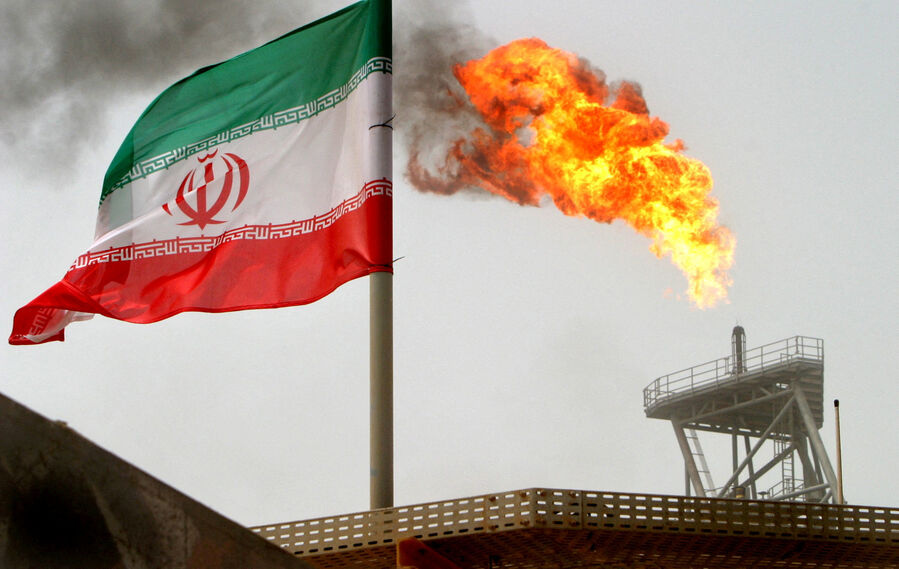
US-Iran Conflict Ignites, Global Arms Race Heats Up, Will Defense Stocks See a New Round of Gains?
TradingKey - On February 28 local time, the United States and Israel launched joint large-scale airstrikes against Iran, targeting its nuclear facilities, missile industry, and naval forces. This marks another sharp escalation in the conflict following the US military strikes on Iranian nuclear facilities in June last year. The military operation not only exacerbates already strained geopolitical tensions but has also sent shockwaves through global capital markets, which is expected to further boost defense stocks.
U.S.-Iran Conflict Escalates. Strait of Hormuz Shutdown, How Much Room for Oil Prices to Rise?
TradingKey - A sharp escalation in geopolitical risks has directly triggered intense volatility in global crude oil markets. At the market open this Monday, WTI crude oil futures surged by over 11%, and Brent crude opened up 13%, though these gains subsequently narrowed.
Shiba Inu 2026: L3 Evolution & the Next Bull Run
Discover the Shiba Inu (SHIB) 2026 outlook as it evolves from a meme coin into a sophisticated L3 utility network. This analysis covers the critical $0.00000589 support level, the impact of U.S. government SHIB holdings, and the Shibarium update featuring FHE privacy. Explore the "next Shiba Inu" bu
How Tesla Survives the Cold Winter, Will Tesla Stock Continue to Fall in 2026?
TradingKey — Recently, weighed down by earnings missing expectations and factors such as AI bubble and disruption theories, Tesla (TSLA) shares have continued to slide, falling nearly 20% from their December 2025 peak.