


EUR/USD soars past 1.1900 as China treasury news sinks US Dollar



- EUR/USD jumps over 0.80% as China-linked Treasury trimming drives broad Dollar weakness.
- Risk-on tone and Japan election outcome push DXY to six-day lows amid scarce US data.
- Focus turns to US Retail Sales, wages, and ECB comments from Christine Lagarde.
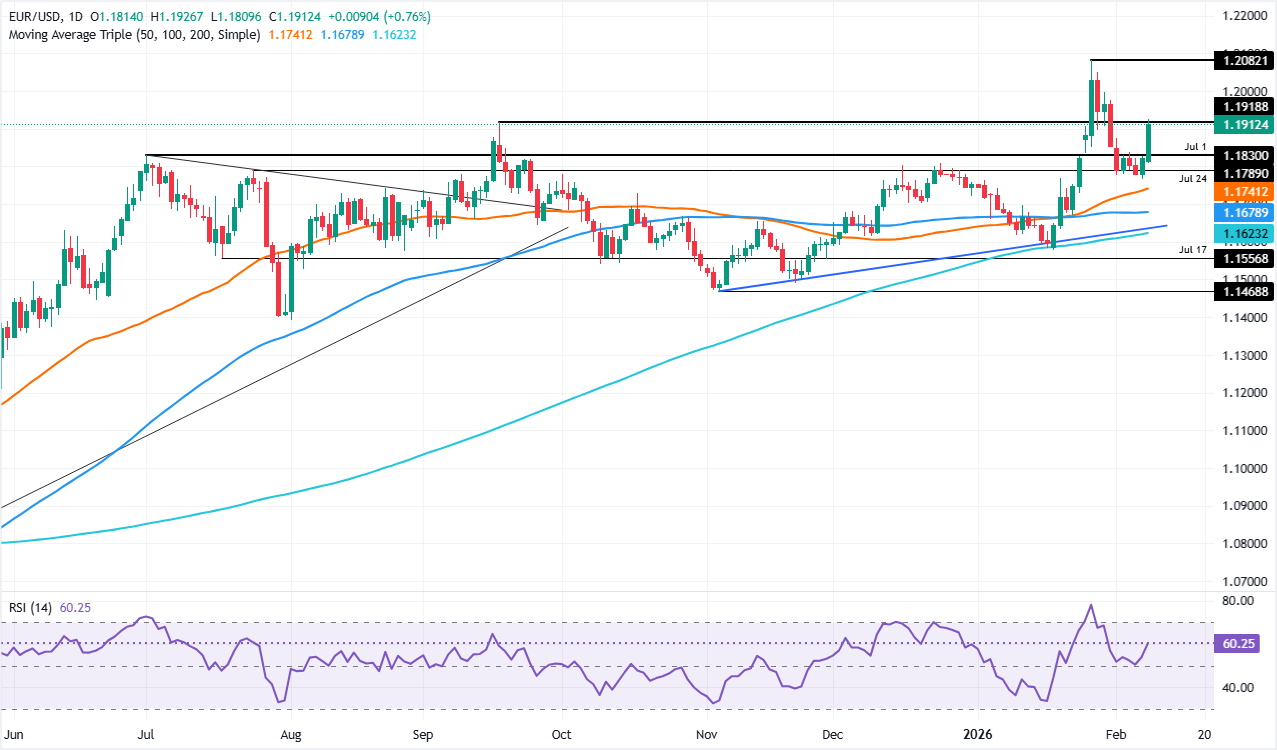
EUR/USD rallies over 0.80% on Monday as the Greenback treads water following breaking news that Chinese authorities recommended financial institutions to trim their positions on US Treasuries, due to sharp volatility swings in the fixed income markets. At the time of writing, the pair trades at 1.1916 after bouncing off daily lows of 1.1808.
Euro jumps as reports of reduced Chinese Treasury exposure and improved risk appetite pressure the Greenback
Risk appetite improvement and the Japanese Prime Minister Takaichi’s landslide victory in Japan, pushed the American currency to a new six day low, as depicted by the US Dollar Index (DXY).
Initially, the USD/JPY rose higher, but retreated after the Japanese top diplomat Atsushi Mimura warned that they’re “closely watching currency movements with a high sense of urgency.”
A scarce economic docket in the US witnessed the release of the NY Fed Survey of Consumers Expectations and speeches by Federal Reserve officials. On Tuesday, traders would eye the release of Retail Sales data and the Employment Cost Index, which measures wages.
In Europe the schedule featured speeches by European Central Bank (ECB) officials. The ECB President Lagarde said that Francois Villeroy will step down at the central bank on June 1.
Euro Price This week
The table below shows the percentage change of Euro (EUR) against listed major currencies this week. Euro was the strongest against the Australian Dollar.
| USD | EUR | GBP | JPY | CAD | AUD | NZD | CHF | |
|---|---|---|---|---|---|---|---|---|
| USD | 0.02% | -0.02% | 0.02% | -0.04% | 0.01% | 0.00% | -0.02% | |
| EUR | -0.02% | -0.04% | -0.04% | -0.06% | -0.01% | -0.01% | -0.04% | |
| GBP | 0.02% | 0.04% | 0.02% | -0.05% | 0.03% | 0.02% | -0.01% | |
| JPY | -0.02% | 0.04% | -0.02% | -0.05% | -0.00% | -0.01% | -0.04% | |
| CAD | 0.04% | 0.06% | 0.05% | 0.05% | 0.05% | 0.04% | 0.02% | |
| AUD | -0.01% | 0.00% | -0.03% | 0.00% | -0.05% | -0.01% | -0.04% | |
| NZD | -0.00% | 0.00% | -0.02% | 0.01% | -0.04% | 0.01% | -0.02% | |
| CHF | 0.02% | 0.04% | 0.00% | 0.04% | -0.02% | 0.04% | 0.02% |
The heat map shows percentage changes of major currencies against each other. The base currency is picked from the left column, while the quote currency is picked from the top row. For example, if you pick the Euro from the left column and move along the horizontal line to the US Dollar, the percentage change displayed in the box will represent EUR (base)/USD (quote).
Daily Market Movers: The Euro rises as the US Dollar treads water
- The US Dollar Index, which tracks the greenback against a basket of six major currencies, is down 0.86% at 96.82.
- The New York Fed’s Survey of Consumer Expectations showed that one-year inflation expectations eased to 3.1% in January from 3.4%. Inflation expectations over the three- and five-year horizons were unchanged at 3%.
- Digging deeper into the poll, credit conditions cooled compared with December, while perceptions about the labor market improved.
- ECB Gediminas Šimkus said that there’s a 50/50 chance that the next move is a hike or a cut, as rates are at neutral level, with growth near potential. ECB Martin Kocher said that inflation expectations are fully anchored, and that it would require a change in the macroeconomic environment to move away from the current policy stance.
- European Central Bank (ECB) President Christine Lagarde said that they expect inflation to stabilize sustainably at the ECB's 2% medium-term target, during the plenary debate on the state of the Eurozone economy and ECB activities in Strasbourg, France, on Monday.
Technical outlook: EUR/USD consolidates past 1.1900, bullish above 1.2000
The EUR/USD technical picture shows the pair is neutral to downward biased as it has achieved successive series of lower lows, while the most recent high at 1.1926 it remains below the yearly peak of 1.2079.
Although momentum turned bullish as depicted by the Relative Strength Index (RSI), the pair needs to clear the yearly peak, to resume the uptrend.
On the flip side, if EUR/USD dives below 1.1900, clears the path to test 1.1800 followed by the 20-day Simple Moving Average (SMA) at 1.1786. On further weakness, the next stop would be the 50-day SMA at 1.1734, followed by 1.1700.
Euro FAQs
The Euro is the currency for the 20 European Union countries that belong to the Eurozone. It is the second most heavily traded currency in the world behind the US Dollar. In 2022, it accounted for 31% of all foreign exchange transactions, with an average daily turnover of over $2.2 trillion a day. EUR/USD is the most heavily traded currency pair in the world, accounting for an estimated 30% off all transactions, followed by EUR/JPY (4%), EUR/GBP (3%) and EUR/AUD (2%).
The European Central Bank (ECB) in Frankfurt, Germany, is the reserve bank for the Eurozone. The ECB sets interest rates and manages monetary policy. The ECB’s primary mandate is to maintain price stability, which means either controlling inflation or stimulating growth. Its primary tool is the raising or lowering of interest rates. Relatively high interest rates – or the expectation of higher rates – will usually benefit the Euro and vice versa. The ECB Governing Council makes monetary policy decisions at meetings held eight times a year. Decisions are made by heads of the Eurozone national banks and six permanent members, including the President of the ECB, Christine Lagarde.
Eurozone inflation data, measured by the Harmonized Index of Consumer Prices (HICP), is an important econometric for the Euro. If inflation rises more than expected, especially if above the ECB’s 2% target, it obliges the ECB to raise interest rates to bring it back under control. Relatively high interest rates compared to its counterparts will usually benefit the Euro, as it makes the region more attractive as a place for global investors to park their money.
Data releases gauge the health of the economy and can impact on the Euro. Indicators such as GDP, Manufacturing and Services PMIs, employment, and consumer sentiment surveys can all influence the direction of the single currency. A strong economy is good for the Euro. Not only does it attract more foreign investment but it may encourage the ECB to put up interest rates, which will directly strengthen the Euro. Otherwise, if economic data is weak, the Euro is likely to fall. Economic data for the four largest economies in the euro area (Germany, France, Italy and Spain) are especially significant, as they account for 75% of the Eurozone’s economy.
Another significant data release for the Euro is the Trade Balance. This indicator measures the difference between what a country earns from its exports and what it spends on imports over a given period. If a country produces highly sought after exports then its currency will gain in value purely from the extra demand created from foreign buyers seeking to purchase these goods. Therefore, a positive net Trade Balance strengthens a currency and vice versa for a negative balance.
Recommended Articles








Comments (0)
Click the $ button, enter the symbol, and select to link a stock, ETF, or other ticker.