


EUR/USD remains steady near four-year highs despite Fed hawkishness



- EUR/USD treads water near 1.2000 after bouncing up from the 1.1900 area.
- The US Dollar retreats on Thursday as the impact of the Fed's hawkish stance wanes.
- Comments by ECB officials hinting at interest rate cuts are keeping Euro bulls in check.
The EUR/USD pair is trading higher on Thursday, with price action back at 1.1970 at the time of writing, after bouncing from lows right below 1.1900 the previous day. The Federal Reserve's (Fed) hawkish stance at Wednesday's meeting and comments by US Treasury Secretary Scott Bessent touting a strong US Dollar (USD) provided some support to the currency, but failed to trigger a solid recovery.
The Fed left interest rates on hold, with Chairman Jerome Powell showing more confidence about the economy and the labor market, adding to the case for a steady monetary policy in the coming months.
Apart from that, US Treasury Secretary Scott Bessent mended US President Donald Trump's comments, affirming that Washington pursues a "strong-Dollar" policy, while European Central Bank (ECB) and European Union (EU) officials started to complain about excessive Euro strength, which contributed to pushing EUR/USD lower.
In the Eurozone economic calendar on Thursday, the Consumer Confidence for January might provide some distraction. In the US, Goods Trade Balance, Factory Orders, and the weekly Jobless Claims data might provide some guidance to the US Dollar.
Euro Price Today
The table below shows the percentage change of Euro (EUR) against listed major currencies today. Euro was the strongest against the US Dollar.
| USD | EUR | GBP | JPY | CAD | AUD | NZD | CHF | |
|---|---|---|---|---|---|---|---|---|
| USD | -0.23% | -0.23% | -0.02% | -0.22% | -0.57% | -0.38% | -0.29% | |
| EUR | 0.23% | -0.00% | 0.18% | 0.01% | -0.34% | -0.15% | -0.06% | |
| GBP | 0.23% | 0.00% | 0.23% | 0.01% | -0.36% | -0.17% | -0.06% | |
| JPY | 0.02% | -0.18% | -0.23% | -0.20% | -0.54% | -0.38% | -0.27% | |
| CAD | 0.22% | -0.01% | -0.01% | 0.20% | -0.35% | -0.17% | -0.08% | |
| AUD | 0.57% | 0.34% | 0.36% | 0.54% | 0.35% | 0.19% | 0.29% | |
| NZD | 0.38% | 0.15% | 0.17% | 0.38% | 0.17% | -0.19% | 0.09% | |
| CHF | 0.29% | 0.06% | 0.06% | 0.27% | 0.08% | -0.29% | -0.09% |
The heat map shows percentage changes of major currencies against each other. The base currency is picked from the left column, while the quote currency is picked from the top row. For example, if you pick the Euro from the left column and move along the horizontal line to the US Dollar, the percentage change displayed in the box will represent EUR (base)/USD (quote).
Daily Digest Market Movers: Euro consolidates gains, the US Dollar remains vulnerable
- The US Dollar drew some support from Wednesday's Fed hawkish stance and US Treasury Secretary Bessent's comments. The Greenback's upside attempts, however, remain limited, with investors pricing further rate cuts from May on, when Trump replaces Powell with a more dovish Fed Chairman.
- The US Dollar Index, which measures the value of the Greenback against a basket of currencies, remains more than 2% down in 2026 so far, weighed by Trump's erratic trade policies and the attacks on the Fed's independence, two of the main pillars of the US Dollar's status as reserve currency.
- In Europe, the ECB officials' view that monetary policy is in a good place is starting to show its first cracks. ECB member and Austrian central bank governor Martin Kocher mentioned interest rate cuts for the first time since June last year, and German Chancellor Friedrich Merz complained that USD weakness is a burden for German exports. If the stance of the European Central Bank changes, the Euro might see a deeper correction.
- In the macroeconomic front, the Eurozone Consumer Confidence index, due later on the day, is expected to remain at -12.4 in January, unchanged from the previous month. The Industrial Confidence is forecast to improve to -8.1 from -9 in the previous month.
- In the US, Initial Jobless Claims are expected to have increased to 205K last week, from the 200K reading in the previous week.
- At a later time, US Factory Orders are expected to show a rebound to 1.6% in November, following a 1.3% contraction in October.
- The US Goods and Services Trade Balance, on the contrary, is forecasted to show a widening deficit of $40.5 billion in November, from the $29.4 billion trade gap seen in October.
Technical Analysis: EUR/USD consolidates between 1.1900 and 1.2000
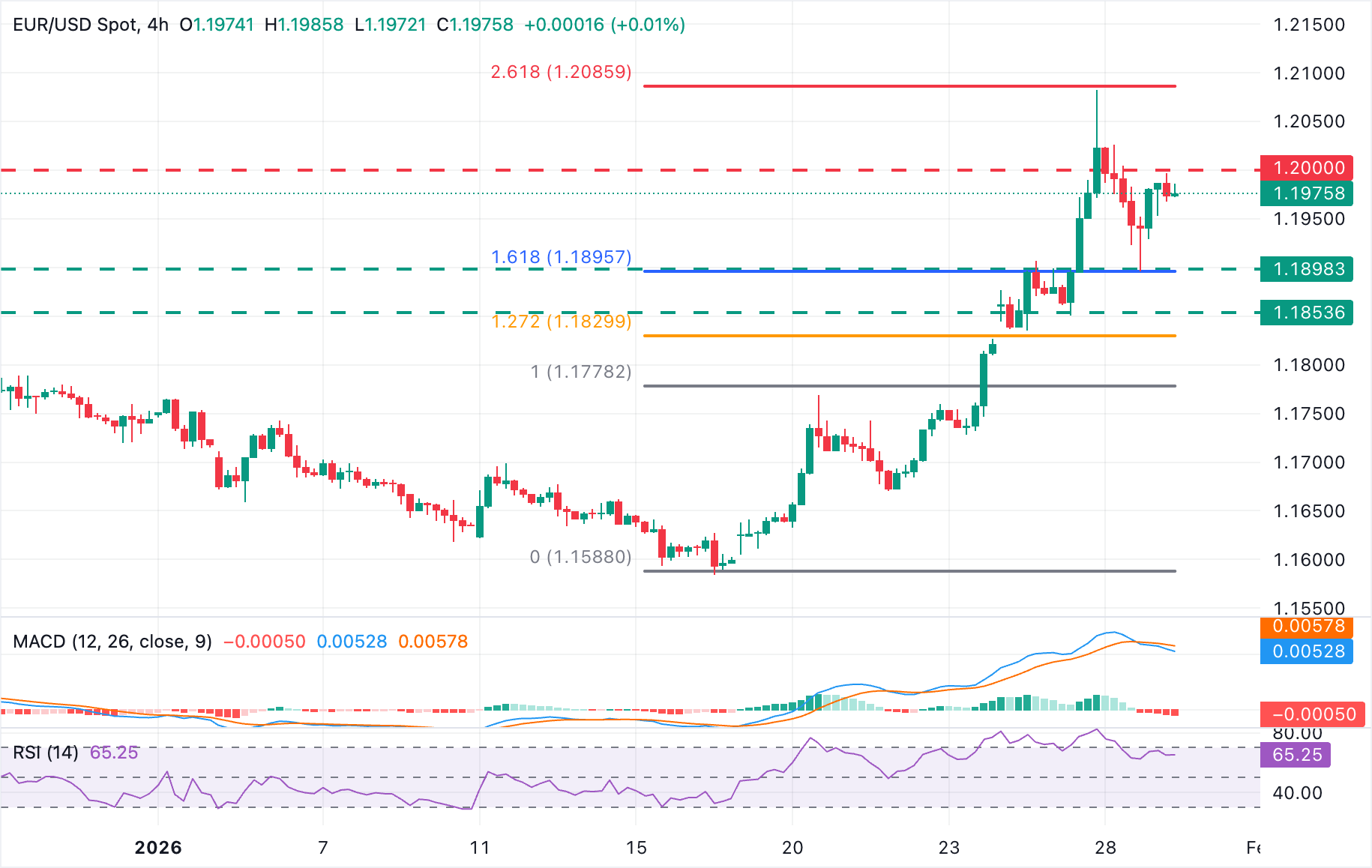
EUR/USD is in a consolidation phase after the reversal from the 261.8% Fibonacci extension of the January 16-20 uptrend, at 1.2085, was contained at the 1.1900 area.
Technical indicators are mixed. The Relative Strength Index (RSI) stands at 65 on the 4-hour chart, highlighting a positive trend, although the Moving Average Convergence Divergence (MACD) has crossed below the signal line, with the histogram turning negative, which points to a fading upside momentum.
Support levels are at Wednesday's low in the area of 1.1900, and the January 27 low, at 1.1850. On the upside, the 1.2000 psychological level is holding bulls at the present time, ahead of the 1.2082 long-term high hit on Tuesday.
(The technical analysis of this story was written with the help of an AI tool.)
Euro FAQs
The Euro is the currency for the 20 European Union countries that belong to the Eurozone. It is the second most heavily traded currency in the world behind the US Dollar. In 2022, it accounted for 31% of all foreign exchange transactions, with an average daily turnover of over $2.2 trillion a day. EUR/USD is the most heavily traded currency pair in the world, accounting for an estimated 30% off all transactions, followed by EUR/JPY (4%), EUR/GBP (3%) and EUR/AUD (2%).
The European Central Bank (ECB) in Frankfurt, Germany, is the reserve bank for the Eurozone. The ECB sets interest rates and manages monetary policy. The ECB’s primary mandate is to maintain price stability, which means either controlling inflation or stimulating growth. Its primary tool is the raising or lowering of interest rates. Relatively high interest rates – or the expectation of higher rates – will usually benefit the Euro and vice versa. The ECB Governing Council makes monetary policy decisions at meetings held eight times a year. Decisions are made by heads of the Eurozone national banks and six permanent members, including the President of the ECB, Christine Lagarde.
Eurozone inflation data, measured by the Harmonized Index of Consumer Prices (HICP), is an important econometric for the Euro. If inflation rises more than expected, especially if above the ECB’s 2% target, it obliges the ECB to raise interest rates to bring it back under control. Relatively high interest rates compared to its counterparts will usually benefit the Euro, as it makes the region more attractive as a place for global investors to park their money.
Data releases gauge the health of the economy and can impact on the Euro. Indicators such as GDP, Manufacturing and Services PMIs, employment, and consumer sentiment surveys can all influence the direction of the single currency. A strong economy is good for the Euro. Not only does it attract more foreign investment but it may encourage the ECB to put up interest rates, which will directly strengthen the Euro. Otherwise, if economic data is weak, the Euro is likely to fall. Economic data for the four largest economies in the euro area (Germany, France, Italy and Spain) are especially significant, as they account for 75% of the Eurozone’s economy.
Another significant data release for the Euro is the Trade Balance. This indicator measures the difference between what a country earns from its exports and what it spends on imports over a given period. If a country produces highly sought after exports then its currency will gain in value purely from the extra demand created from foreign buyers seeking to purchase these goods. Therefore, a positive net Trade Balance strengthens a currency and vice versa for a negative balance.
Recommended Articles









Comments (0)
Click the $ button, enter the symbol, and select to link a stock, ETF, or other ticker.