


Breaking: Bitcoin slips below $70,000 as falling knife scenario in play



- Bitcoin price slips below $70,000 on Thursday, falling nearly 20% so far in 2026.
- Momentum indicators continue to deteriorate, signaling strengthening bearish pressure and confirming the weakening technical outlook.
- Technical levels suggest BTC could test the $65,000 psychological support if selling pressure continues.
Bitcoin (BTC) price dips below $70,000 on Thursday, having corrected nearly 20% for this year. Market momentum turned extremely bearish, with technical indicators pointing to further downside toward the next key support at $65,000.
Bitcoin could retest the $65,000 mark if the correction deepens
Bitcoin has extended its decline by more than 20% so far this week, after correcting by 7.48% in the previous one. As of Thursday, BTC is trading below $70,000, levels not seen since early November 2024.
The current market situation suggests a falling knife scenario. Traders should be cautious, as attempting to buy the dip remains risky, as the downside may not be complete yet.
If BTC continues its downward trend, it could extend the decline toward the key psychological level of $65,000.
The Relative Strength Index (RSI) reads 20 on the daily chart, indicating an oversold condition and strong bearish momentum. The Moving Average Convergence Divergence (MACD) also showed a bearish crossover on January 20, which remains intact with rising red histogram bars below the neutral level, further supporting the negative outlook.
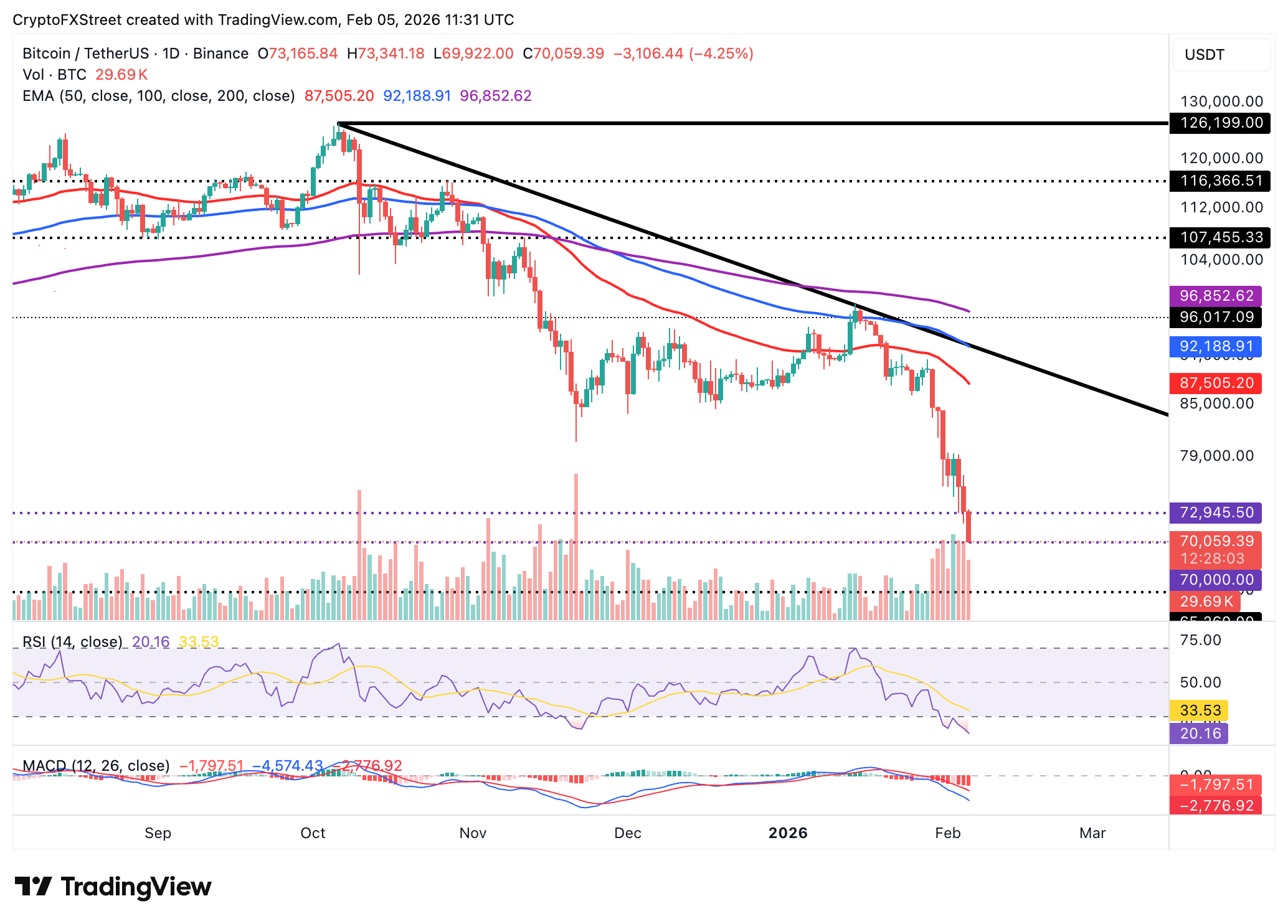
Meanwhile, market participants should keep a watch as the primary trend for BTC remains bearish, so any short-term recovery has a high probability of a dead-cat bounce — a brief price increase within a broader downtrend.
If BTC recovers, it could extend the advance toward the key psychological level at $75,000.
( ... Developing story, please refresh the page for updates...)
Bitcoin, altcoins, stablecoins FAQs
Bitcoin is the largest cryptocurrency by market capitalization, a virtual currency designed to serve as money. This form of payment cannot be controlled by any one person, group, or entity, which eliminates the need for third-party participation during financial transactions.
Altcoins are any cryptocurrency apart from Bitcoin, but some also regard Ethereum as a non-altcoin because it is from these two cryptocurrencies that forking happens. If this is true, then Litecoin is the first altcoin, forked from the Bitcoin protocol and, therefore, an “improved” version of it.
Stablecoins are cryptocurrencies designed to have a stable price, with their value backed by a reserve of the asset it represents. To achieve this, the value of any one stablecoin is pegged to a commodity or financial instrument, such as the US Dollar (USD), with its supply regulated by an algorithm or demand. The main goal of stablecoins is to provide an on/off-ramp for investors willing to trade and invest in cryptocurrencies. Stablecoins also allow investors to store value since cryptocurrencies, in general, are subject to volatility.
Bitcoin dominance is the ratio of Bitcoin's market capitalization to the total market capitalization of all cryptocurrencies combined. It provides a clear picture of Bitcoin’s interest among investors. A high BTC dominance typically happens before and during a bull run, in which investors resort to investing in relatively stable and high market capitalization cryptocurrency like Bitcoin. A drop in BTC dominance usually means that investors are moving their capital and/or profits to altcoins in a quest for higher returns, which usually triggers an explosion of altcoin rallies.
Recommended Articles











Comments (0)
Click the $ button, enter the symbol, and select to link a stock, ETF, or other ticker.