


WTI Crude crashes below $90 as Trump suspends Iran strikes, but will it last?



WTI Crude Oil plunged from above $106 to below $90 per barrel on Tuesday after President Trump announced a two-week suspension of military operations against Iran, though markets had already been selling Oil throughout the session as traders bet he would blink on his own 00:00 GMT Wednesday deadline. S&P 500 E-minis surged 1.1%, and Nasdaq futures jumped 1.2% on the confirmation, but logical warnings exist that infrastructure damage to Gulf production facilities means supply normalization could take months even if a permanent deal is reached.
What just happened?
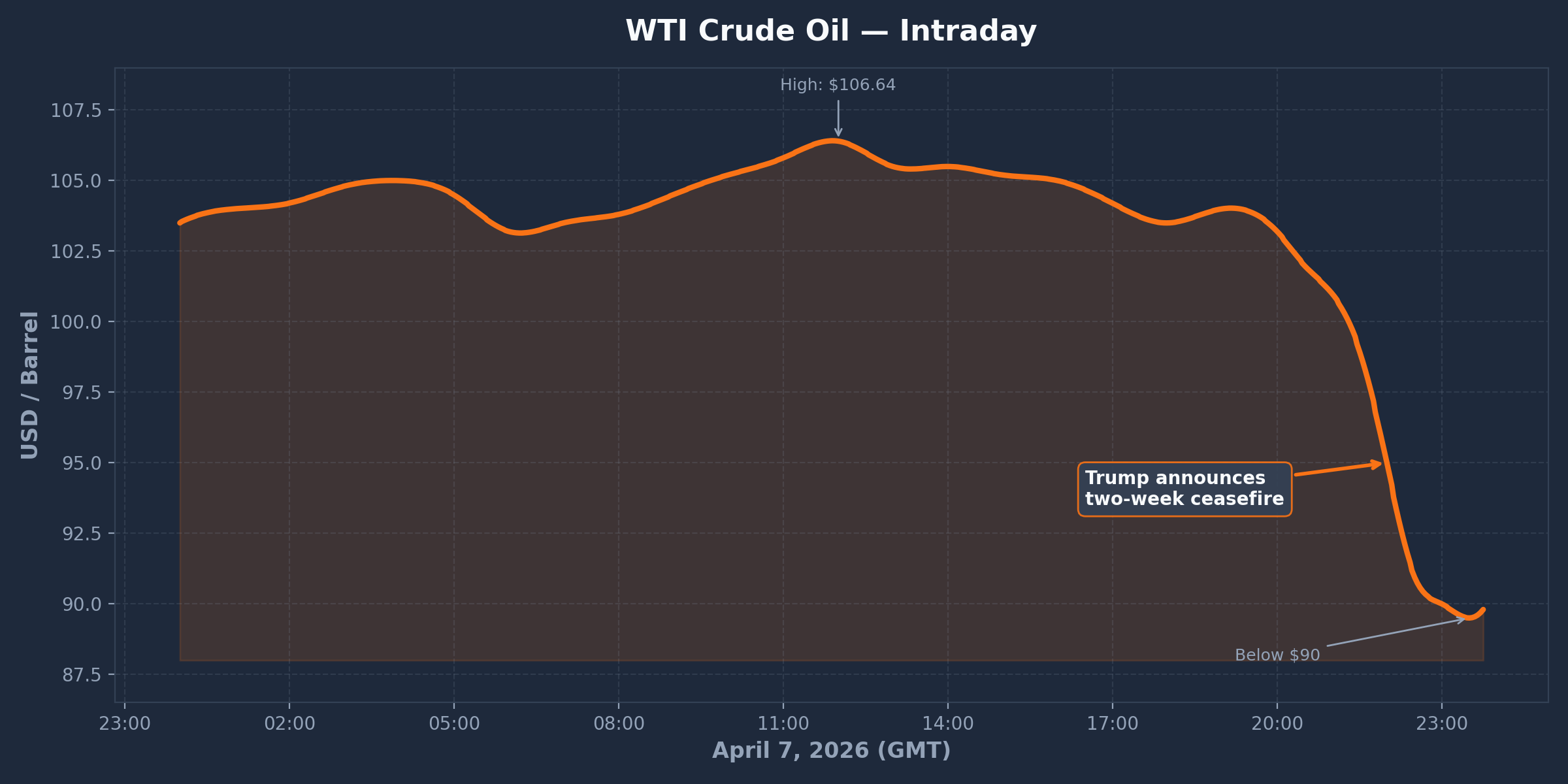
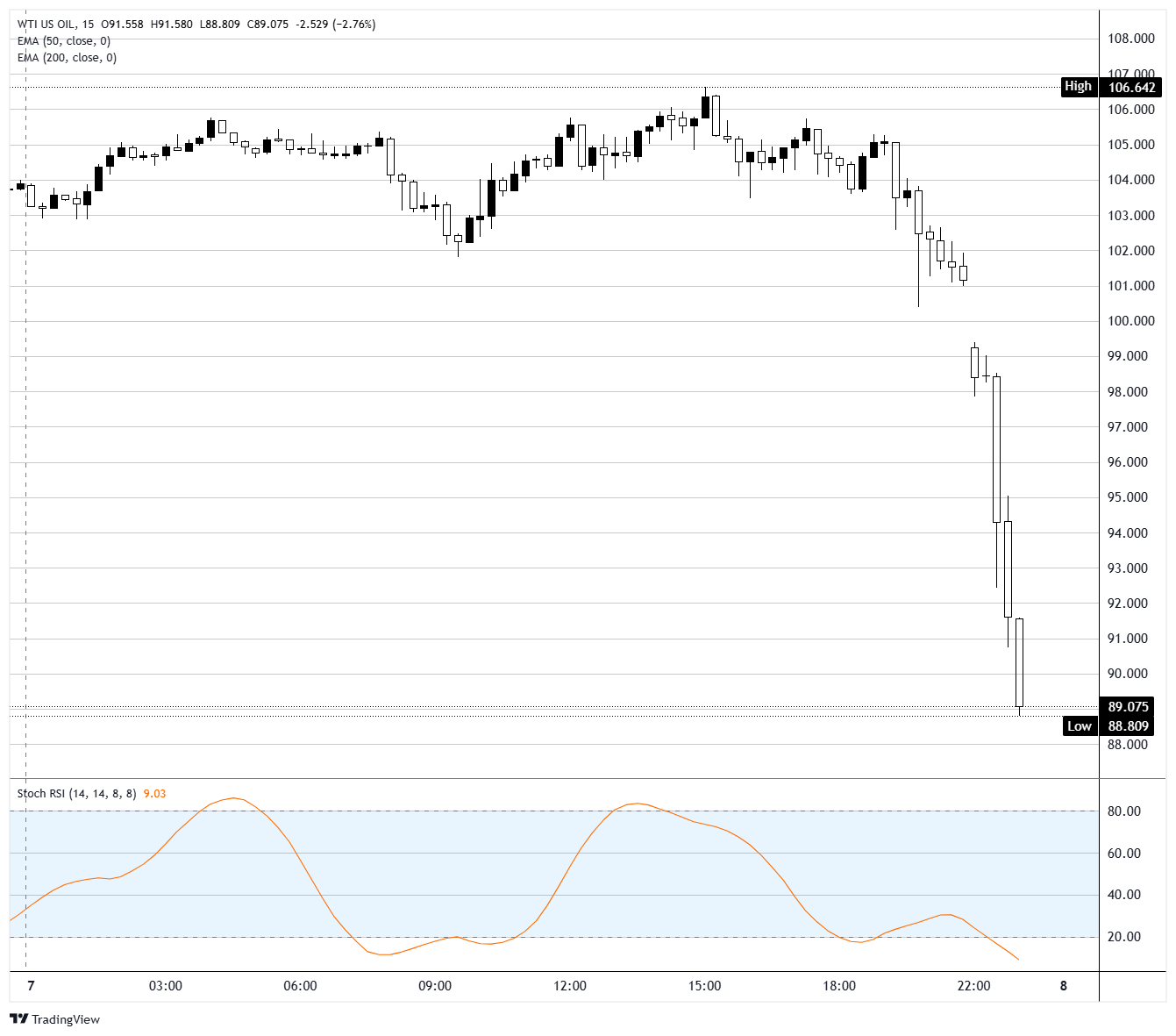
West Texas Intermediate (WTI) US Crude Oil's war premium just took its biggest hit in weeks, and the market saw it coming. WTI Crude Oil cratered from above $106 to back below $90 per barrel on Tuesday, its sharpest intraday decline since the conflict began. The crash came after President Trump posted on Truth Social that he would suspend bombing and attacks on Iran for two weeks. But the selloff did not begin with that post. Prices had been leaking lower throughout the session as traders, now well-versed in Trump's pattern of setting aggressive deadlines only to extend them, positioned for exactly this outcome. By the time the announcement hit, the market had already done much of the heavy lifting.
Traders had the playbook memorized
This was Trump's fourth deadline for Iran since the conflict began in late February. Each prior ultimatum followed the same arc: inflammatory rhetoric, a hard deadline, last-minute diplomatic activity, then an extension. The late-March five-day pause sent WTI tumbling 11% in a single session. The April 1 "ceasefire" claim produced another sharp dip before prices ground back higher. Traders did not need to wait for the Truth Social post this time around. Reports earlier in the day that Pakistan, Egypt, and Turkey were making a last-ditch mediation push gave the market its cue, and the S&P 500 erased a 1.2% intraday decline well before Trump confirmed the pause. Oil followed suit, sliding steadily from the session high above $106 before the announcement turned an orderly retreat into a vertical drop that tested territory south of $90 per barrel.
Pakistan brokers the off-ramp
The ceasefire came together through Pakistani mediation. Trump cited conversations with Prime Minister Shehbaz Sharif and Field Marshal Asim Munir as the catalyst, noting that Pakistan had requested he hold off on what he described as "destructive force being sent tonight to Iran." The deal is conditional: Iran must agree to the "complete, immediate, and safe opening" of the Strait of Hormuz. Trump called it a "double-sided ceasefire" and said a 10-point proposal received from Tehran was a "workable basis" for negotiation. The announcement landed just before his own 00:00 GMT Wednesday deadline, after which he had threatened to destroy every bridge and power plant in the country within four hours.
How much premium is left to unwind?
The numbers tell the story of just how inflated Oil prices have become. WTI traded below $58 in January before the US-Israeli military campaign against Iran began on February 28. The effective closure of the Strait of Hormuz choked off roughly 20% of global seaborne Oil supply, which Goldman Sachs has called the largest supply disruption in the history of the global crude market. TD Securities estimates nearly 1 billion barrels of crude and refined products will be lost by the end of April. Even after Tuesday's crash below $90, WTI is still roughly 55% above its pre-war level. The futures curve already prices Brent at $90 by August, suggesting the market sees further downside if the ceasefire holds. Goldman's Q4 2026 base case sits at $67 WTI and $71 Brent, assuming gradual Strait reopening. JPMorgan's pre-war outlook had Brent in the $60 range.
Don't pop the champagne yet
The market may have correctly front-run this particular deadline extension, but the trade is far from clean. Iran had publicly rejected a 45-day ceasefire proposal just hours before this announcement and had been demanding a permanent end to hostilities, war reparations, and sanctions relief. The two-week window gives both sides room to negotiate, but the gap between their positions remains wide. Polymarket odds as of Monday put the probability of a ceasefire by end of April at just 22.5%, rising to 51.5% by end of June. Infrastructure damage to Gulf production facilities also means that even a genuine peace deal would not restore supply overnight. Analysts at Rapidan Energy project a total net loss of 630 million barrels of Oil and products by the end of June, accounting for redirected pipeline flows, emergency stockpile releases, and inventory drawdowns.
What to watch next
The real question is whether this two-week window produces anything different from the last four deadline cycles. Traders will be watching for actual Strait of Hormuz shipping traffic to resume, not just diplomatic language. Staying below $90 per barrel requires genuine flows at something close to pre-war volumes. The market has proven it will sell first and ask questions later when ceasefire headlines land, but it has also proven it will buy everything back just as fast when diplomacy stalls. If this pause collapses like the others, the $116 high seen earlier this week may not hold as the ceiling for long.
WTI 15-minute chart
WTI Oil FAQs
WTI Oil is a type of Crude Oil sold on international markets. The WTI stands for West Texas Intermediate, one of three major types including Brent and Dubai Crude. WTI is also referred to as “light” and “sweet” because of its relatively low gravity and sulfur content respectively. It is considered a high quality Oil that is easily refined. It is sourced in the United States and distributed via the Cushing hub, which is considered “The Pipeline Crossroads of the World”. It is a benchmark for the Oil market and WTI price is frequently quoted in the media.
Like all assets, supply and demand are the key drivers of WTI Oil price. As such, global growth can be a driver of increased demand and vice versa for weak global growth. Political instability, wars, and sanctions can disrupt supply and impact prices. The decisions of OPEC, a group of major Oil-producing countries, is another key driver of price. The value of the US Dollar influences the price of WTI Crude Oil, since Oil is predominantly traded in US Dollars, thus a weaker US Dollar can make Oil more affordable and vice versa.
The weekly Oil inventory reports published by the American Petroleum Institute (API) and the Energy Information Agency (EIA) impact the price of WTI Oil. Changes in inventories reflect fluctuating supply and demand. If the data shows a drop in inventories it can indicate increased demand, pushing up Oil price. Higher inventories can reflect increased supply, pushing down prices. API’s report is published every Tuesday and EIA’s the day after. Their results are usually similar, falling within 1% of each other 75% of the time. The EIA data is considered more reliable, since it is a government agency.
OPEC (Organization of the Petroleum Exporting Countries) is a group of 12 Oil-producing nations who collectively decide production quotas for member countries at twice-yearly meetings. Their decisions often impact WTI Oil prices. When OPEC decides to lower quotas, it can tighten supply, pushing up Oil prices. When OPEC increases production, it has the opposite effect. OPEC+ refers to an expanded group that includes ten extra non-OPEC members, the most notable of which is Russia.
Recommended Articles







Comments (0)
Click the $ button, enter the symbol, and select to link a stock, ETF, or other ticker.