U.S., Australia can do little to replace lost Qatari LNG cargoes

By Curtis Williams, Scott DiSavino and Helen Clark
HOUSTON/NEW YORK/PERTH, March 4 (Reuters) - Companies in the United States and Australia, two of the top global liquefied natural gas producers, have little spare capacity to offset lost supply after Qatar halted production and declared force majeure on shipments due to the conflict in the Middle East, according to Reuters calculations and industry analysts.
Qatar supplies around 20% of the world's LNG but stopped production this week because it is unable to send tankers full of the super-chilled gas through the Strait of Hormuz. Iran has said it would fire on any vessel that attempts to sail through the strait, and a vessel was damaged by a projectile on Wednesday as it sailed toward the shipping chokepoint at the entrance to the Middle East Gulf.
The U.S. is the world’s largest LNG producer, but its plants are running near full tilt and most cargoes are locked into long-term contracts. New U.S. production that could come online soon is unlikely to exceed 2 billion cubic feet per day, far short of the 10 bcfd gap left by Qatar - equal to about 80 million tons per year, according to Reuters calculations.
“There is no massive capacity on the sidelines,” said Alex Munton, director of global gas and LNG at research firm Rapidan Energy Group.
The Dutch TTF benchmark fell to $16.72 per mmBtu after hitting a three‑year-high near $19 per mmBtu on Tuesday.
VENTURE'S FLEXIBILITY
Second-largest U.S. producer Venture Global VG.N has the most flexibility to help in the short term because it can sell cargoes on the spot market that it produces as it brings online a plant in Louisiana.
Venture Global has been selling 2 million metric tons per month in commissioning volumes on the spot market from its Plaquemines plant in Louisiana. That gives it more room to redirect cargoes, CEO Mike Sabel said during an earnings call on Monday.
Plaquemines is awaiting final sign‑off from the U.S. Department of Energy for additional expansion beyond its currently approved volume of 27.2 million tons per year. If that is received quickly, Venture Global could boost output by up to 7.2 million tons per annum, though that would account for just a fraction of the capacity lost in Qatar.
Shipping firm Poten & Partners said on Tuesday that Venture Global accounted for more than half of the 80 cargoes of LNG sent from the U.S. to the Middle East last year.
Venture Global declined further comment.
Another new U.S. supply source, the Golden Pass LNG project - a joint venture between QatarEnergy and Exxon Mobil XOM.N - is expected to begin initial production this month at a train with capacity for 6 million tons per annum. Golden Pass didn't immediately respond to a question about whether that could be used by Qatar to cover its shortfalls.
Leading U.S. exporter Cheniere Energy LNG.N last week began production from Train 5 of its Stage 3 expansion at Corpus Christi. The unit, which is relatively small, with capacity to produce 1.5 million tons per year, is expected to take about a month to reach full output. Most of that volume has been contracted out.
Cheniere told Reuters it was monitoring developments in the Middle East and will deliver on customer commitments.
US, AUSTRALIA AND QATAR LEAD IN GLOBAL LNG
Global gas consumption is around 400 billion cubic feet per day, energy analysts estimate. Roughly 55 bcfd of that is traded as LNG, with the U.S., Australia and Qatar accounting for about 60% of global output, according to the International Gas Union. Most of that LNG is sold under long-term contracts.
Before halting production, Qatar supplied LNG to buyers in Europe and Asia. Australia, which ships around 11 bcfd, has few spot cargoes to plug the supply gap in Asia.
“There is almost no scope for pushing out additional LNG volumes from Australia as plants are run at full rates. Some LNG plant maintenance could be deferred to squeeze out up to three million tons over the next six months, but that’s about it,” said MST Marquee analyst Saul Kavonic.
Smaller producers also have limited room to increase flows. LNG Canada has capacity to produce up to 2 bcfd and is currently running at about 1.5 bcfd, LSEG data shows.
Related Articles
Is GE Vernova an Energy Stock You Should Buy in 2026?
TradingKey - GE Vernova (GEV), the global energy infrastructure company, was spun off from General Electric (GE) in 2024. It develops, produces, and services equipment for the generation and transmission of electricity, including gas and steam turbines, wind turbines, as well as grid infrastructure
Here Are US Stock Winners Following the Iran Attacks
Tradingkey - On Tuesday, U.S. equities extended their slide as rising oil prices and the specter of war in Iran rippled through global markets. The Dow Jones Industrial Average at one point plunged more than 1,000 points.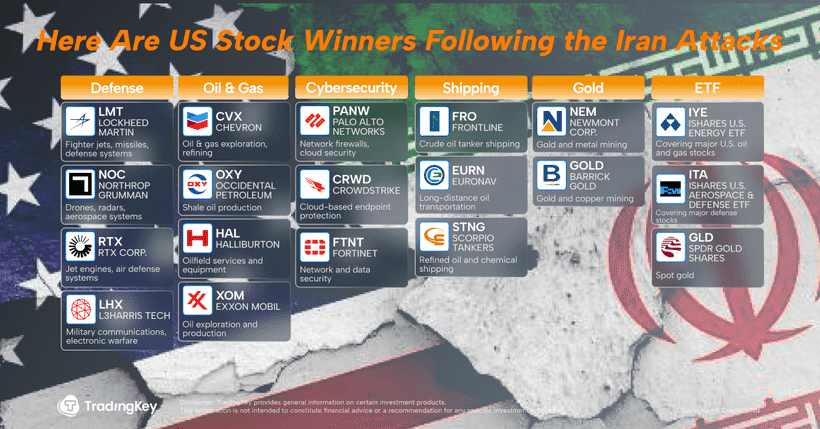
Middle East Conflict Escalates, Global Stocks and Bonds Fall, Was It Really Caused by One Sentence From Trump?
TradingKey - On Tuesday local time, the escalation of conflict in the Middle East triggered intense global market volatility. Gold (XAUUSD), bonds, and stocks fell in tandem, an unconventional movement that shattered the conventional logic of "buying safe havens during turmoil and trading stocks during stability."
Gold’s $5,000 Breaking Point: Why the Middle East Crisis Isn't Saving the Bulls
As US-Iran tensions continue to escalate, gold prices saw a sudden plunge. Has the metal already peaked?
AGI Approaches: 2026 May Be Artificial Intelligence Turning Point, Musk Warns White-Collar Class Will Bear the Brunt
TradingKey — Have you noticed that the pace of artificial intelligence evolution is exceeding the limits of human intuitive perception? From the debut of ChatGPT to the rapid rise of multimodal AI systems, the development of AI technology has demonstrated a non-linear, exponential acceleration in ju