Americas heavy crude prices hit multi-year highs as Iran conflict disrupts oil markets

By Arathy Somasekhar, Georgina McCartney and Amanda Stephenson
HOUSTON, March 4 (Reuters) - Prices for heavy crude produced in the Americas surged to multi-year highs on Wednesday, as the U.S.-Israeli attacks on Iran stymied exports of similar oil produced in the Middle East.
Benchmark crude oil prices have surged since the initial attacks last week, with Brent crude at its highest levels since January 2025.
Iran has threatened to fire on any vessel sailing through the shipping lanes of the Strait of Hormuz off its southern coast in retaliation for the U.S.-Israeli attacks. That has effectively closed the strait, cutting off around a fifth of global oil supplies and leaving hundreds of vessels anchored outside the strait.
Refiners are scrambling to deal with higher costs that could translate to higher consumer prices for gasoline and diesel fuel, and with Middle Eastern supply curtailed, the price of heavy oil produced in the United States, Canada and Venezuela has risen.
Prices of Mars sour crude, the flagship crude produced in the U.S. Gulf of Mexico and favored by refiners globally, traded at a $5.50 premium to U.S. benchmark West Texas Intermediate (WTI) crude on Wednesday, brokers said. That was the highest since April 2020, and marks a $1.75 jump from Tuesday.
"Buyers seem to be rushing to buy up these barrels as they expect the Middle East conflict to drag on longer," said Rohit Rathod, a senior analyst with ship tracking firm Vortexa.
That will eat into refinery margins, even for plants not directly affected by the disruption. Many U.S. refineries are configured to run heavier crude, and would use it as they boost diesel production in response to rising prices for the fuel.
OIL SUPPLY SQUEEZE
Iraq, OPEC's second-largest producer, on Tuesday said it may be forced to cut production by more than three million barrels per day in a few days if oil tankers cannot move freely to loading points in the Gulf, according to two Iraqi oil officials. Refiners in India, South Korea and the United States buy Iraq's Basrah oil and would have to replace that oil with similar quality crude from other regions.
Heavy Louisiana Sweet, another crude produced off the U.S. coast, closed at a premium of $5.25 on Tuesday, highest since 2020, and $1 higher than Light Louisiana Sweet. That signals higher demand for heavier grades, which typically trade at a discount to lighter grades.
The discount on heavy Canadian oil to WTI has tightened by $1.25 a barrel since last Friday, as buyers in India and China squeezed by the Middle East supply shortage are likely to turn in part to Canada, one of the world's largest producers of heavy crude, analysts said. The Trans Mountain pipeline, which ships heavy crude from Alberta's oil sands to the British Columbia coast for export overseas, is currently not full.
"We could see significant uptake of the remaining spot capacity on the Trans Mountain pipeline within weeks to a month if the Iran situation continues," said Patrick O'Rourke of ATB Cormark Capital Markets.
Venezuelan heavy crude was also being offered at higher prices, a source said.
FUEL PRICES RISE
In the U.S., where gasoline prices are a key political pressure point, the cost of the motor fuel jumped above $3 per gallon for the first time since November, a major risk for Trump and his fellow Republicans as they head into midterm elections in November.
Diesel prices < HOc1> closed at $3.19 a gallon on Tuesday, highest since October 2023, and touched a high of $3.45 a gallon during Wednesday's session. Diesel is sensitive to the worsening conflict in the Middle East because the region is a major supplier of the fuel.
Those inventories have dropped sharply after a period of high demand stemming from the harsh U.S. winter, analysts and traders said.
Prices for light sweet barrels should start to rise soon due to the shortfall, said Neil Crosby, Sparta Commodities analyst. Already, key grades were seeing premiums rise, such as Brazilian light crude to China, where offers were scarce and the premium above ICE Brent surged to $13 to $14 per barrel, compared to a premium of $2 to $3 before the conflict, two traders said.
U.S. WTI was trading at a discount of as much as $8.75 a barrel on Wednesday to globally-traded Brent, the most in more than three years, in the expectation that U.S. supply is less likely to be affected by global developments. Japan's second-largest refiner Idemitsu Kosan <5019.T> on Monday bought two million barrels of West Texas Intermediate crude from SK Energy for June arrival, traders said.
Iran conflict embeddable graphics: Iran's drone threat in the Gulf 
Related Articles
Is GE Vernova an Energy Stock You Should Buy in 2026?
TradingKey - GE Vernova (GEV), the global energy infrastructure company, was spun off from General Electric (GE) in 2024. It develops, produces, and services equipment for the generation and transmission of electricity, including gas and steam turbines, wind turbines, as well as grid infrastructure
Here Are US Stock Winners Following the Iran Attacks
Tradingkey - On Tuesday, U.S. equities extended their slide as rising oil prices and the specter of war in Iran rippled through global markets. The Dow Jones Industrial Average at one point plunged more than 1,000 points.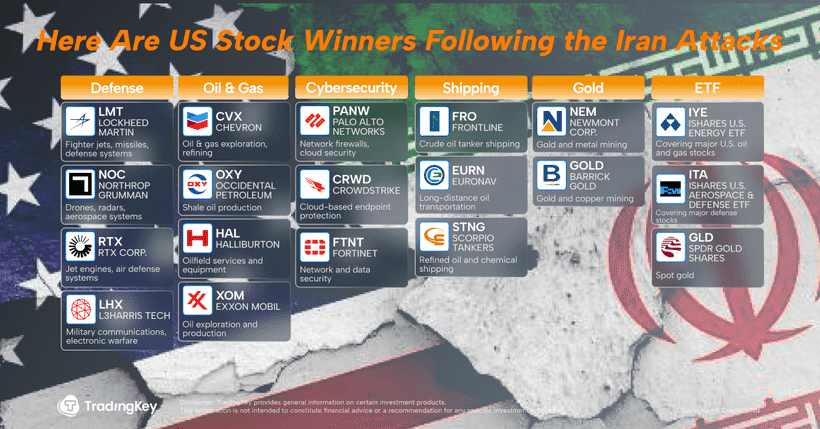
Middle East Conflict Escalates, Global Stocks and Bonds Fall, Was It Really Caused by One Sentence From Trump?
TradingKey - On Tuesday local time, the escalation of conflict in the Middle East triggered intense global market volatility. Gold (XAUUSD), bonds, and stocks fell in tandem, an unconventional movement that shattered the conventional logic of "buying safe havens during turmoil and trading stocks during stability."
Gold’s $5,000 Breaking Point: Why the Middle East Crisis Isn't Saving the Bulls
As US-Iran tensions continue to escalate, gold prices saw a sudden plunge. Has the metal already peaked?
AGI Approaches: 2026 May Be Artificial Intelligence Turning Point, Musk Warns White-Collar Class Will Bear the Brunt
TradingKey — Have you noticed that the pace of artificial intelligence evolution is exceeding the limits of human intuitive perception? From the debut of ChatGPT to the rapid rise of multimodal AI systems, the development of AI technology has demonstrated a non-linear, exponential acceleration in ju