


Gold stabilises after sharp correction as dip buying emerges



- Gold stabilises after brutal correction from record highs.
- Geopolitical tensions and institutional demand continue to underpin the broader uptrend.
- XAU/USD remains technically weak on the 4-hour chart, with price holding below both the 50- and 100-period SMAs.
Gold (XAU/USD) stabilises on Monday with dip-buying interest emerging after a sharp correction from last week’s surge to fresh all-time highs near $5,600. At the time of writing, XAU/USD trades around $4,770, recovering after an intraday slide of nearly 10% to over three-week lows near $4,402.
The precious metal suffered its largest intraday decline in decades on Friday, ending the day down 10.7%, as elevated volatility and thin liquidity triggered forced liquidations and heavy profit-taking at record levels.
Selling pressure intensified further as markets tilted toward a more hawkish monetary policy outlook after US President Donald Trump nominated former Federal Reserve (Fed) Governor Kevin Warsh as the next Fed Chair.
Despite the sharp correction, the broader uptrend in Gold remains intact. The macro backdrop stays supportive, with persistent geopolitical risks and economic uncertainties continuing to underpin demand. At the same time, robust institutional and investment flows remain a key source of support.
Looking ahead this week, a heavy slate of US labour market data is set to steer near-term price action, with the spotlight firmly on Friday’s Nonfarm Payrolls (NFP) report. The ISM Manufacturing Purchasing Managers Index (PMI) is also due later on Monday.
Market movers: Geopolitics, margin hikes and Fed signals in focus
- The United States (US) government entered a partial shutdown on Saturday after a midnight funding deadline passed without approval from the US Congress for the 2026 budget. Disruptions are expected to be limited, as the House of Representatives is set to vote early next week on a deal backed by the US Senate.
- US-Iran tensions keep geopolitical risks in play, with Iran’s Supreme Leader Ayatollah Khamenei warning that any US attack would trigger a ‘regional war’ after US President Donald Trump issued fresh warnings of potential military action over Iran’s nuclear programme.
- The CME Group is raising margin requirements on COMEX Gold and Silver futures due to heightened market volatility, with Gold margins set to rise to 8% from 6% and Silver margins to 15% from 11%. The changes take effect after the market closes on Monday. Higher margins mean traders must put up more capital to hold positions, which can dampen speculative activity in precious metals.
- The nomination of former Fed Governor Kevin Warsh as the next Fed Chair has also helped ease some concerns surrounding the ongoing debate over the Fed's independence. Investors broadly view Warsh as a more institutional, policy-insider candidate compared with other potential contenders.
- The Fed kept its benchmark interest rate unchanged at 3.50%-3.75% last week. Fed Governor Christopher Waller said he dissented in favour of a 25-basis-point rate cut, arguing that policy remains too restrictive and should move closer to a neutral level near 3%. In contrast, Atlanta Fed President Raphael Bostic said the central bank should remain patient and needs clearer evidence that inflation is returning to its 2% target.
Technical analysis: XAU/USD remains bearish below moving averages
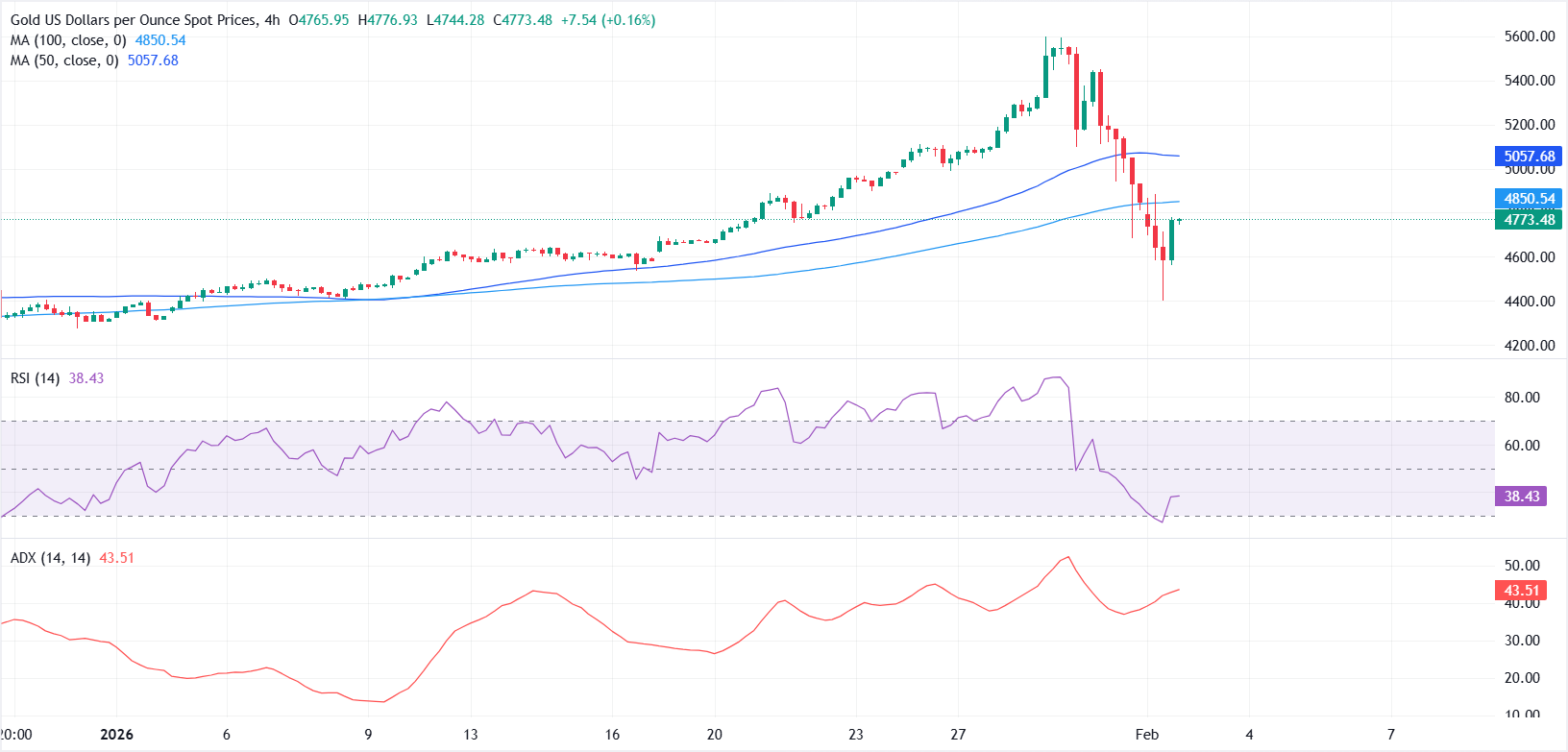
On the 4-hour chart, the near-term technical outlook for XAU/USD remains bearish. The 50-period Simple Moving Average (SMA) has turned lower and, while it still sits above the 100-period SMA, price action remains below both moving averages, keeping sellers firmly in control.
The Relative Strength Index (RSI) stands near 38, well below the 50 midline, confirming persistent bearish momentum. The 100-period SMA at $4,850.34 acts as nearby dynamic resistance.
Trend strength builds as the Average Directional Index (ADX) rises to 43.51, reinforcing a sustained downside phase. A sustained 4-hour close above the 100-period SMA would help ease immediate downside pressure and could open the door for a corrective rebound toward the 50-period SMA at $5,057.28.
As long as price fails to reclaim these moving averages, the path of least resistance remains to the downside, with momentum still tilted in favour of sellers.
(The technical analysis of this story was written with the help of an AI tool.)
Gold FAQs
Gold has played a key role in human’s history as it has been widely used as a store of value and medium of exchange. Currently, apart from its shine and usage for jewelry, the precious metal is widely seen as a safe-haven asset, meaning that it is considered a good investment during turbulent times. Gold is also widely seen as a hedge against inflation and against depreciating currencies as it doesn’t rely on any specific issuer or government.
Central banks are the biggest Gold holders. In their aim to support their currencies in turbulent times, central banks tend to diversify their reserves and buy Gold to improve the perceived strength of the economy and the currency. High Gold reserves can be a source of trust for a country’s solvency. Central banks added 1,136 tonnes of Gold worth around $70 billion to their reserves in 2022, according to data from the World Gold Council. This is the highest yearly purchase since records began. Central banks from emerging economies such as China, India and Turkey are quickly increasing their Gold reserves.
Gold has an inverse correlation with the US Dollar and US Treasuries, which are both major reserve and safe-haven assets. When the Dollar depreciates, Gold tends to rise, enabling investors and central banks to diversify their assets in turbulent times. Gold is also inversely correlated with risk assets. A rally in the stock market tends to weaken Gold price, while sell-offs in riskier markets tend to favor the precious metal.
The price can move due to a wide range of factors. Geopolitical instability or fears of a deep recession can quickly make Gold price escalate due to its safe-haven status. As a yield-less asset, Gold tends to rise with lower interest rates, while higher cost of money usually weighs down on the yellow metal. Still, most moves depend on how the US Dollar (USD) behaves as the asset is priced in dollars (XAU/USD). A strong Dollar tends to keep the price of Gold controlled, whereas a weaker Dollar is likely to push Gold prices up.
Recommended Articles







Comments (0)
Click the $ button, enter the symbol, and select to link a stock, ETF, or other ticker.