


Should You Buy Upcoming SpaceX Now or Tesla After a 20% Pullback?



SpaceX plans to submit its IPO prospectus soon, potentially raising over $75 billion and aiming for a June listing. While a high-profile event, its valuation faces scrutiny. Retail investors can gain indirect exposure through ETFs like Baron First Principles ETF (RONB) or Scottish Mortgage Investment Trust (SMT), or by investing in suppliers. Tesla, facing sales headwinds and AI anxiety, has seen its stock decline over 20%. Its high P/E ratio is supported by future ventures like FSD and robotics, though significant uncertainties remain. SpaceX's investment logic is characterized by long-term expectations and high capital expenditure, suggesting potential valuation bubbles at IPO.
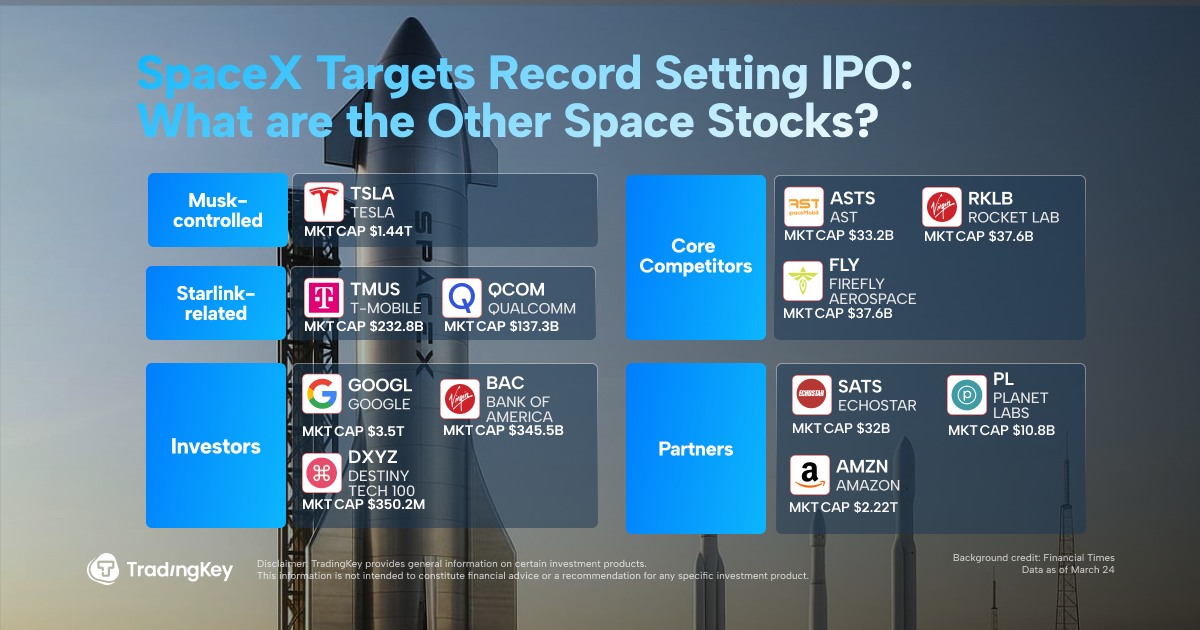
TradingKey - According to media reports, Tesla (TSLA.US) SpaceX, founded by Elon Musk, plans to file its IPO prospectus with regulators later this week or next week, potentially raising over $75 billion—surpassing the previously reported $50 billion. The company's latest valuation is $1.25 trillion, lower than the previously reported $1.75 trillion, and it aims to go public in June.
Market observers interpret the timing as a symbolic gift for Musk, whose birthday falls in June.
As the most high-profile IPO in the global market for 2026, SpaceX's fundraising scale is set to break the record of $29.4 billion set by Saudi Aramco in 2019, becoming the largest IPO in history.
Notably, both SpaceX and Tesla are companies under Musk. The market is weighing whether the SpaceX IPO will erode Tesla's 'protagonist premium,' leading to a share price decline, or if it will benefit from synergistic capital influence and rise in tandem with SpaceX stock.
Meanwhile, should investors buy the upcoming SpaceX IPO or the currently declining Tesla?
How can retail investors buy SpaceX stock?
As SpaceX has not yet gone public, making it difficult for retail investors to access investment opportunities, they can still participate in SpaceX through ETF allocations and indirect investments. TradingKey CEO Yeap Ming Feng, in "How to Invest in SpaceX IPO Before It Launches," detailed how retail investors should position themselves before the SpaceX IPO.
First, retail investors can indirectly participate in SpaceX's potential IPO through the Baron First Principles ETF (RONB), which holds a staggering 14.9% stake in SpaceX, and the Scottish Mortgage Investment Trust (SMT), which has a 15.1% holding. These funds provide diversified exposure to both private and public companies.
Furthermore, investing in companies that directly or indirectly hold shares in SpaceX, or in SpaceX's suppliers—such as Alphabet, EchoStar, STMicroelectronics, Garmin, Iridium Communications, or Rocket Lab—represents another investment route.
Should investors buy Tesla immediately?
Tesla continues to be hit by a triple whammy of AI anxiety, weakening sales in its core electric vehicle business, and the fading halo of its 'future dreams.' The stock price has fallen from a high of nearly $500 to $383 (as of the close on March 24, ET), representing a drop of more than 20% from its peak.
For now, Tesla's 'future narrative' premium still exists. Its P/E ratio of 354x is far higher than those of traditional automakers and most growth-oriented tech stocks. The core logic supporting this premium lies not in current profitability, but in the pricing of its future business, including potential growth curves like Full Self-Driving (FSD), humanoid robots, and energy operations.
Regarding FSD, while Elon Musk has repeatedly stressed that commercialization is nearing, large-scale implementation still faces high uncertainty from the standpoint of the regulatory environment and technical maturity. Autonomous driving is not just a technical issue but also involves legal liability, data security, and regulatory approval, meaning its realization cycle could be much longer than market expectations.
Secondly, the humanoid robot business is still in a 'narrative-driven' phase. Although Tesla has introduced the Optimus prototype, there is a long road ahead—from engineering capabilities and cost control to practical application scenarios—before a scalable business model can be formed. In the absence of a clear revenue contribution, this business is more akin to a long-term option.
Over the long term, Tesla's future is full of visionary potential, but investors must assess whether they can withstand short-term price volatility before buying. Historical trends show that Tesla's stock is highly volatile, even with the current 20% retracement from its peak.
Should Investors Buy SpaceX?
From a business structure perspective, although Starlink has achieved a degree of scaled revenue, its capital expenditures remain extremely high. Coupled with long cycles for satellite launches, maintenance, and updates, it is difficult to generate stable free cash flow in the short term. Meanwhile, although the rocket launch business possesses high technological barriers, its overall market size is limited, making it difficult to support an exceptionally high valuation on its own.
Secondly, from a time horizon perspective, the commercial aerospace logic represented by SpaceX is essentially a 'long-cycle, capital-intensive' play. Whether it is the completion of a global satellite internet network or the commercialization of deep space exploration, these milestones require a long time to materialize. This implies that its valuation reflects 'forward-looking expectations' rather than verifiable short-term performance.
Against this backdrop, should SpaceX move forward with an IPO, its first-day trading would likely suffer from an 'excessive sentiment premium.' Intense pursuit by market capital could create a significant valuation bubble during the initial listing phase, leading to a risk-reward asymmetry where upside is limited while correction risks are significantly magnified.
Consequently, from a strategic standpoint, the more rational path today is not to 'bet directly on SpaceX' but to allocate via the supply chain and companies with indirect holdings. This approach captures the beta returns of the commercial aerospace sector while mitigating the valuation volatility risks associated with a single ticker.
Investing in SpaceX-related assets and ETFs—such as companies with direct or indirect stakes in SpaceX, or suppliers like Alphabet, EchoStar, STMicroelectronics, Garmin, and Iridium Communications—carries significantly lower risk than a direct bet on SpaceX itself.
Ultimately, the future depicted by SpaceX is undoubtedly compelling, but its investment logic more closely resembles a 'long-dated option' rather than a growth asset capable of short-term realization.
Recommended Articles





Comments (0)
Click the $ button, enter the symbol, and select to link a stock, ETF, or other ticker.