


Gold extends record-setting rally amid flight to safety, Fed rate cut bets, weaker USD



- Gold attracts buyers for the fourth straight day and remains supported by a combination of factors.
- Geopolitical risks, fresh trade tensions, and the US government shutdown underpin the commodity.
- Dovish Fed expectations exert pressure on the USD and also benefit the non-yielding yellow metal.
Gold (XAU/USD) touches a fresh all-time peak during the Asian session on Wednesday, with bulls now eyeing a move towards conquering the $4,200 round figure amid the global anxiety. Investors now seem worried about economic risks stemming from the protracted Russia-Ukraine war, fresh US-China trade tensions, and a prolonged US government shutdown. This has been a key factor driving safe-haven flows towards the bullion amid dovish Federal Reserve (Fed) expectations.
In fact, traders have been pricing in a greater chance that the US central bank will lower borrowing costs two more times by the end of this year. The outlook drags the US Dollar (USD) away from its highest level since early August, touched last week, and turns out to be another factor underpinning the non-yielding Gold. The XAU/USD bulls, meanwhile, seem rather unaffected by extremely overbought conditions on short-term charts and look to build on the recent well-established uptrend.
Daily Digest Market Movers: Gold is underpinned by sustained safe-haven buying and Fed rate cut bets
- US President Donald Trump threatened on Tuesday to terminate trade with China in cooking oil and other products in response to the latter's decision not to purchase US soybeans. China also announced new special port fees for US ships arriving in Chinese ports and enhanced restrictions on the export of rare earths.
- This marks a significant escalation of the trade war between the world's two largest economies. Adding to this, geopolitical risks and concerns that the US government could affect the economic performance drive safe-haven flows towards the Gold, pushing it to a fresh record high during the Asian session on Wednesday.
- The International Monetary Fund edged up its 2025 global growth forecast for the second time since April, to 3.2% from 3.0% in July, but warned that a renewed US-China trade war could slow output significantly. The IMF further added that the Trump administration’s tariffs have so far proved less disruptive than expected.
- Media reports suggest that Trump was considering sending the US-made Tomahawk long-range cruise missiles to Ukraine to pressure Russian President Vladimir Putin into negotiations. This keeps geopolitical risks in play and turns out to be another factor that contributes to the precious metal's strong move up.
- Meanwhile, the latest vote on the Republican-backed stopgap funding bill to end the partial federal government shutdown fell short of the votes needed for passage in the Senate on Tuesday. This means that the US shutdown, which started on October 1, will extend into a third week, with no resolution in sight.
- US Federal Reserve Chair Jerome Powell did not provide specific guidance on interest rates on Tuesday, though comments about weakness in the labor market suggested that further easing is firmly on the table. Moreover, other Fed officials have pointed to the likelihood of additional rate cuts moving ahead.
- According to the CME Group's FedWatch Tool, traders have fully priced in a 25-basis-point rate cut in October and see a 90% chance that the US central bank will lower borrowing costs again in December. This exerts pressure on the US Dollar for the second straight day and benefits the non-yielding yellow metal.
- Given that important US macro releases have been delayed due to the government closure, the market focus will remain glued to speeches from influential FOMC members. This would play a key role in driving the USD demand, which, along with trade developments, should provide some impetus to the commodity.
Gold bulls retain control despite overbought daily RSI; corrective slides could be seen as buying opportunities
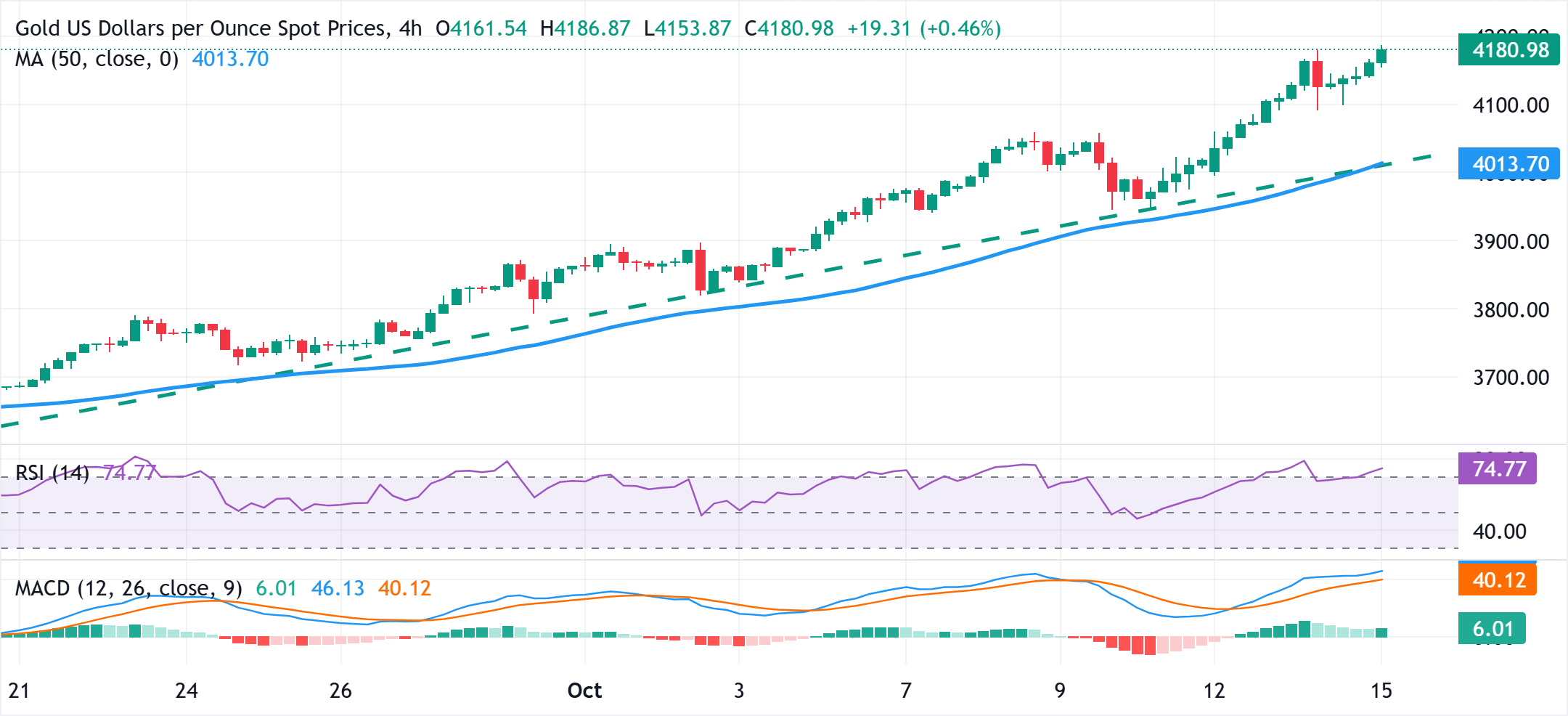
The XAU/USD pair showed some resilience below the $4,100 mark on Tuesday. Moreover, the recent move up witnessed over the past three weeks or so has been along an upward sloping trend-line support, suggesting that the path of least resistance for the Gold price remains to the upside. However, an extremely overbought daily Relative Strength Index (RSI) warrants caution before positioning for a further appreciating move.
Meanwhile, any corrective pullback towards the $4,100 mark might still be seen as a buying opportunity and is more likely to be cushioned near the $4,060-4,055 region. A convincing break below the latter, however, might prompt some technical selling and drag the Gold price to the $4,000 psychological mark. The latter represents a confluence – comprising the ascending trend-line support and the 50-period Simple Moving Average (SMA) on the 4-hour chart. Hence, a convincing break below could be seen as the first sign of a possible bullish exhaustion and pave the way for deeper losses.
Gold FAQs
Gold has played a key role in human’s history as it has been widely used as a store of value and medium of exchange. Currently, apart from its shine and usage for jewelry, the precious metal is widely seen as a safe-haven asset, meaning that it is considered a good investment during turbulent times. Gold is also widely seen as a hedge against inflation and against depreciating currencies as it doesn’t rely on any specific issuer or government.
Central banks are the biggest Gold holders. In their aim to support their currencies in turbulent times, central banks tend to diversify their reserves and buy Gold to improve the perceived strength of the economy and the currency. High Gold reserves can be a source of trust for a country’s solvency. Central banks added 1,136 tonnes of Gold worth around $70 billion to their reserves in 2022, according to data from the World Gold Council. This is the highest yearly purchase since records began. Central banks from emerging economies such as China, India and Turkey are quickly increasing their Gold reserves.
Gold has an inverse correlation with the US Dollar and US Treasuries, which are both major reserve and safe-haven assets. When the Dollar depreciates, Gold tends to rise, enabling investors and central banks to diversify their assets in turbulent times. Gold is also inversely correlated with risk assets. A rally in the stock market tends to weaken Gold price, while sell-offs in riskier markets tend to favor the precious metal.
The price can move due to a wide range of factors. Geopolitical instability or fears of a deep recession can quickly make Gold price escalate due to its safe-haven status. As a yield-less asset, Gold tends to rise with lower interest rates, while higher cost of money usually weighs down on the yellow metal. Still, most moves depend on how the US Dollar (USD) behaves as the asset is priced in dollars (XAU/USD). A strong Dollar tends to keep the price of Gold controlled, whereas a weaker Dollar is likely to push Gold prices up.
Recommended Articles








Comments (0)
Click the $ button, enter the symbol, and select to link a stock, ETF, or other ticker.