


Gold flat lines below $3,750 as traders await key US economic data, Fedspeak



- Gold oscillates in a narrow band during the Asian session on Thursday amid mixed cues.
- Powell's remarks raised questions about the Fed’s rate-cut path and underpinned the USD.
- Geopolitical risks act as a tailwind for the commodity ahead of important US macro data.
Gold (XAU/USD) lacks any firm intraday directional bias on Thursday and seesaws between tepid gains/minor losses below the $3,750 level during the Asian session. The growing acceptance that the US Federal Reserve (Fed) will cut interest rates twice by the end of this year keeps a lid on the overnight US Dollar (USD) rally to a two-week high and acts as a tailwind for the non-yielding yellow metal. Moreover, persistent geopolitical risks stemming from the intensifying Russia-Ukraine war and conflicts in the Middle East further offer some support to the safe-haven commodity.
Meanwhile, Fed Chair Jerome Powell's cautious remarks on potential interest rate cuts earlier this week helped limit deeper USD losses and cap the upside for the Gold price. Traders also seem reluctant and opt to wait for important US macro data before positioning for the next leg of a directional move. Thursday's US economic docket features the release of the final Q2 GDP print, the usual Weekly Initial Jobless Claims, and Durable Goods Orders. The focus, however, will remain glued to the US Personal Consumption Expenditure (PCE) Price Index, or the Fed's preferred inflation gauge, on Friday.
Daily Digest Market Movers: Gold bulls seem reluctant and opt to wait for more Fed rate-cut cues
- Federal Reserve (Fed) Chair Jerome Powell's comments earlier this week pushed the US Dollar to a two-week top and weighed heavily on the non-yielding Gold price on Wednesday. Powell tried to push back against expectations of more interest rate cuts and said that easing too aggressively could leave the inflation job unfinished and necessitate a reversal of course.
- Traders, however, still expect the US central bank to lower borrowing costs again in October and December, following a 25-basis-point rate cut earlier this month. This was the first rate cut since December amid concerns about a softening US labor market. Moreover, the dovish outlook caps any further USD gains and offers some support to the commodity.
- US President Donald Trump escalated his rhetoric against Russia and said on Tuesday that he believes NATO member countries should shoot down Russian aircraft if they enter their airspace. Trump added further that Ukraine, with the support of the European Union and NATO, could win back all of the territory Russia has captured since its invasion.
- This marked a significant shift in Trump's attitude toward Russia. In response, Kremlin spokesperson Dmitry Peskov declared on Wednesday that Russia would continue its offensive on Ukraine to ensure its interests and achieve its goals. Adding to this, Peskov hit back at Trump’s claim and said that the idea that Ukraine can recapture something is mistaken.
- Trump reportedly promised Arab and Muslim leaders that he would not allow Israeli Prime Minister Benjamin Netanyahu to annex the West Bank. Meanwhile, Iran-backed Houthis forces in Yemen claim responsibility for a drone strike, which hit the Israeli city of Eilat on Wednesday. This keeps geopolitical risks in play and underpins the safe-haven commodity.
- Traders now look forward to important US macro releases and speeches from influential FOMC members for some meaningful impetus. The key focus, meanwhile, will be on the US Personal Consumption Expenditure (PCE) Price Index on Friday, which will play a key role in driving the USD demand and determining the near-term trajectory for the XAU/USD pair.
Gold could accelerate the corrective decline below $3,700
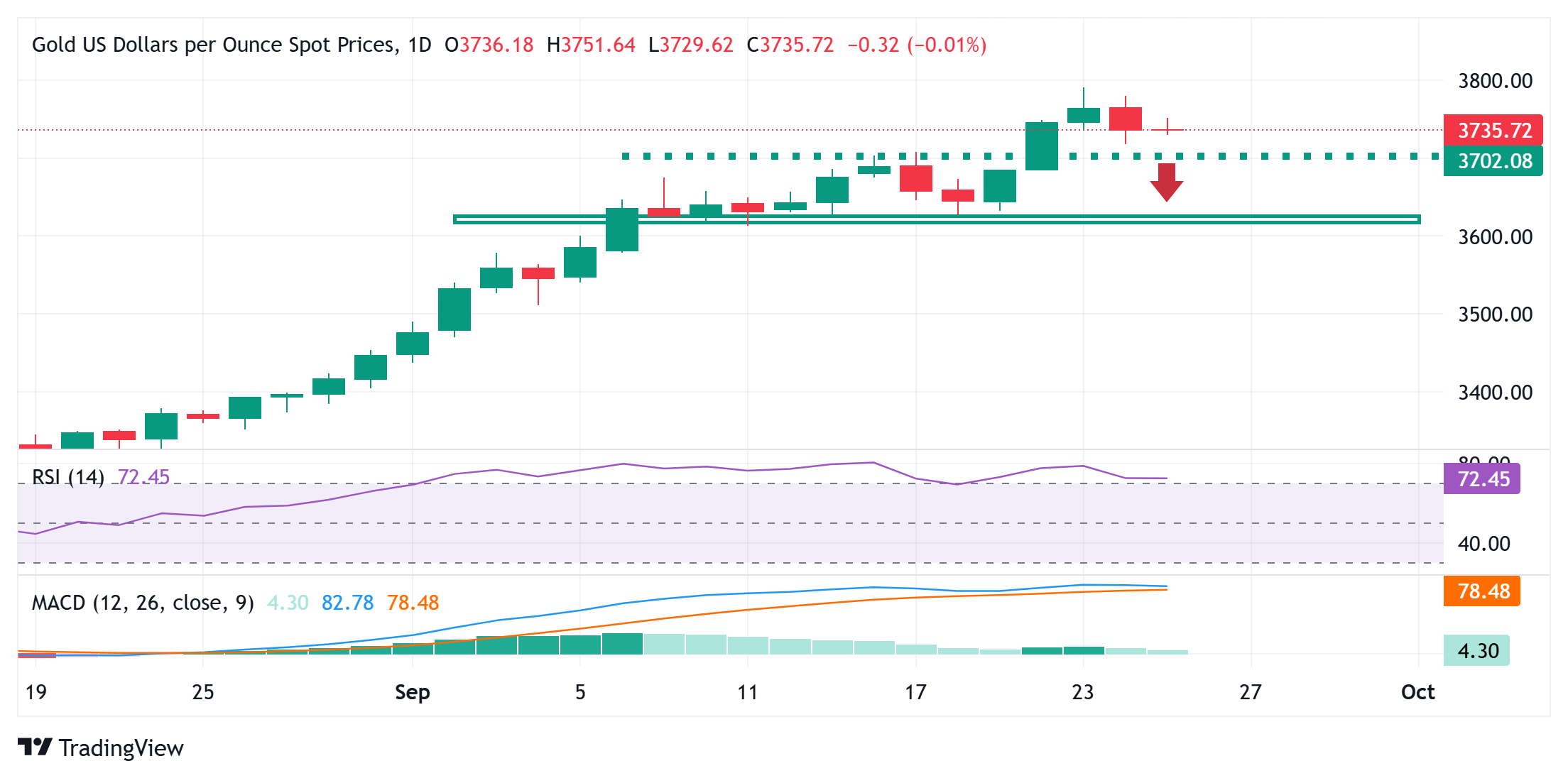
From a technical perspective, this week's failure ahead of the $3,800 mark could be seen as the first sign of a possible bullish exhaustion amid still overbought Relative Strength Index (RSI) on the daily chart. That said, last week's breakout through the $3,700 mark was seen as a key trigger for the XAU/USD bulls and backs the case for the emergence of some dip-buying near the said handle. A convincing break below the latter, however, might prompt some technical selling and drag the Gold price to the $3,650 intermediate support en route to the $3,610-$3,600 region.
On the flip side, momentum beyond the Asian session high, around the $3,752 area, might confront some resistance near the $3,765-3,766 region. The subsequent move up would set the stage for a move towards retesting the all-time peak, around the $3,790 area. Some follow-through buying and acceptance above the $3,800 mark would set the stage for an extension of the recent well-established uptrend witnessed over the past month or so.
Gold FAQs
Gold has played a key role in human’s history as it has been widely used as a store of value and medium of exchange. Currently, apart from its shine and usage for jewelry, the precious metal is widely seen as a safe-haven asset, meaning that it is considered a good investment during turbulent times. Gold is also widely seen as a hedge against inflation and against depreciating currencies as it doesn’t rely on any specific issuer or government.
Central banks are the biggest Gold holders. In their aim to support their currencies in turbulent times, central banks tend to diversify their reserves and buy Gold to improve the perceived strength of the economy and the currency. High Gold reserves can be a source of trust for a country’s solvency. Central banks added 1,136 tonnes of Gold worth around $70 billion to their reserves in 2022, according to data from the World Gold Council. This is the highest yearly purchase since records began. Central banks from emerging economies such as China, India and Turkey are quickly increasing their Gold reserves.
Gold has an inverse correlation with the US Dollar and US Treasuries, which are both major reserve and safe-haven assets. When the Dollar depreciates, Gold tends to rise, enabling investors and central banks to diversify their assets in turbulent times. Gold is also inversely correlated with risk assets. A rally in the stock market tends to weaken Gold price, while sell-offs in riskier markets tend to favor the precious metal.
The price can move due to a wide range of factors. Geopolitical instability or fears of a deep recession can quickly make Gold price escalate due to its safe-haven status. As a yield-less asset, Gold tends to rise with lower interest rates, while higher cost of money usually weighs down on the yellow metal. Still, most moves depend on how the US Dollar (USD) behaves as the asset is priced in dollars (XAU/USD). A strong Dollar tends to keep the price of Gold controlled, whereas a weaker Dollar is likely to push Gold prices up.
Recommended Articles








Comments (0)
Click the $ button, enter the symbol, and select to link a stock, ETF, or other ticker.