


Stablecoin Market Shakes Up. Wall Street Launches New Stablecoin OUSD as Circle Shares Plunge Over 17% After Hours.



AI Podcast


On June 30, Eastern Time, an alliance of over 140 financial and crypto firms launched Open USD (OUSD), a stablecoin featuring zero fees and profit-sharing for partners. This move directly challenges Circle’s profit-monopoly model, causing its stock (CRCL) to plunge 17.55% to near $62. The participation of Circle’s core partners, including BlackRock and Coinbase, threatens its ecosystem dominance. While William Blair maintains an Outperform rating citing Circle’s first-mover advantage, market sentiment remains bearish. Analysts anticipate potential short-term volatility, with the stock price potentially testing the $50 support level amid intensifying competition.

TradingKey - More than 140 financial institutions jointly launch OUSD, breaking Circle's profit-monopoly model and sending its stock price plunging to near $60.
On June 30, Eastern Time, Wall Street launched a brand-new stablecoin, Open USD (OUSD). The news triggered a 17.55% post-market plunge in Circle ( CRCL ), the first public stablecoin stock, with the price dropping to a low of near $62, marking its worst single-day performance since its listing.
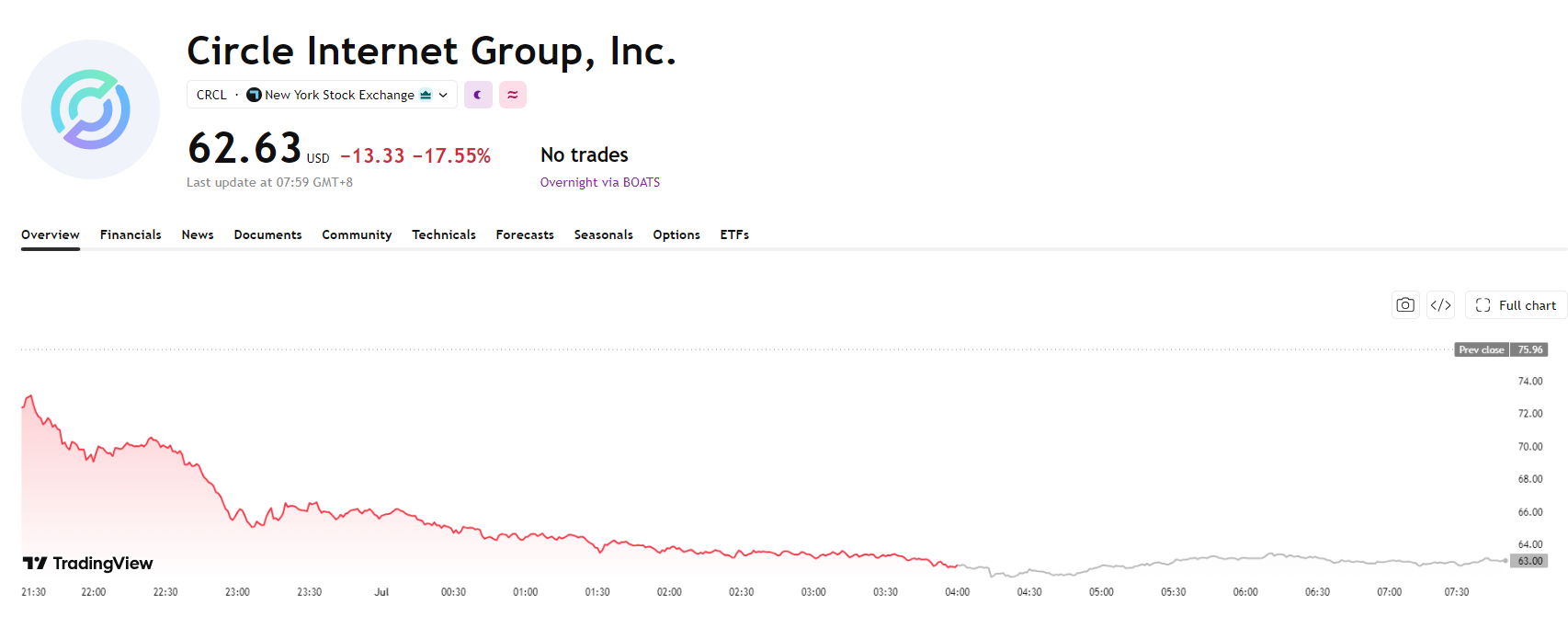 Circle stock price chart, Source: TradingView
An epic alliance called the Open Standard—composed of over 140 traditional finance, payment giants, and crypto majors including Stripe, Visa ( V ), Mastercard ( MA ), BlackRock ( BLK ), and Coinbase ( COIN )—has rolled out the stablecoin OUSD. It announced zero minting and redemption fees, no size limits, and that 100% of the Treasury interest profits generated by reserves will be distributed back to partners.
OUSD's disruptive approach directly challenges Circle's profit-monopoly model. Specifically, giants like Visa, Mastercard, and Stripe, which control the capillaries of global payments, will no longer be working for Circle "for free" when helping promote stablecoins; instead, they will receive tangible USD profits. The network effect of this community of shared interests (alliance system) exerts an extremely formidable crowding-out effect on single issuers.
The biggest blow to Circle could be the collective defection of distributors choosing to align with their financial interests. Among the founding partners of OUSD are BlackRock, Coinbase, and BNY Mellon ( BNY ), which are Circle's core asset management and custody partners or its largest ecosystem supporters. Now, the fact that these three core allies have chosen to join the OUSD camp undoubtedly deals a heavy blow to Circle's institutional growth expectations.
As investors sold off Circle shares heavily, US investment bank William Blair deemed the market reaction excessive and reaffirmed its Outperform rating on Circle. Analysts Andrew Jeffrey and Adib Choudhury noted, "Circle is well-positioned given its first-mover advantage, deep liquidity, and established payments infrastructure, even when facing high-profile competitors like OUSD."
The crypto market was already weak, and now with the arrival of aggressive competition from OUSD featuring zero costs and profit-sharing, it is pouring salt on Circle's wounds. In the short term, there is a strong probability of a continued pullback to test the bottom at $50, an all-time low set in February this year, representing about a 20% downside from the current price.
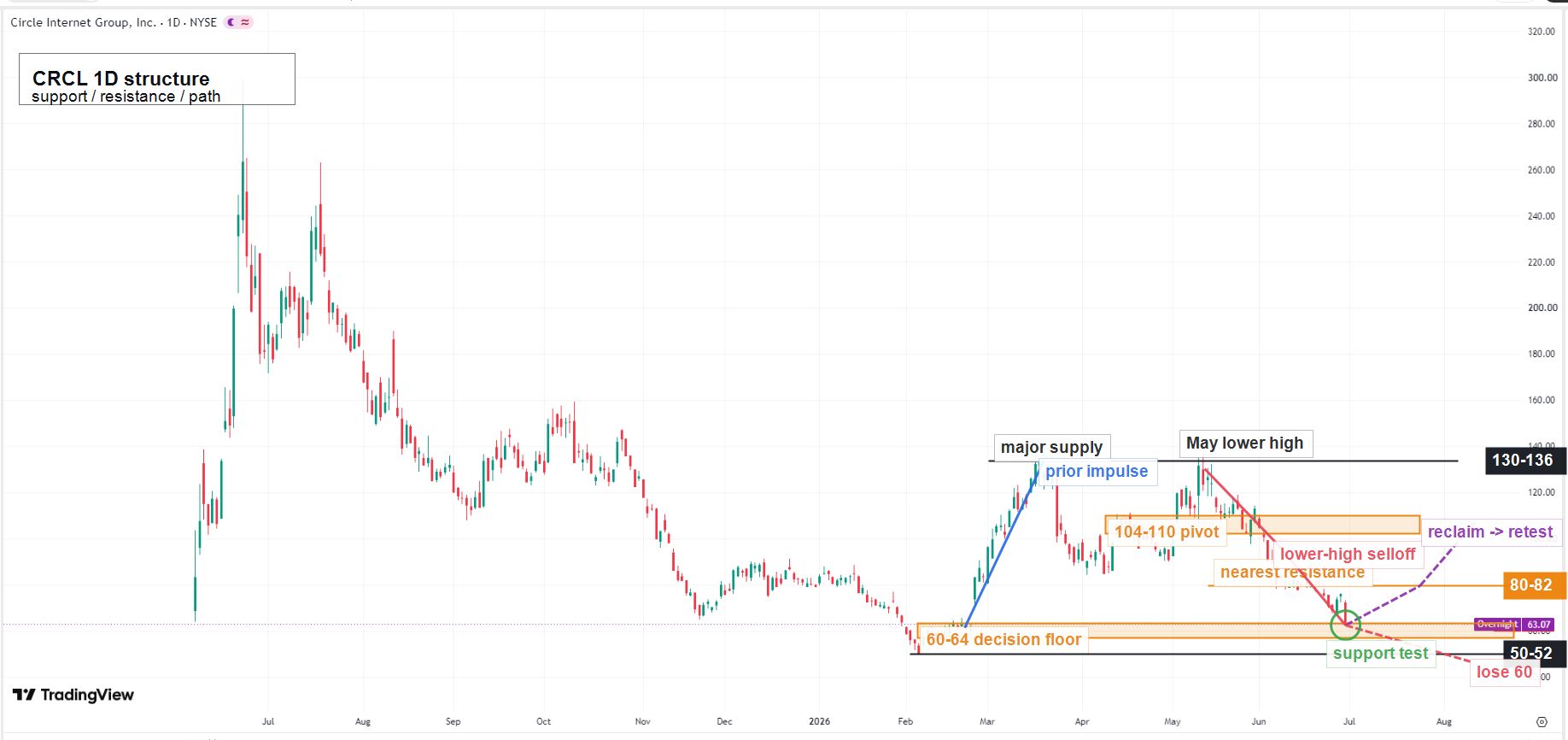 Circle stock price chart, Source: TradingView
This content was translated using AI and reviewed for clarity. It is for informational purposes only.
Recommended Articles








Comments (0)
Click the $ button, enter the symbol, and select to link a stock, ETF, or other ticker.