


Intel Stock Outlook: Can the Apple Foundry Deal Justify INTC’s 250% Rally?



AI Podcast


Intel (INTC) has surged over 250% in 2026, reaching $140.05 amid optimism regarding foundry partnerships, notably with Apple and Microsoft. While 18A-P technology has entered risk production, significant revenue impact remains 12–18 months away. Despite BofA’s upgrade to a $160 target, Intel’s Q1 2026 net loss reflects an ongoing investment phase. Technicals remain neutral-bullish, with an upside breakout possible above $150.40. Key risks include execution delays in 18A yields, which could defer margin targets to 2028. Investors should monitor July 23 earnings for formal contract disclosures and concrete foundry volume commitments.
TradingKey - Intel (NASDAQ: INTC) is sitting at $140.05, holding the line on an ascending trend in the 4H timeframe following a run-up that has carried the stock from $36.90 at the beginning of 2026 to its highest level in 25 years, a gain of over 250% over the past half-year. The catalyst stack here is, to be frank, atypical for a turnaround story: President Trump publicly confirmed the Apple foundry deal on June 18; 18A-P entered risk production at the VLSI Symposium two days prior, right on schedule; Bank of America upgraded Intel from Underperform to Buy and hiked its price target to $160; and President Trump has repeatedly touted a 10% U.S. government stake alongside Nvidia and “TerraFab” (Elon Musk’s new company) onshoring. RSI is sitting at 62.55, neutral-bullish, with some room to run on the way up and no sign of bearish divergence yet. The charts look good. But whether investors are paying for a 2027-and-beyond revenue stream in a stock that is already up 250% is up for each of them to decide.
The Apple Deal Is Real, But ‘Real’ Doesn’t Mean Shipping Chips Yet
The Apple deal is real but it doesn’t mean shipping product yet. Intel and Apple have been in talks with an established timeline going back months before President Trump confirmed the foundry deal on June 18: Bloomberg reported on May 5 that talks had begun, and shares rallied 14% that day; the Wall Street Journal reported on an initial agreement in early May, and shares hit their previous all-time high on May 11. President Trump’s June 18 social post, noting that Apple “has agreed to work with Intel to design and build chips” domestically, was, at the time, a restatement from the President of information the market had already partially absorbed, though it drove the stock higher 9% in pre-market trading.
Neither Intel nor Apple have released a formal joint communication with specific volumes, or value or time commitments, President Trump’s post on the social platform confirms a working relationship but is not itself a signed public contract.
But in substance the announcement did not come with no real substance either; Intel said at the June 16 VLSI symposium that 18A-P, delivering 9% higher speed or 18% less power than normal 18A and 20% higher heat tolerance with full design rule compatibility, is now in risk production, an early development phase. Chief Financial Officer David Zinsner told analysts yields are currently two quarters ahead of their forecast.
But as Counterpoint Research’s Neil Shah noted, the 90% yield rate in the first month is most likely to attract more foundry business customers. Yet in terms of timeline, given 18A-P is now in risk production in the middle of June, Intel probably won’t ship any significant amount of Apple chips in production until 2027, which means the recent 250% rally in Intel shares may be pricing in a material revenue impact a year to year-and-half away from financial statement inclusion.
The Trump Claims That Aren’t Yet Confirmed — And Why That Distinction Matters for Investors
Trump’s other claims aren’t confirmed, and this matters. President Trump’s comments weren’t limited to the Apple relationship. He has also claimed the U.S. has a 10% stake in Intel, and that Nvidia, Apple and Elon Musk’s new “TerraFab” have been brought together via onshoring brokerages now all in an Intel manufacturing family. The 10% government stake in Intel is a fact stemming from a transaction in August 2025 and easily verified; Nvidia’s $5 billion in Intel stock from the beginning of September 2025 is also a confirmed fact.
The bigger characterization, however, where President Trump has grouped Nvidia, Apple and TerraFab as part of an Intel-manufacturing onshoring effort has been called out by some traders as a bit more of a stretch, while the core relationships are there, the framing of a coordinated strategic push beyond the public statements from both companies has yet to be confirmed.
But there is a practical difference between what Intel and the others have said and what the President has said, and the price tag is an investor’s first priority. In Q1 2026, Intel posted revenue of around $13.6 billion, and a net loss of $3.7 billion, which suggests we are still in the earlier stage of the transformation. In its AI efforts, Reuters reported, revenue now accounts for around 60% of quarterly sales, compared to less than 25% a year ago, which is a pretty good change, especially if we factor in how standard hyperscaler server setups have shifted to include the new Xeon 6 CPUs and Nvidia graphics cards, and if we consider Microsoft’s multi-year agreement for 18A wafer supplies signed in February.
Gross margin hit a low of about 35% in Q4 2025; but it will likely rise to around 50% by the end of 2027, according to management, as long as the following occurs: 18A foundry capacity utilization rises above 70% by the end of the year, the revenue mix tilts more toward the higher average-selling-price (ASP) AI server chips, and operating expenses remain flat in dollar terms while revenue grows by double digits. Consensus calls for a gross margin of 48% by Q4 2027, which aligns with the official targets but leaves little room for errors in execution.
INTC Technical Setup — Trendline Defense at $140, RSI 62.55, Target $159.90
INTC is defending the multi-touch ascending black trendline (4H) on rejections from previous descending trendlines from the $169-plus highs and well above $106.07 EMA200 with higher lows. RSI (62.55) is neutral-bullish and can climb toward overbought levels; no bearish divergence, green candles indicate buyers absorbed selling pressure near trendline confluence. Resistance $150.43 to $159.97 above. A hold supports a $159.97 to $169.13 retracement, breakdown opens $126.24 to $117.07. Trendline bounce above $150.40 targets $159.90.
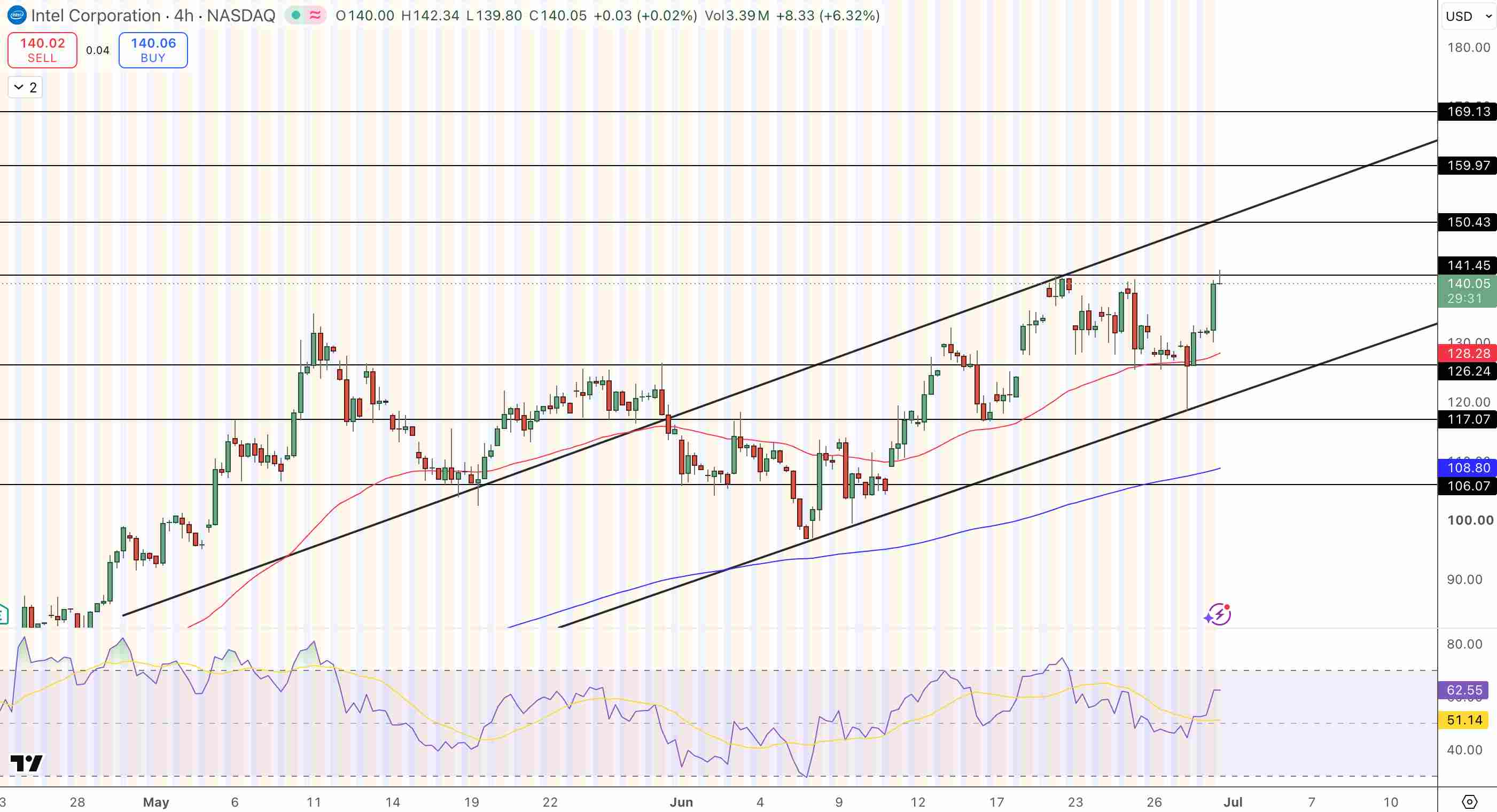
- Entry: Buy above $150.40 (trendline + resistance broken).
- Target: $159.90 (trendline bounce extension).
- Stop Loss: Close below $126.20 (ascending trendline broken).
- YTD Performance: +250%+ from $36.90 (January) to $140.05.
- BofA Target: $160 (raised from $135, June 25, a double upgrade from Underperform).
- Earnings Next: July 23, 2026, watch for formal foundry customer commitments.
Is the Apple-Intel Chip Deal Officially Confirmed?
Yes. Bloomberg reported talks May 5; WSJ said Intel and Apple are in agreement, early May; Trump said June 18 that Apple and Intel agreed to co-develop and build chip products in the U.S. But no formal joint statement between Apple and Intel has disclosed volume amounts or dollar amounts or a timeline or any contract. Intel’s 18A-P process, the most likely process for Apple chips, started risk production June 16, which is an early phase, so Apple chip volume is unlikely to exist before 2027.
How Much of Intel’s 250% Rally Is Already Priced for Future Apple Revenue?
A significant portion of the 250% rally to $140 came before the latest Trump announcement: a 14% price jump on May 5 with Bloomberg’s reporting, peak at previous ATH on May 11 after the WSJ reported a preliminary agreement. With 18A-P only at risk production mid-June, and Apple chip volume not likely to exist before 2027, the market is pricing a revenue stream a full 12 to 18 months out before it impacts financial results. The latest quarterly results, 1Q 26, were revenue $13.6B with net income -$3.7B, meaning the turnaround is still in the investment phase, not the monetization phase.
Is INTC a Buy at $140 After the 250% Rally?
The technicals support an upside breakout. RSI (62.55) is neutral-bullish and there is room higher, the trendline holds above $106.07 EMA200. Buy above $150.40 to target $159.90, stop below $126.20. There is actual traction for the Intel Foundry story: the 18A process with AI-related revenue at ~60% of the sales mix and an announced, multi-year Intel Foundry 18A wafer agreement with Microsoft. BofA’s double upgrade from Underperform to Buy, June 25, also shows Wall Street support ($160 target). The biggest risk is 18A-P yield improvement: a 6-month delay could push Intel margin break-even from 2027 into 2028 and could result in a 25 to 30% price drawdown in 2026, according to analyst commentary. Earnings July 23 will be a key checkpoint for formal foundry customer commitments.
Bottom Line
The 250%+ rally to $140.05 this year is supported by a still-unconfirmed Intel-Apple foundry partnership, 18A-P entering risk production, and the BofA double upgrade to Buy, June 25 ($160 target). We know Trump’s specific claims, the $2B government stake in Intel August 2025 and Intel investment in Nvidia September 2025. But we don’t have the full story about a coordinated onshore chip foundry push led by Nvidia, Intel and Apple.
Revenue from Intel 18A chips with an AI focus at roughly 60% of sales and the Intel/Microsoft deal signed and disclosed are the only hard evidence supporting the 250%+ rally. Intel Foundry Volume of chips for Apple is a full 12 to 18 months from now. Technicals: INTC ($140.05), RSI (62.55), neutral-bullish, trendline holds, trade above $150.40, target $159.90, stop $126.20. Check July 23 earnings to see if the story moves to formal, disclosed foundry customer contracts.
Recommended Articles








Comments (0)
Click the $ button, enter the symbol, and select to link a stock, ETF, or other ticker.